
 Buy Crypto
- Markets
 Futures
- Spot
- Copy Trade
- Earn
- More
The Largest Oil Reserve Release in History: Why Is the Oil Price Still Above 100?


400 Million Barrels. This is the largest-ever release of strategic petroleum reserves carried out at once by the 32 member countries of the International Energy Agency (IEA) in its 50-year history. When IEA announced this decision on March 11, Brent crude closed at $90.42 on that day. Today, 12 days later, the oil price is above $107.
Things started on February 28. After the U.S. and Israel launched a joint strike against Iran, Iran threatened to attack oil tankers passing through the Strait of Hormuz, the world's most critical oil shipping chokepoint, causing almost a standstill. According to IEA data, the current actual transit through the strait is less than 10% of pre-war levels. Brent crude has surged from around $65 pre-war, hitting $119.5 intraday on March 9, representing a nearly 80% increase in two weeks.
In this context, IEA deployed its most potent weapon. The question is, why didn't this weapon work?
The Mathematical Mirage of 400 Million Barrels
400 million barrels may sound like a massive number, but when placed in the context of the Strait of Hormuz's gap, the scale is entirely different.
IEA has utilized its strategic reserves five times in its 50-year history, with this being the sixth instance. The total release amounts from the previous four occasions sum up to about 352.7 million barrels (approximately 50 million barrels during the 1991 Gulf War, 60 million barrels for Hurricane Katrina in 2005, 60 million barrels during the 2011 Libyan Civil War, and 182.7 million barrels for the 2022 Russia-Ukraine War). This time, the 400 million barrels released surpass the total of the previous four instances.
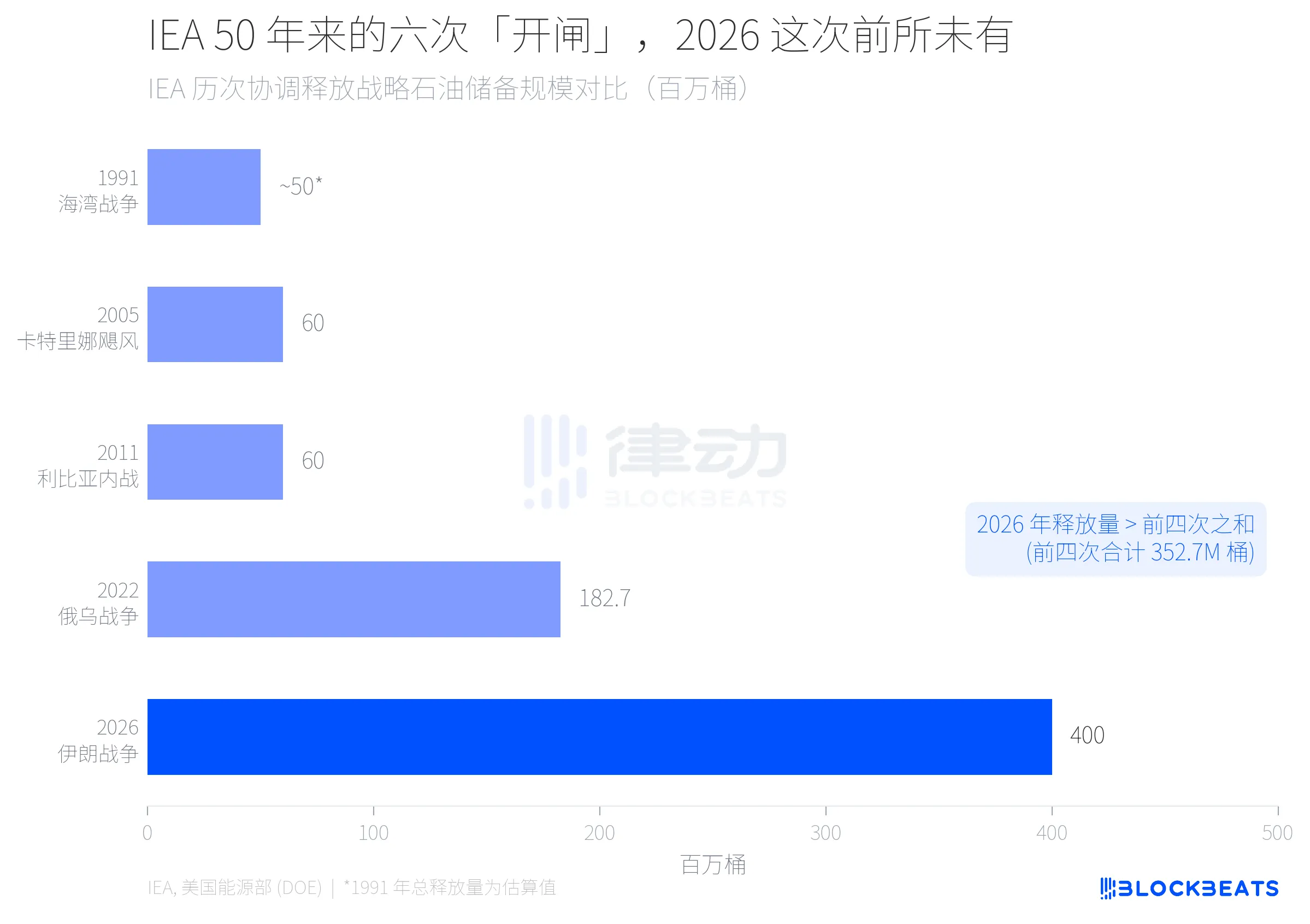
However, quantity does not equate to sufficiency.
Before the conflict, the daily average flow through the Strait of Hormuz was about 20 million barrels of crude and oil products, accounting for 25% of global seaborne oil trade. As per a U.S. Department of Energy announcement, the U.S.'s 172 million barrels will be released within 120 days. Calculated at this rate, the daily release of the entire 400 million barrels by IEA would be approximately 3.3 million barrels, covering only 17% of the gap. According to a JPMorgan estimate cited by Al Jazeera, the maximum production capacity of IEA member countries is only 1.2 million barrels per day, far from enough to bridge the deficit.
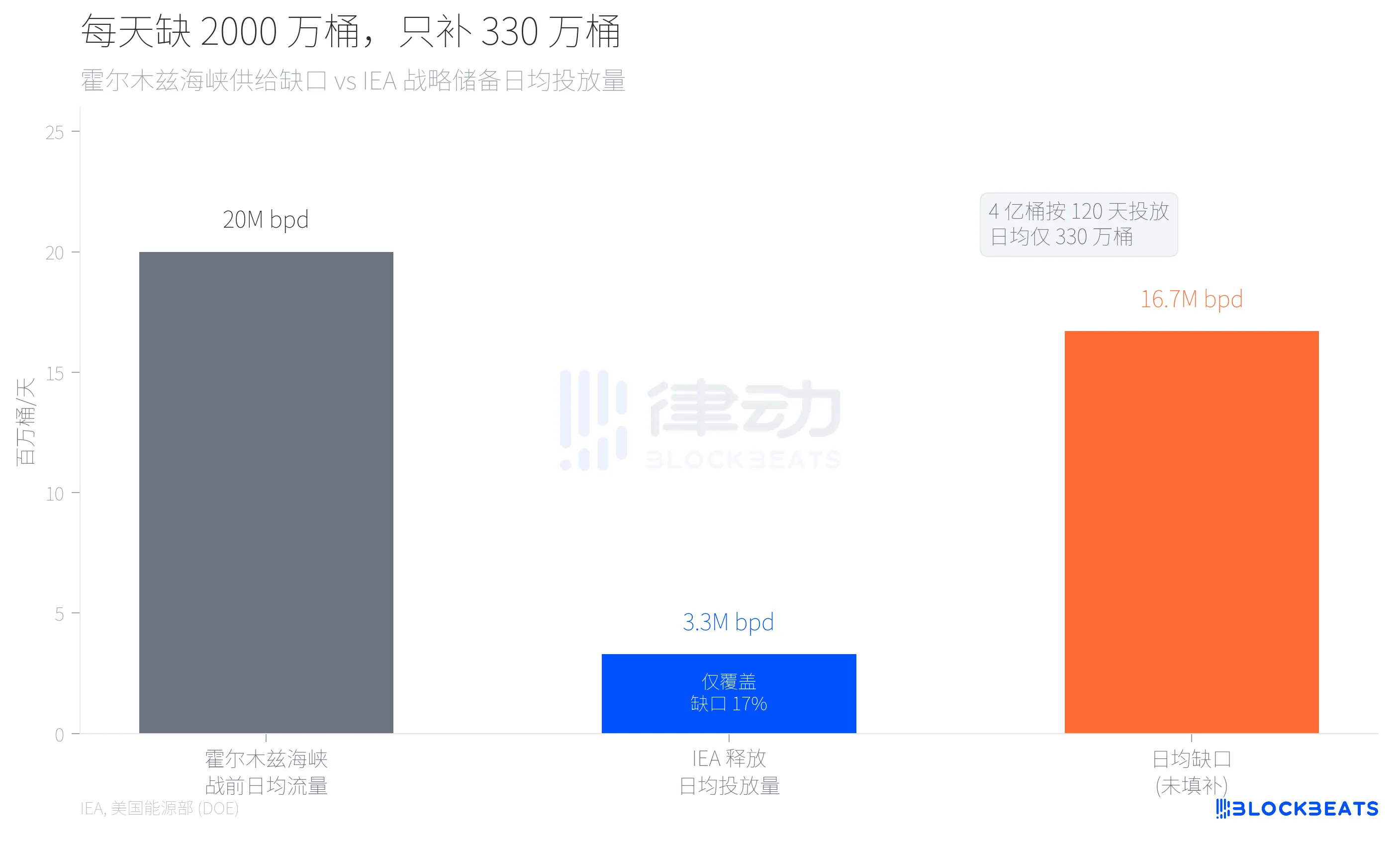
Using a more intuitive calculation: According to the IEA's March report, global daily oil consumption is around 103 million barrels. If all 400 million barrels are poured into the market at once, it would only sustain for less than 4 days.
When Have Past Oil Release Interventions Actually Worked?
The results of the IEA's 50-year, five-time reserve releases are clearly divided into two categories.
In 1991 during the Gulf War, the IEA's announcement of the release led to an immediate oil price drop of around 20%, with a subsequent one-week drop of one-third. After Hurricane Katrina in 2005, the market also quickly stabilized. These two instances shared a common factor: the source of the supply disruption was being repaired. The start of airstrikes in the Gulf War signaled a potential recovery of the Kuwaiti oil fields, while Hurricane Katrina had passed, and refineries were gradually restarting.
A counterexample is seen in 2022. Following the Russia-Ukraine conflict, the IEA released 182.7 million barrels, but rather than falling, Brent crude oil prices surged upon the announcement, initially spiking to $113 before slowly receding over the next few months. The reason was simple: there was no immediate prospect of Russia's supply disruption being resolved.
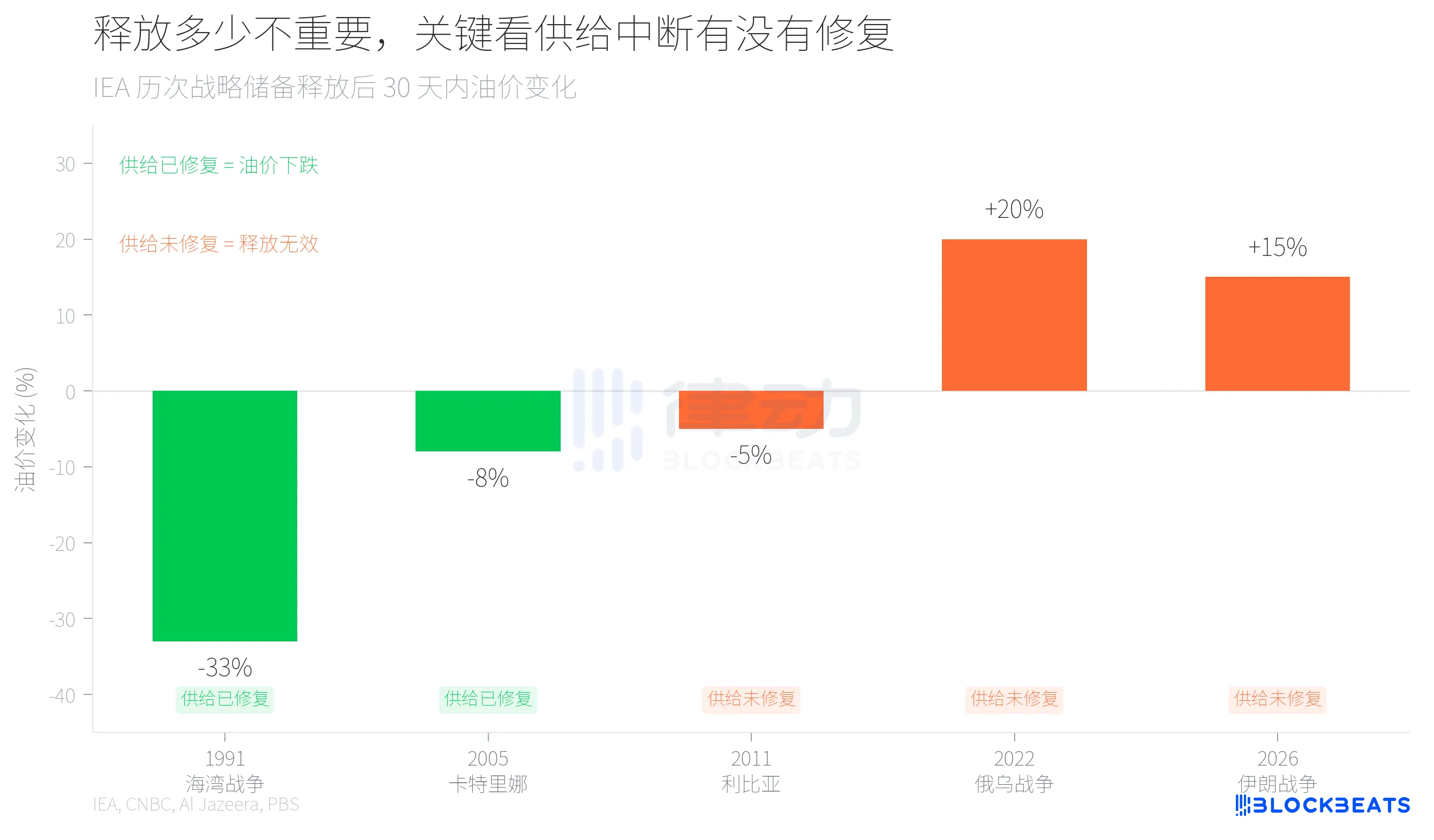
The situation in 2026 is more akin to 2022 than 1991. The Strait of Hormuz remains semi-blocked, with no ceasefire in sight in Iran. According to an analysis by Stanford University researcher Maksim Sonin cited by Al Jazeera, "This is not a panacea; market trading is based on expectations, and current expectations lean towards concerns." University of Massachusetts Amherst economist Gregor Semieniuk more directly points out, "The release can only buy temporary respite, and once the release is over, the firepower is gone."
What determines the oil price response is not how many barrels are released, but whether the source of the supply disruption has been eliminated. Reserve releases are essentially not about "refueling" but about "buying time," using limited ammunition to secure negotiation space and allocate flexibility for alternative routes. If time is bought but the disruption source remains unresolved, the price will rise.
How Much Ammunition Is Left in the Arsenal?
This raises a more long-term question: after repeated episodes of "buying time," is the ammunition depot itself still sufficient?
The U.S. Strategic Petroleum Reserve (SPR) is the world's largest government emergency oil stockpile. According to data from the U.S. Energy Information Administration (EIA), the SPR peaked at 727 million barrels by the end of 2010. In 2022, the Biden administration, in response to the Russia-Ukraine conflict and surging oil prices, released about 180 million barrels, bringing the SPR down to 347 million barrels by June 2023, its lowest level since 1983. After over two years of replenishment, it only recovered to around 415 million barrels by March 2026.
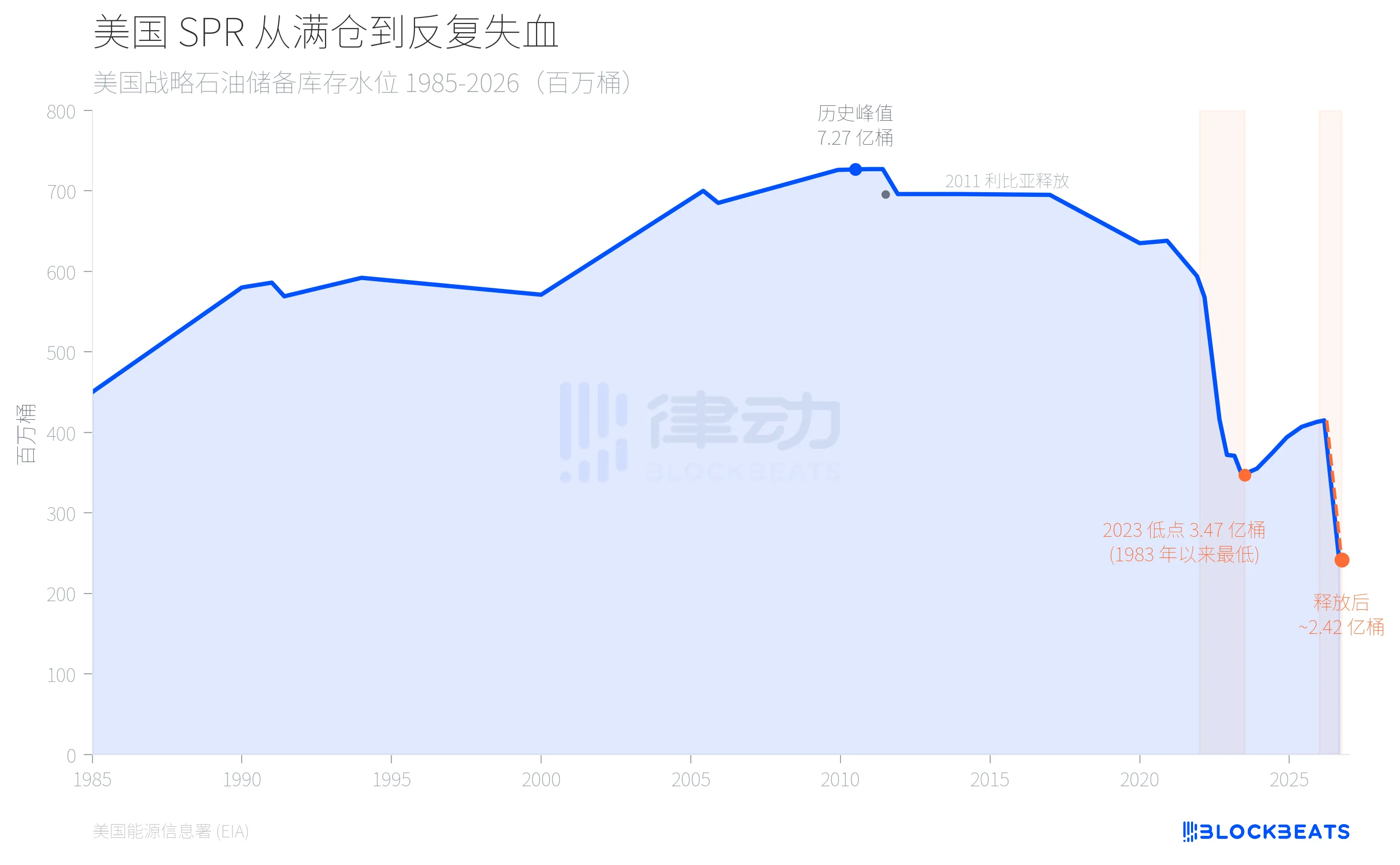
Now, out of this 415 million barrels, another 172 million barrels are about to be released. After the planned release, the SPR will drop to around 242 million barrels, back to the level at the beginning of the mid-1980s when the reserve was established. The U.S. Department of Energy has committed to replenishing about 200 million barrels within a year after the release, but it took over two years in the last round of replenishment to climb from 347 million barrels to 415 million barrels, indicating that the replenishment speed significantly lags behind the depletion speed.
It's not just the U.S. The 32 IEA member countries collectively held about 1.2 billion barrels of public emergency reserves before this release, and this 400 million barrels directly cut off one-third of that.
If the next supply crisis arrives before the SPR is replenished, will the global "last resort arsenal" be sufficient? This question currently has no answer. And it's precisely because the market has seen this issue that it is unwilling to let oil prices drop.
You may also like

The organization has accessed the prediction market, but is stuck at the third stage

Head of crypto VC collective shrinks: a16z crypto fund management scale plummets by 40%, Multicoin cut in half

Arthur Hayes New Post: It's "No Trade" Time Now

Claude Opus 4.7 Review: Is It Worthy of the Title of Strongest Model?

DWF In-Depth Report: AI Outperforms Humans in Yield Farming Optimization in DeFi, But Complex Transactions Still Lag Behind 5x
The financial tricks of the crypto giant Kraken

When proactive market makers start to take initiative

Massive Whale Movement: Unstaking $84.96 Million in HYPE Tokens
Key Takeaways A crypto whale, known as TechnoRevenant, has unstaked approximately $84.96 million in HYPE tokens. The tokens…

ListaDAO Addresses Third-Party Contract Vulnerability Concerns
Key Takeaways GoPlus Security revealed a vulnerability in a contract resembling those of ListaDAO. ListaDAO confirmed that their…

Security Risks of Fake Ledger Nano S+ Devices Emerging Through Chinese E-Commerce
Key Takeaways Counterfeit Ledger Nano S+ devices are being sold on Chinese e-commerce platforms, posing significant risks to…

Wave of Cyber Attacks Hits DeFi Protocols Post-Drift Hack
Key Takeaways A significant $280 million attack on Drift Protocol set off a chain of security breaches across…
Tom Lee Says ‘Mini Crypto Winter’ Is Over, Sees Ether Above $60K
Key Takeaways: Tom Lee predicts Ether’s resurgence, projecting it to surpass $60,000 in the coming years. Bitmine suffered…

French Government Tackles Rising Crypto Safety Concerns
Key Takeaways: France is intensifying measures to counter the surge in crypto kidnappings and wrench attacks. Since early…
Europe’s Bitcoin Treasury Playbook Unlikely to Mirror US Strategy: PBW 2026
Key Takeaways: European firms are adapting unique Bitcoin treasury strategies due to distinct financial regulations and market dynamics…
Circle Confronts Lawsuit Over $280M Drift Protocol Hack
Key Takeaways: Circle faces a lawsuit for allegedly aiding in the transfer of $230 million in stolen USDC.…
Bitcoin Faces ‘Near-Term Selling Pressure’ Following Surge to $76K: CryptoQuant
Key Takeaways: Bitcoin reaches a multi-month high of $76,000, prompting increased deposits to exchanges. CryptoQuant identifies a peak…

Ethereum Foundation Unveils North Korean Infiltration in Web3
Key Takeaways: The Ethereum Foundation’s ETH Rangers program exposed 100 North Korean operatives infiltrating Web3 companies. The Ketman…

Crypto in Sustained Winter as CEX Volumes Drop 39% in Q1
Key Takeaways: Centralized crypto exchange trading volume fell by 39% in Q1 2026 to $2.7 trillion. March saw…



 App
App