
Timeline | OM plunges over 80% – Whose "Fault" Is It: Team, Liquidity Provider, or Investor?



In the early morning, the RWA sector project MANTRA (OM) experienced a rapid 90% drop, plummeting from $6 to $0.5, causing its market value to plummet by over $5.5 billion. Three hours later, the MANTRA team released a statement indicating that the drop was triggered by an irrational liquidation event unrelated to the project itself, asserting that it was not the team's doing. Subsequently, OM rebounded from around $0.5 to $1.2, experiencing a brief price spike. According to Coinglass data, within a mere four hours, the amount of OM contracts liquidated reached $58 million.
Prior to this steep decline, OM had gone through multiple violent price surge phases since November last year, earning the nickname "Strong Whale Demon Coin" from the community. Related reading: "After Evaporating $5.5 Billion in 15 Minutes and Surging 4x, Why Did the 'Demon Coin' OM Suddenly Crash?". So, what is the truth behind this sudden drop? Was it truly caused by off-exchange trading liquidations? BlockBeats will continue to monitor and provide real-time updates. Below is a timeline of the events:
9:06 AM: 10 OM positions worth over a million dollars liquidated in the past 12 hours
At 9:06 AM, according to Coinglass data, 10 OM positions worth over a million dollars were liquidated in the past 12 hours.
On-chain Monitoring: Ahead of OM's Flash Crash, 4.5% of the circulating supply transferred to CEX with strategic investor Laser Digital suspected to be involved
At 8:40 AM, as per The Data Nerd's monitoring, 6 hours prior to OM's price plummet from $6 to 90% down to $0.4, over the past 3 days, 24.4 million OM tokens (equivalent to approximately $143.94 million at the time) were moved from 5 wallets to OKX. Four wallets had the same operational pattern: withdrawals from Binance last month followed by deposits to OKX.
At 8:55 AM, according to Lookonchain monitoring, prior to OM's collapse (since April 7), at least 17 wallets deposited 43.6 million OM (equivalent to $227 million at the time) to a CEX, accounting for 4.5% of the circulating supply. Based on Arkham's tags, two of the addresses are associated with Laser Digital. Laser Digital is a strategic investor in MANTRA.
At 9:56 AM, according to Spot On Chain monitoring, just 3 days before the crash, a certain OM whale group transferred 14.27 million OM tokens at an average price of $6.375 (approximately $91 million at the time) to OKX. Back in late March, they had collectively withdrawn 84.15 million OM tokens from Binance, totaling around $564.7 million (at an average of $6.711). Now, after experiencing about a 90% plummet, their remaining 69.08 million OM tokens are only worth $62.2 million — an estimated total loss of up to $406.3 million. Spot On Chain suggests they may have hedged this portion of their position elsewhere, which may have been one of the reasons for this crash.
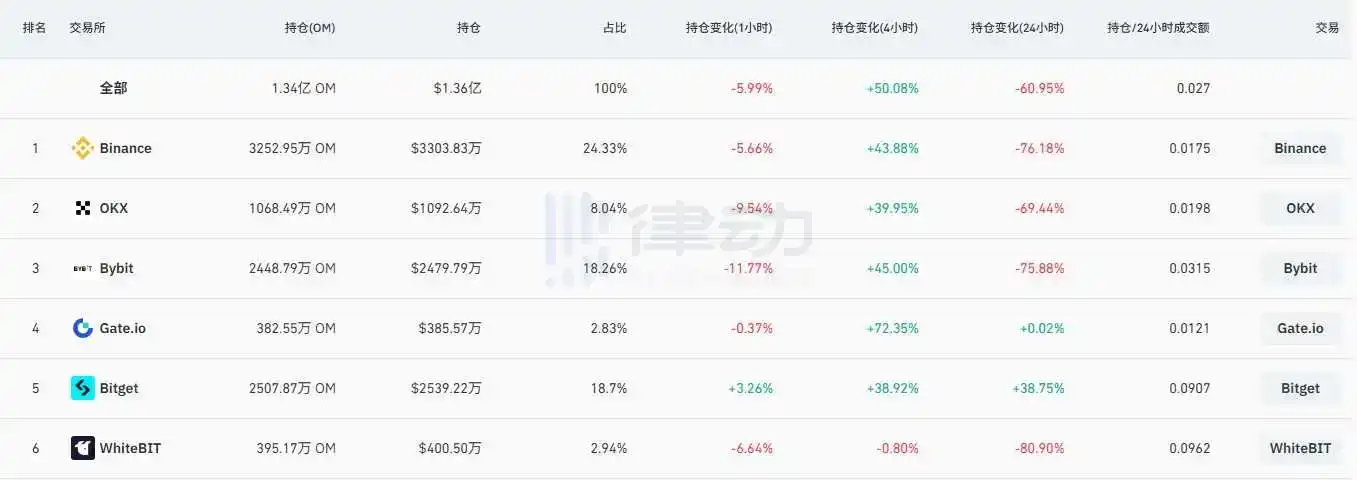
At 8:28 AM: The total net open interest in OM contracts reached $136 million, with a 24-hour decrease of 60.95%; in nearly 12 hours, the total liquidation amount exceeded $65 million, second only to Bitcoin
According to Coinglass data, the total net open interest in OM contracts was $136 million, with a holding of 134 million OM tokens, experiencing a 24-hour decrease of 60.95%. Binance held the highest market share, with an OM contract position of $33.038 million, accounting for 24.33%. Additionally, in the past nearly 12 hours, the total liquidation amount for OM exceeded $65 million, with long liquidations amounting to $47.3255 million. In this period, the liquidation volume of this currency was second only to Bitcoin.
MANTRA Founder: OM Crash Not Due to Binance, but Caused by Improper Forced Liquidations on Other CEXs
At 7:16 AM, MANTRA founder JP Mullin responded to the OM crash event on social media, stating that this market imbalance was not caused by the team, MANTRA Chain Association, its core advisors, or MANTRA's investors selling tokens, nor was it due to Binance, but rather improper forced liquidations on other CEXs.
JP Mullin indicated that this market imbalance was not caused by the team, MANTRA Chain Association, its core advisors, or MANTRA's investors selling tokens. The tokens remain in a locked state and follow the previously announced unlock schedule. In the next few hours, the team will host a community AMA on Platform X to further discuss these events.

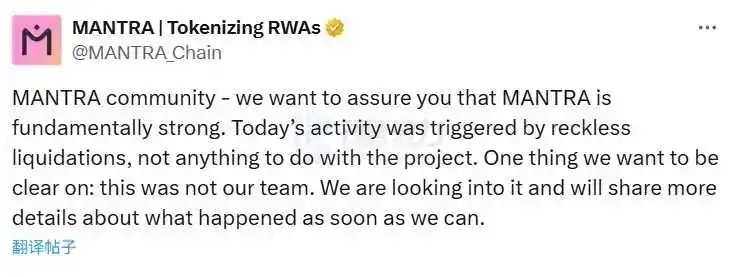
4:51 AM: OM Responds to Early Morning Flash Crash: Volatility Caused by Disorderly Liquidation, Not Team's Doing
At 4:51 AM, the MANTRA community released a statement stating that today's OM's abnormal volatility was caused by a "disorderly liquidation," unrelated to the project itself, and emphasizing that the event was not caused by the team. The official team stated that they are investigating the specific reasons and will announce more details soon.
MANTRA stated that the timing and depth of the crash indicate that account positions were closed very abruptly and without sufficient warning or notice. This situation occurred during a period of low liquidity in the early morning Asian time zone, which at least indicates a certain degree of negligence on the part of the CEX or could possibly be intentional market manipulation.
“CEX partners play a crucial role in providing liquidity for projects like ours. We work closely with them; however, they still have significant discretion. When this discretion is exercised without proper internal and external oversight, as it may have been recently, market dislocation can occur, harming the interests of the project and investors. It needs to be clarified that this market dislocation was not caused by the team, MANTRA Chain Association, its core advisors, or MANTRA's investors selling off tokens. The tokens remain locked and are subject to the disclosed vesting periods. OM's tokenomics remain unchanged, as stated in our latest token report last week. Our token wallet addresses are online and visible.”
4:00 AM: Liquidity Provider's Algorithm Abnormally Drives up BTCDOM Perpetual Contract by 20%
At 4:01 AM, according to Formula News, an unidentified liquidity provider experienced an algorithm error following OM's (Mantra) flash crash, unintentionally driving up the Binance platform's BTCDOM (Bitcoin Dominance Index) perpetual contract by 20%.
The BTCDOM index includes the top 20 cryptocurrencies by market capitalization on Binance and Binance Futures, excluding BTC and stablecoins, with OM's weight at only about 5%. The unusual fluctuation is suspected to have resulted from the liquidity provider mistakenly interpreting the sharp price movement of OM as a structural change in the market, triggering a strategic buy-in operation in error.
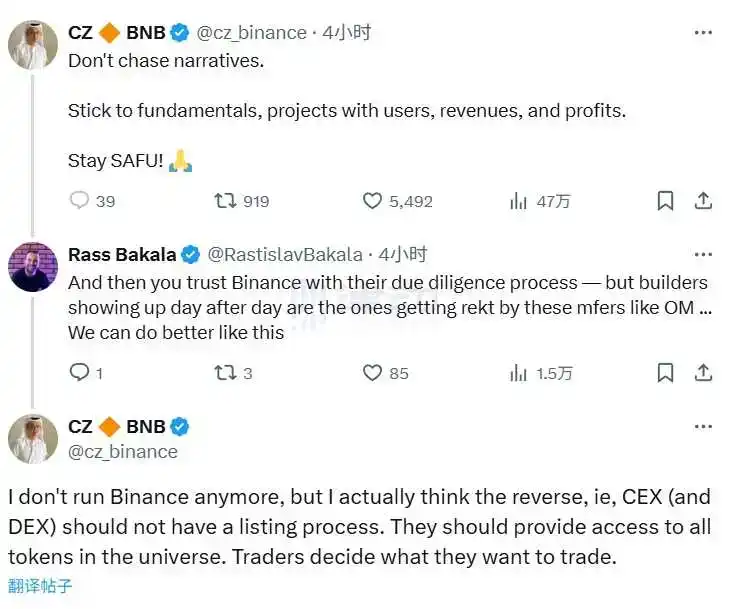
3:00 AM: CZ Responds to OM's Flash Crash: Do Not Chase Narratives, CEX Should No Longer Have Listing Processes, Investors Should Decide on Trading Pairs Themselves
Around 3:00 AM, CZ, following OM's drop, posted on Platform X advising investors, “Do not chase narratives. Stick to fundamental projects with users, revenue, and profits.” In response to the community's questioning of whether "Binance platform had conducted due diligence on OM's flash crash," CZ once again emphasized that CEX should no longer have listing processes, and investors should decide on trading pairs themselves.
2 AM: OM Suffers Sudden Crash, Over 80% 24-hour Loss
Around 2 AM on April 14, according to HTX market data, OM experienced a short-term drop of over 67%. Additionally, Coinglass data shows that within the last hour, OM saw $28.61 million in liquidations, with long liquidations accounting for around $28.14 million and short liquidations around $0.47 million. Subsequently, OM's 24-hour loss expanded to 80%.
You may also like

WEEX Makes Affiliate Access Easier on the Web and in the App

Customize Your Spot Trading Page: Drag Modules and Move the Order Panel Where You Want It

Perp DEX: The Next Generation Exchange "War"

10 Counterintuitive Insights on Latin American Payments

The AI gamble of mining companies: Valuations enter a phase of differentiation, and it's hard to turn the tide

A letter from Alliance to entrepreneurs: Written on the occasion of Cursor selling for 60 billion dollars
Stablecoins Finally Find Real Returns: On-Chain Reinsurance Re Explained | Interview with Re Founder Karan Saroya

The impossible triangle is simply a pseudo problem

Will MicroStrategy fall into a death spiral? What will the macro trend be in the second half of the year?

Blockchain Capital Partner: The Core Secret of Arbitrage
STRC unanchored by 11%, can the perpetual motion machine of Strategy still operate?

Bitcoin Market Analysis 2026: Can BTC Reach $150K by Year-End?
Bitcoin ETF Outflows Hit a Record $4.4 Billion: What Are Traders Doing With Their Cash?
WEEX App Just Got Smarter – New Tabs for Faster Trades & Easy Asset Management

WEEX All-New Search Features: Find, Trade & Earn Faster Than Ever

Morning Report | Illinois signs the strictest digital asset tax law in the U.S.; RWA tokenization market size surpasses $43 billion, institutions accelerate the migration of on-chain assets
Full version of the debut Q&A! Federal Reserve Chairman Waller: Sticking to the 2% inflation target, establishing five special working groups, individual did not submit the dot plot

From Disruptor to Shadow Market: The Crypto Market is Becoming a Colony of Traditional Finance
WEEX Makes Affiliate Access Easier on the Web and in the App
Customize Your Spot Trading Page: Drag Modules and Move the Order Panel Where You Want It
Perp DEX: The Next Generation Exchange "War"
10 Counterintuitive Insights on Latin American Payments
The AI gamble of mining companies: Valuations enter a phase of differentiation, and it's hard to turn the tide
A letter from Alliance to entrepreneurs: Written on the occasion of Cursor selling for 60 billion dollars


