
Trump's First Hundred Days Banquet: SEC 'Pardons All,' Cryptocurrency Market Cap Shrinks by $800 Billion


Original Title: Crypto experts score Trump's first 100 days: 「More symbolic than substantial」
Original Source: DL News
Original Translation: Bitpush News
Since taking office as U.S. President, it has been a period of turmoil for various industries under Trump. As he marks the first 100 days of his second term in office, supporters of digital assets are also examining what Trump's governance means for the industry.
Mateusz Kara, CEO of the cryptocurrency company Ari10, told DL News, "The question is, 'Have we overestimated what Trump can do?'"
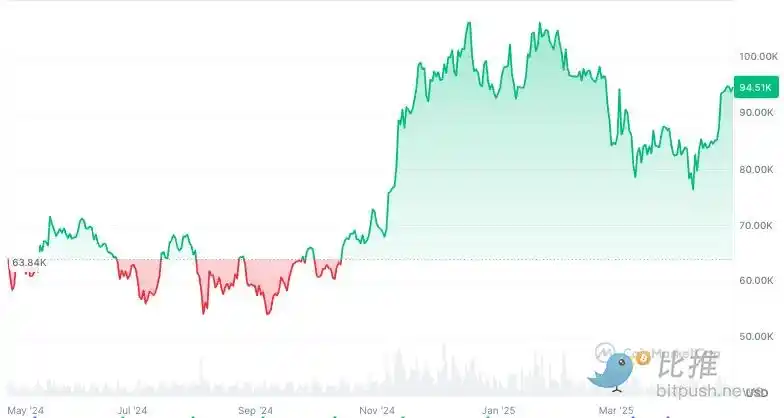
In last year's U.S. election, the cryptocurrency industry supported Trump, hoping that he would end the Biden administration's crackdown on cryptocurrency, implement rules favorable to the industry, and kickstart a bull market. While some rules have been relaxed, the White House's trade war has caused the global cryptocurrency market capitalization to shrink by nearly 21% since its peak in December last year, approximately $800 billion.
Bitcoin has fallen by over 10% since Trump's inauguration on January 20, compared to the day before the inauguration. On that day, the price of Bitcoin hit a historical high of $109,225. Dow Jones market data shows that earlier this month, impacted by tariff concerns, Bitcoin, along with other risk assets, took a hit, dropping below $74,500 on April 7, and rebounding to around $94,500 at the time of writing.
So, what promises has Trump fulfilled so far, and where is the industry headed?
The "Cryptocurrency War" of the Biden Era
Former U.S. President Joe Biden had harshly criticized cryptocurrency, advocating for strict regulation of the industry and supporting the cryptocurrency crackdown launched by then-Securities and Exchange Commission (SEC) Chairman Gary Gensler.
During his campaign, Trump promised to end Biden's "cryptocurrency war." After taking office, Trump replaced Gensler with a pro-cryptocurrency new chairman, Paul Atkins, who pledged to bring clarity to cryptocurrency regulation. This year, the SEC dropped lawsuits against cryptocurrency companies such as Coinbase, Ripple, and Kraken.
Trump also appointed industry supporters, such as financial tycoon Howard Lutnick, who supports Tether, as Secretary of Commerce, and David Sacks as the cryptocurrency czar. In his first 100 days in office, Trump issued a series of comprehensive orders, banning the creation of a digital dollar, protecting self-custody, establishing a regulatory cryptocurrency advisory group, and creating a strategic Bitcoin reserve.
He also pardoned Silk Road's founder Ross Ulbricht and hosted the first White House cryptocurrency summit. This year, federal regulators have rolled back multiple cryptocurrency guidance policies from the Biden era, paving the way for financial institutions to enter the cryptocurrency services.
Symbolism>Substantive Benefit?
In short, Trump seems to have delivered on most of his cryptocurrency promises. So why are some market observers dissatisfied?
Jonathan Dixon, a senior executive at regulatory technology company eflow Global, told DL News: "So far, many campaign promises seem more symbolic than substantive."
"The Bitcoin reserve is essentially a rebranding—it is assets long held by the government and not a sign of active market participation." Dixon stated that while Trump's actions mark a "rhetorical shift from the previous administration," "mere rhetoric does not translate into regulatory certainty."
The Trump administration has not yet pushed through new laws, but some legislation is making its way through Capitol Hill. South Carolina Republican Senator Tim Scott stated in early April, "We are making progress."
Eric Rose, Executive Head of Digital Assets at StoneX Digital, pointed out: "These are all very bullish factors for the sector, but they take time to prove... Just because banks are allowed into the digital asset field doesn't mean they can enter tomorrow, right? They need time to formulate strategies, decide where they want to go, how to implement that strategy, and hire the people for it."
Eric Rose told Market Watch that this may take up to two years of preparation time.
Trade War
Ari10 CEO Mateusz Kara stated, "The market may be disappointed with Trump's administration because we haven't seen an uptrend in data. This is the result of delayed interest rate cuts and the chaos Trump has brought to the market." Trump has so far failed to deliver on his interest rate cut promise, with the Fed's rate cut seen as a catalyst for risk assets like cryptocurrency and stocks.
This is why one of the reasons Bitcoin surged when the central bank cut interest rates in September and November. The issue is that the Federal Reserve operates independently of the White House, and Federal Reserve Chairman Jerome Powell was unwilling to cut rates, particularly after Trump imposed full tariffs on nearly 100 countries (including an island nation where most residents are "penguins"), making the financial future of the United States even more uncertain.
After Trump stopped these tariffs, the overall cryptocurrency market experienced a slight recovery, but any hostile actions could offset this impact. Anthony Young, Chief Business Officer of cryptocurrency risk management company CoinCover, said, "The U.S. government's trade wars will inevitably impact the cryptocurrency industry, and the focus is on whether cryptocurrency can continue to act as a hedge against global market behavior."
Some believe that Trump's trade war could benefit cryptocurrency. Papuna Lezhava, CEO and Co-Founder of fintech startup Keepz and former IMF advisor, stated, "Trump's foreign trade policy could actually make cryptocurrency more attractive to those who wish to avoid the traditional financial system or government-controlled currencies."
You may also like

Standard Chartered Bank sings a 50x rhapsody again, aiming for AAVE to reach 3500 USD
Tidal Investment: We still have a positive outlook on the AI industry chain, but the reasons have changed

Former SpaceX engineer reconstructs the financial execution system using first principles

Why Is PAXG Price Different From Gold? 5 Reasons Crypto Traders Should Know

The cryptocurrency industry has entered the "Show Me" era: merely relying on vision is no longer enough

WEEX OpenAPI 101: 5 Powerful Modules, AI Trading Tools, and Grab Up to 70% Revenue Opportunities
Learn how WEEX OpenAPI connects traders, developers, AI agents, and trading platforms. Discover WEEX API features, Binance-compatible integration, automated trading workflows, revenue opportunities, and ecosystem possibilities.

Morning News | The draft amendment to the People's Bank of China Law aims to clarify the legal status of digital renminbi; South Korea will transfer about 40 unregistered virtual asset service providers to law enforcement agencies

Interpreting the Ethereum Foundation's new structure: Reaffirming self-sovereignty amid institutional trends

Interview with NDV Founder Jason Huang: Popping the AI Bubble and the Myth of Microstrategy, Seeking the Ultimate Ace in the Crypto Market
Morning Report | Former Ethereum Foundation researcher establishes Ethlabs; EU Parliament Economic Committee passes digital euro regulatory proposal

Dragonfly partner Haseeb: The fastest-growing companies in the future may all be stuck at 149 people

How xBubble Breaks the Deadlock in VC's Heavy Investment in the OPC Economy

The encrypted unicorn Blockstream is deeply embroiled in a serious fraud case

Morning Report | The South Korean Financial Services Commission plans to expand the regulatory sandbox to include virtual assets; the parent company of the New York Stock Exchange, ICE, has reached a partnership with OKX to jointly establish a cryptocu...

Exclusive Interview with Strategy CEO: Putting Aside the Sale of 32 BTC, the 60 Trillion AI Intelligence is the Ultimate Fate of Bitcoin

TRON revitalizes the image of the bull, creating a more approachable brand character

Will the STRC issuance price discussed with ChatGPT really fall into a death spiral?

The foundation retreats, Ethlabs steps forward: Ethereum welcomes its largest restructuring in history
Standard Chartered Bank sings a 50x rhapsody again, aiming for AAVE to reach 3500 USD
Tidal Investment: We still have a positive outlook on the AI industry chain, but the reasons have changed
Former SpaceX engineer reconstructs the financial execution system using first principles
Why Is PAXG Price Different From Gold? 5 Reasons Crypto Traders Should Know
The cryptocurrency industry has entered the "Show Me" era: merely relying on vision is no longer enough
WEEX OpenAPI 101: 5 Powerful Modules, AI Trading Tools, and Grab Up to 70% Revenue Opportunities
Learn how WEEX OpenAPI connects traders, developers, AI agents, and trading platforms. Discover WEEX API features, Binance-compatible integration, automated trading workflows, revenue opportunities, and ecosystem possibilities.


