
Unveil the Crazy Truth Behind the ADL Mechanism - Don't Let Exchanges Easily Take Your Money


Original Article Title: Auto-Deleveraging (ADL) Wrap-Up
Original Author: @ltrd_
Original Article Translation: zhouzhou, BlockBeats
Editor's Note: This article explains the Auto-Deleveraging (ADL) mechanism in the cryptocurrency market, particularly illustrating how ADL works by forcibly closing the positions of profitable clients to cover losses in times of insufficient market liquidation, using the example of $MANEKI. The article mentions that the execution of ADL has many opacities, such as price discrepancies and delayed execution. The author points out that understanding liquidation and ADL mechanisms is crucial for a deeper understanding of the crypto market and encourages readers to provide feedback for improvement.
Below is the original content (reorganized for better comprehension):
Today, I want to write a summary of the Auto-Deleveraging (ADL) mechanism in the cryptocurrency market. I am writing this article because I have recently received many messages about ADL and issues with this mechanism on various exchanges.
Furthermore, ADL is solely related to the crypto market—this is not something you would see in traditional financial markets (please correct me if I'm wrong). My goal today is to briefly explain what ADL is, what issues it faces, and why Bybit (and possibly not just this exchange) has raised many doubts about the ADL mechanism, as not everything is crystal clear.
Let me first explain what ADL is.
Currently, there is no clear, comprehensive whitepaper explaining how ADL works, the lack of clear examples, possible solutions, and plans for the development of this mechanism.
A friend recently provided me with the ADL data for MANEKI on the Bybit futures platform. I will slightly modify some numbers (without changing the range and percentage changes) to protect their anonymity.
Auto-Deleveraging is a mechanism that closes the most profitable position (i.e., the position opened with the highest leverage) when the exchange cannot continue to liquidate other clients' positions without facing losses.
Let me explain this more clearly, in case the previous explanation was not clear enough. Suppose there is a significant market fluctuation, with a sharp price drop leading to the forced liquidation of many clients' accounts. At this point, market liquidity worsens, and the market impact grows.
Let's assume we are at a specific moment where only one client is being liquidated. Let's say this client's position in $MANEKI is worth $50,000. For such a position, if you don't want to be liquidated, your account needs to maintain $2,500 (as the maintenance margin rate for this position is 5%).
If your 'Account Value' falls below $2,500, then your position will be liquidated — meaning, the maintenance margin is the cash you need to keep in your account to hold the position open.
Assuming the market continues to drop, and you incur significant losses on your open position, causing your account to drop below $2,500 — this would trigger an automatic liquidation process.
For this, let's assume some terms:
Liquidation Price → The price of $MANEKI at which your account is liquidated
Bankruptcy Price → The price of $MANEKI when your account value reaches 0 (if you are in a long position, this price should be strictly lower than the liquidation price, as at the liquidation price, your account should still have approximately the maintenance margin balance)
Execution Price → The market order price related to your account liquidation.
Your account is closed through a market order (sell), and the exchange gets the weighted average price of that order.
Here comes a very important point — if the Execution Price (EP) (assuming you are in a long position) is higher than the Bankruptcy Price (BP), theoretically, your account value should not be equal to 0 (because only when liquidation happens at BP, the account value would be equal to 0). However — you will not receive this additional amount — this is taken by the exchange.
If the exchange can execute the order at a better price than BP, it will take this surplus (and — as per the documentation — possibly contribute it to an insurance fund).
We'll come back to this issue later, but for now, let's focus on a more complex scenario:
Let's assume the market is volatile, and the exchange cannot execute orders at a price better than BP. In this case, the 'Account Value' would fall below 0, and the exchange would use the insurance fund to cover the losses.
The insurance fund is a "reserve pool that the system can use to protect traders from excessive losses in derivative trading."
Therefore, any liquidation orders below the bankruptcy price would result in additional losses, and the insurance fund would be used to cover these losses — this fund is typically composed of the exchange's funds or additional profits collected during settlement.
This is the ADL mechanism we ultimately want to discuss—if the insurance fund cannot cover the loss (because there is no money in it), the exchange will trigger an automatic deleveraging mechanism to fill this gap.
I want to define it as accurately and clearly as possible: ADL allows the exchange to offset the liquidation loss with the position of a profitable client.
So, if a client's position is liquidated, and the insurance fund cannot absorb the loss, the exchange will find a profitable client and forcibly close a portion of that client's profitable position to cover the loss.
Let's say the exchange needs to liquidate a $30,000 position: the insurance fund cannot cover the loss, so the exchange ranks clients based on the formula: Profit × Leverage. Assuming the top-ranked client holds a $100,000 position, the exchange will automatically close a $30,000 portion of that profitable position.
No liquidation order is placed in the market—this does not affect the order book, and the entire impact is silently absorbed by the profitable client with no warning.
It sounds a bit crazy—but that's basically how it operates.
You could say it's a kind of "excessive profit protection" mechanism created by the exchange.
I guess you should now understand this mechanism (I really hope so—I always try to explain slightly complex things in a simple way). Now we can start discussing some of my concerns and issues with this mechanism.
What's Weird About ADL?
First, the issue is that we know very little about the ADL mechanism. For example, we don't know when the exchange decides it cannot correctly execute a liquidation order and must resort to the ADL mechanism. This situation could happen at any time, and with no explanation.
For instance, Carol Alexander has a great article discussing the insurance fund and some volatile events.
There's a very peculiar point: on May 19, 2021 (a date that anyone serious about crypto trading in 2021 should know—if you don't, I suggest you make a cup of tea and spend at least an hour looking at that day's data), there was a massive sell-off and liquidation event.
However, when we look at Binance Futures' Insurance Fund data, we found that the Insurance Fund actually grew larger that day—it was not depleted!
I know it should have been cleared out because I personally got ADL'd on many contracts—clearly, the mechanism was flawed. I highly recommend you to read this article.
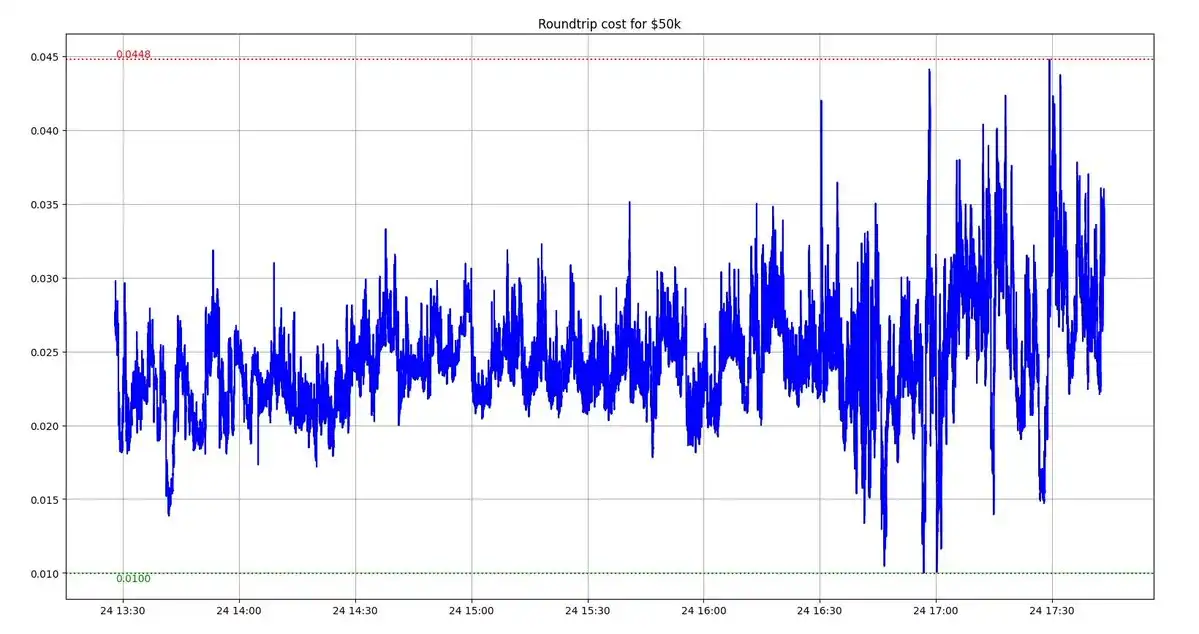
Let me go back to the decision between ADL and market sell order. On market sell orders and potential slippage: during the massive ADL event of $MANEKI (I assume it was significant as I know many got liquidated over the past few days), the cost of turnaround for a $50,000 order (i.e., the cost of doing a simultaneous buy and sell market order) did not significantly increase compared to before the large-scale liquidation event.
Remember: for a $50,000 order, the maintenance margin rate was 5%—even during a large swing period, the turnaround cost (not just the one-sided cost) was lower than this.
For larger positions (hence potentially causing more market impact), you would have a higher maintenance margin rate anyway.
Next, a really crazy part is the difference between the mark price (assuming this is the price in the market at some moment) and the ADL price.
In my friend's case, his ADL price was around 0.0033, but the mark price (i.e., the actual market price) at the time of ADL was 0.002595—a significant difference.
Even crazier is—the price of 0.0033 had been absent from the market for over 30 minutes at the time of ADL.
Why didn't the exchange trigger ADL right after the liquidation of other clients at a price of 0.0033? Why did they wait for 30 minutes to execute it?
A trade that was initially profitable turned into a 30% loss at the time of ADL. Since we have no information on historical ADL or its mechanics, the exchange can essentially act arbitrarily.
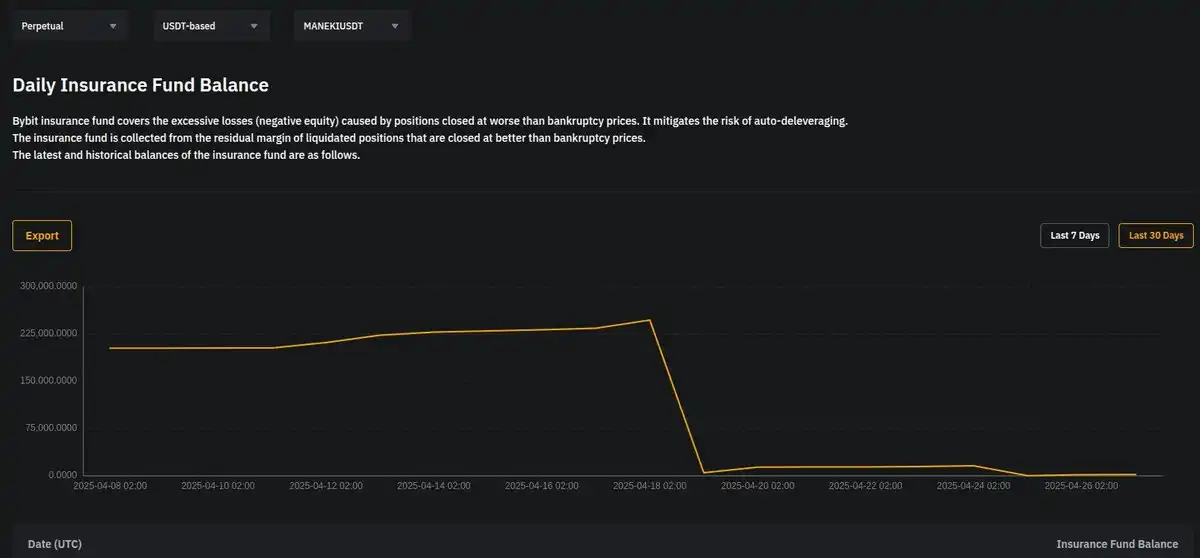
I tried to verify with others if there were similar price disparities and crazy ADL situations—and yes, I found corroborated individuals. But the story doesn't end there. Prior to these bizarre events happening, the Insurance Fund had already been empty for several days.
I previously mentioned the story from April 24th, but as you can clearly see, the Insurance Fund has been nearly depleted since April 19th—and Bybit did nothing about it.
They could have done many things: adjusted the maintenance margin, added funds to the insurance fund, introduced better protection measures for customers.
But they did nothing.
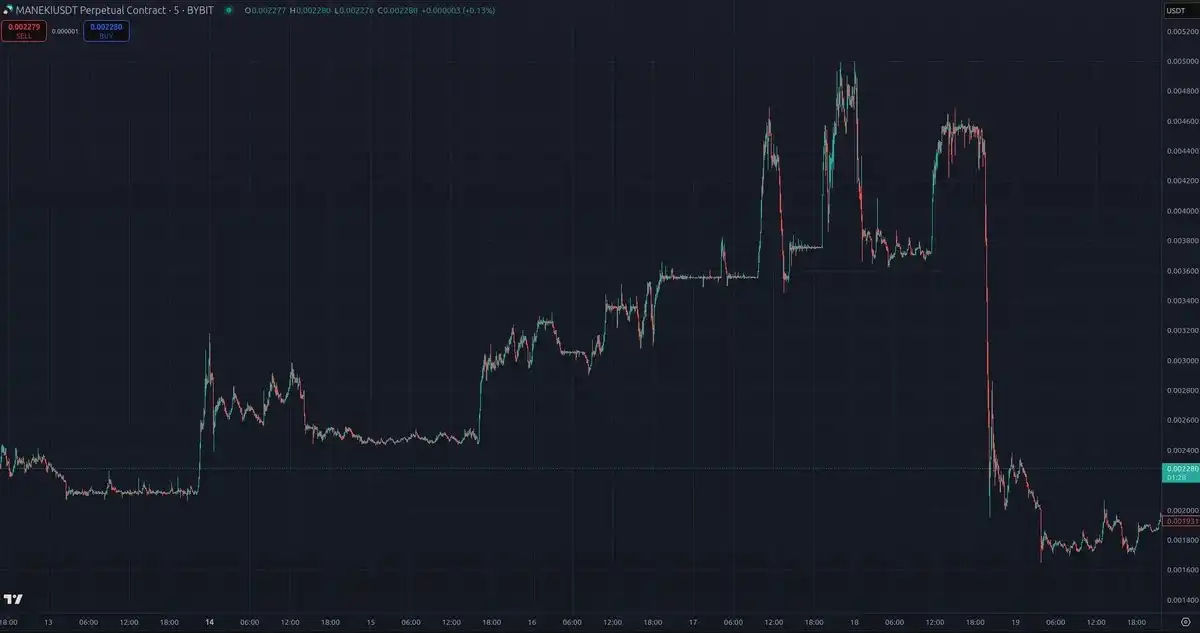
A significant sell-off (over 40%) occurred the day before Bybit announced the delisting of $MANEKI.
For the curious, I have provided a chart from a few days before the sell-off showing the craziness, absurdity, and manipulation. But from Bybit's perspective, no one paid any attention to it.
Through this crazy example of $MANEKI, I hope to explain to you a little about what ADL is.
I think understanding the liquidation process, the ADL mechanism, and all the aspects related to perpetual contracts and margin is crucial to fully understanding the cryptocurrency market.
You may also like

Why does OKX want to start a new company with the parent company of the New York Stock Exchange?

The interim executive director of the Ethereum Foundation speaks out: What is our mission?

Standard Chartered Bank sings a 50x rhapsody again, aiming for AAVE to reach 3500 USD
Tidal Investment: We still have a positive outlook on the AI industry chain, but the reasons have changed

Former SpaceX engineer reconstructs the financial execution system using first principles

Why Is PAXG Price Different From Gold? 5 Reasons Crypto Traders Should Know

The cryptocurrency industry has entered the "Show Me" era: merely relying on vision is no longer enough

WEEX OpenAPI 101: 5 Powerful Modules, AI Trading Tools, and Grab Up to 70% Revenue Opportunities
Learn how WEEX OpenAPI connects traders, developers, AI agents, and trading platforms. Discover WEEX API features, Binance-compatible integration, automated trading workflows, revenue opportunities, and ecosystem possibilities.

Morning News | The draft amendment to the People's Bank of China Law aims to clarify the legal status of digital renminbi; South Korea will transfer about 40 unregistered virtual asset service providers to law enforcement agencies

Interpreting the Ethereum Foundation's new structure: Reaffirming self-sovereignty amid institutional trends

Interview with NDV Founder Jason Huang: Popping the AI Bubble and the Myth of Microstrategy, Seeking the Ultimate Ace in the Crypto Market
Morning Report | Former Ethereum Foundation researcher establishes Ethlabs; EU Parliament Economic Committee passes digital euro regulatory proposal

Dragonfly partner Haseeb: The fastest-growing companies in the future may all be stuck at 149 people

How xBubble Breaks the Deadlock in VC's Heavy Investment in the OPC Economy

The encrypted unicorn Blockstream is deeply embroiled in a serious fraud case

Morning Report | The South Korean Financial Services Commission plans to expand the regulatory sandbox to include virtual assets; the parent company of the New York Stock Exchange, ICE, has reached a partnership with OKX to jointly establish a cryptocu...

Exclusive Interview with Strategy CEO: Putting Aside the Sale of 32 BTC, the 60 Trillion AI Intelligence is the Ultimate Fate of Bitcoin

TRON revitalizes the image of the bull, creating a more approachable brand character
Why does OKX want to start a new company with the parent company of the New York Stock Exchange?
The interim executive director of the Ethereum Foundation speaks out: What is our mission?
Standard Chartered Bank sings a 50x rhapsody again, aiming for AAVE to reach 3500 USD
Tidal Investment: We still have a positive outlook on the AI industry chain, but the reasons have changed
Former SpaceX engineer reconstructs the financial execution system using first principles
Why Is PAXG Price Different From Gold? 5 Reasons Crypto Traders Should Know


