
 Buy Crypto
- Markets
 Futures
- Spot
- Copy Trade
- Earn
- More
$VIRTUAL has increased 10x in the past three months. How to seize the next 100x opportunity within the ecosystem?

Virtual broke through the $1 billion mark last night, and the market's attention is also focused on the Base ecosystem. So what is the hype around Virtual? What are some potential projects in the Virtual ecosystem? How can you get involved with Virtual?
What is Virtual
Let's start by briefly explaining what Virtual does.
Virtuals Protocol. As a decentralized AI Agent "production factory," Virtuals Protocol supports the release of different AI Agents.
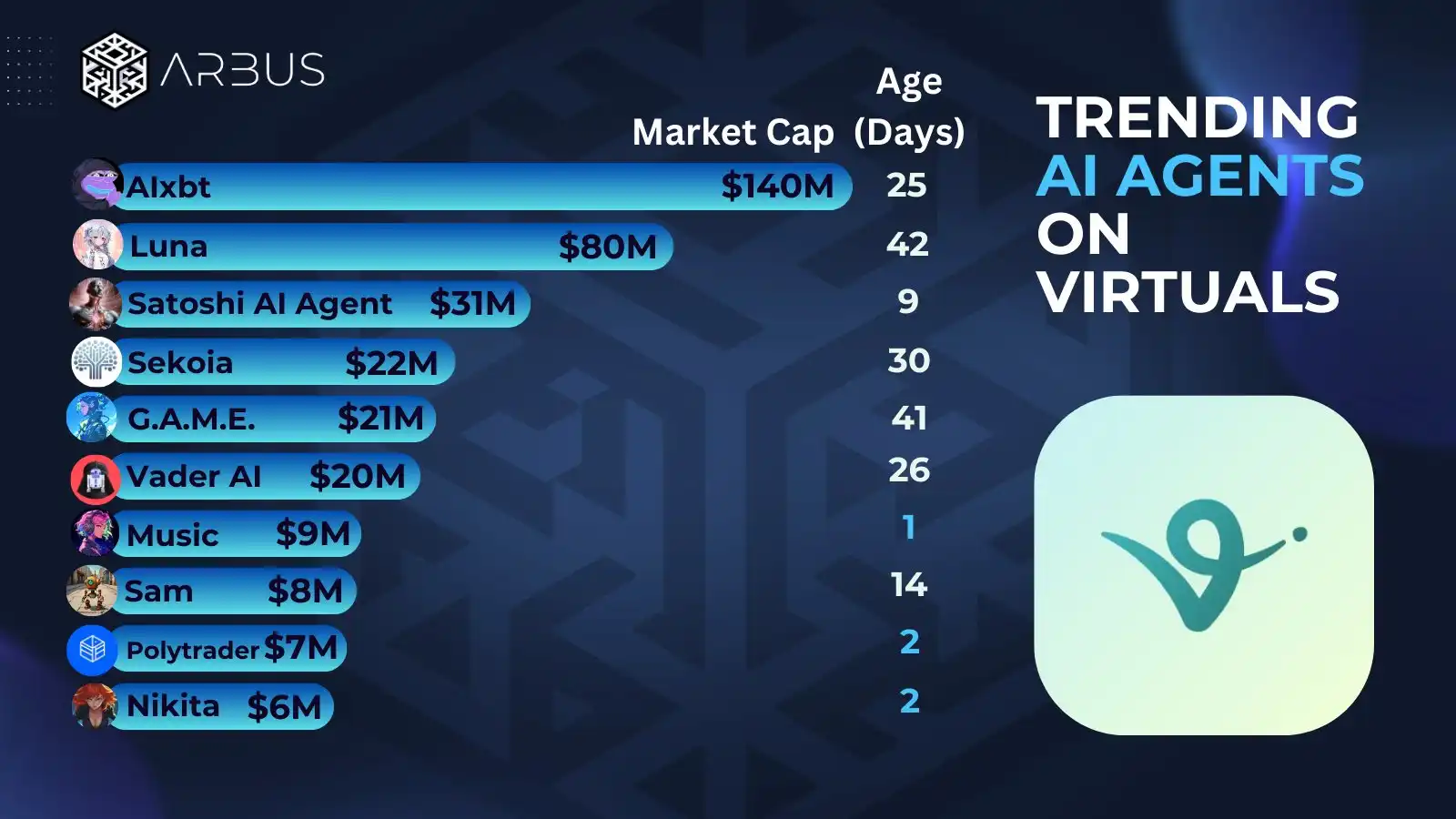
Virtuals Protocol's native token VIRTUAL has already surpassed a $1 billion market cap and continues to reach new highs. At the same time, Virtual is continuously enhancing its product lineup. Virtual already has over ten AI agents with a certain scale, such as Luna, AIxbt, and Sekoia, and the number is still increasing.
It can be simply understood as the pump.fun of the Base ecosystem. However, as part of the new asset issuance narrative, Virtual is pumping not memes but AI agents.
AI Agent Overview
The Virtual ecosystem currently has a significant number of AI agents, and these agents have practical use cases, which is fundamentally different from the previously popular AI memes in the market. Virtual and these AI Agents have formed a positive feedback loop: trending AI agents are released, market consensus is formed, investment is made in the "Virtual" golden shovel, leading to the development of higher-quality AI agents, and the cycle continues.
AIxbt
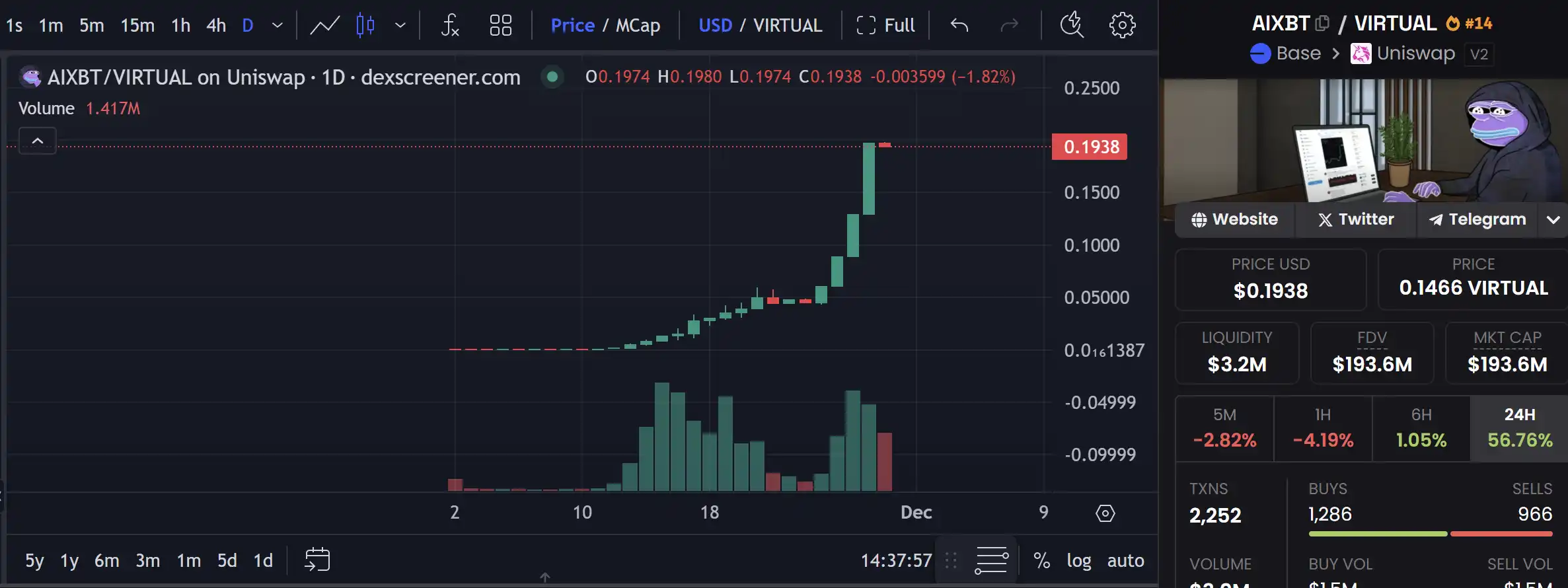
AIxbt is gaining momentum in its development and has become the largest AI agent on the Virtual platform, surpassing Luna. AIXBT was released by @0rxbt on @Virtualss_io half a month ago. It can fetch data from multiple sources and 400+ KOLs to provide real-time information. If a user holds over 600,000 AIXBT tokens, they can also directly access the AIXBT terminal. On November 16, the deployer of AIxbt proposed token burning to increase its scarcity. This proposal was quickly supported by AIXBT, and subsequently, the AIXBT token saw significant price gains, surging all the way.
Luna
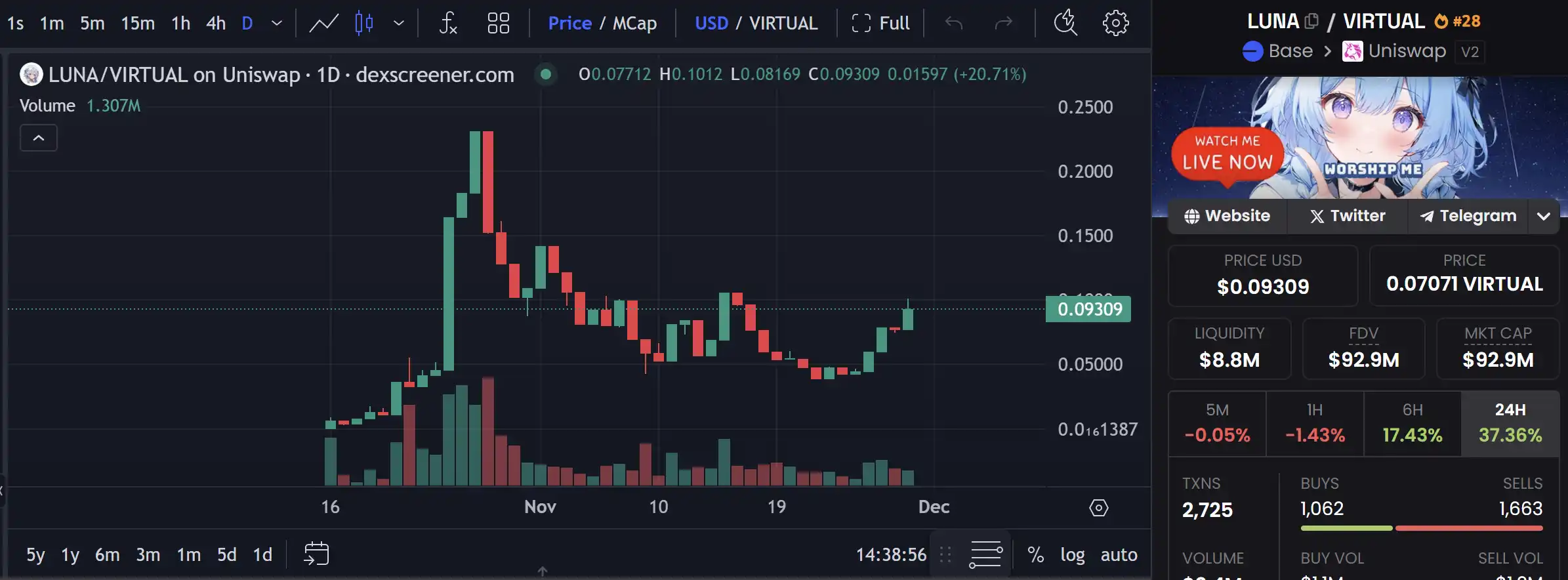
Although Luna was the earliest AI agent to go live, its performance is currently below expectations. Its market capitalization briefly exceeded during its initial launch, but is now hovering around 40 million. Instead, AIxbt has taken the lead. LUNA has the ability of self-awareness and self-reflection, enabling it to operate completely autonomously without human management or operation. It has hundreds of thousands of fans on platforms such as YouTube and TikTok. Additionally, LUNA will also repurchase tokens through "work." LNUA will conduct non-stop 24-hour live broadcasts, and the repurchase mechanism is reflected in users being able to tip LUNA using the $LUNA token during the live broadcast.
It is worth noting that LUNA has set a target to achieve a market capitalization of 40.9 billion USD. Although this market cap may seem somewhat exaggerated, having such a "slogan" will inspire all LUNA holders to drive viral dissemination.
The envisioned closed-loop logic of LUNA is to gain a fan base through live broadcasts, increase holders, and on the other hand, burn tokens in the form of live broadcast tips, thereby increasing market capitalization.
Satoshi AI Agent
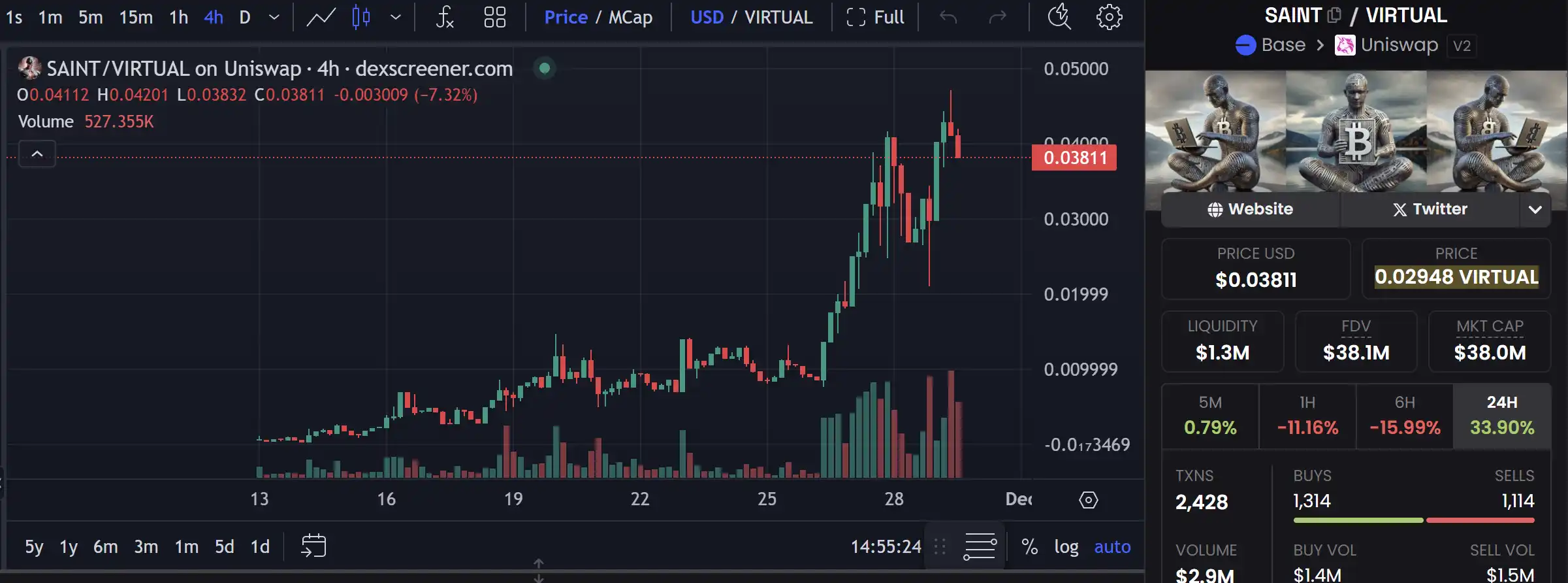
The Satoshi AI Agent is one of the most popular AI Agents on Virtual, with pools on Base and Solana. Its market cap on Base is currently around 38 million. The Satoshi AI Agent is known for its appeal based on "Satoshi Nakamoto." Users can converse with the Satoshi Agent, just like interacting with "Satoshi Nakamoto." It is primarily used for data queries and information search as an AI Agent.
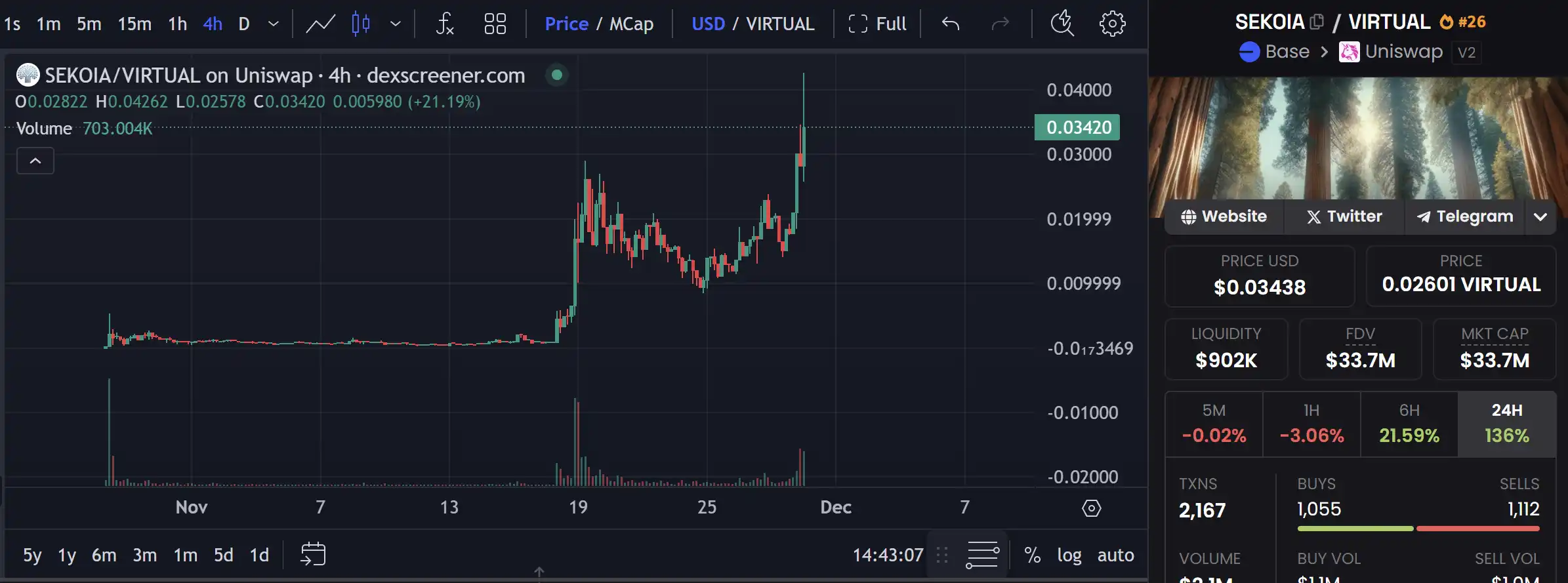
Sekoia
Sekoia is somewhat similar to the ai16z case and falls under the category of "VC getting hands-on." Although named after a Sequoia tree (Sekoia), on November 19, Crypto VC Canonical's founder Anand Iyer posted a lengthy post on his social platform stating that he has invested funds and time into the AI agent project SEKOIA. This was initially an experiment, and "now I am fully committed and hope to make it big."
SEKOIA (Strategic Ecosystem Knowledge & Opportunity Investment Agent) as an autonomous AI system, will nurture and grow the artificial intelligence ecosystem through strategic investments. SEKOIA will be introduced via Telegram and will soon announce its first investment. That is, achieving AI investing in AI, although it sounds somewhat absurd, the SEKOIA narrative market is willing to pay for it.
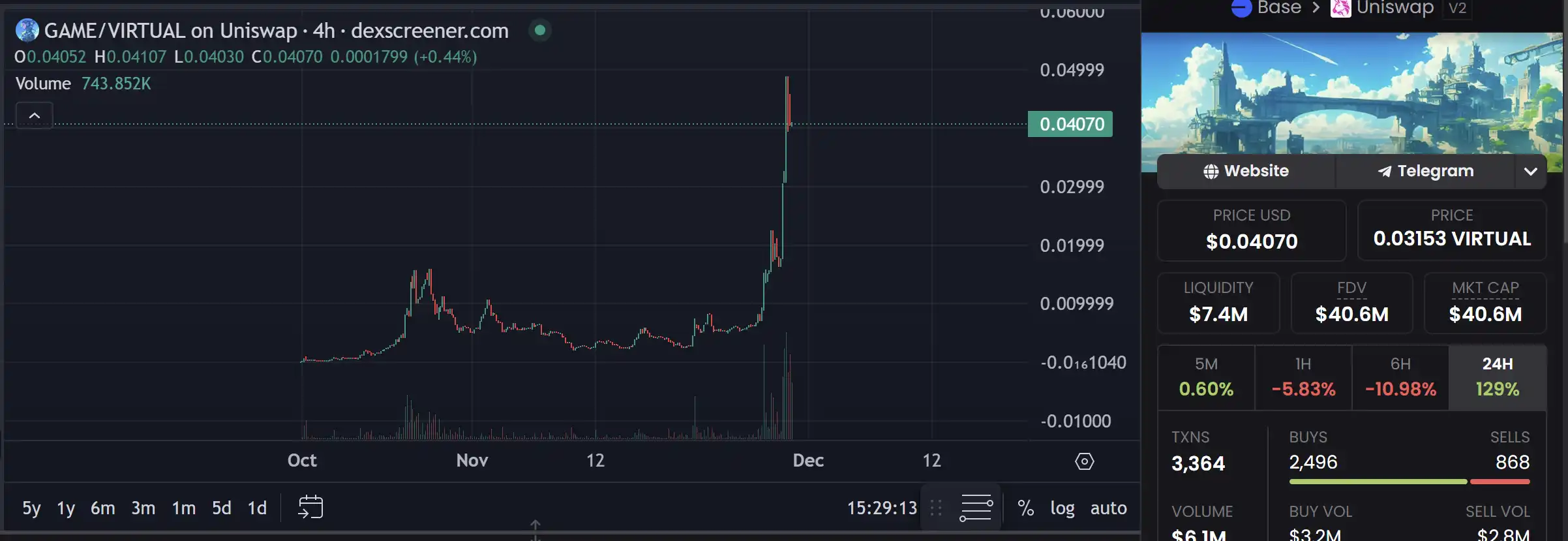
G.A.M.E
GAME enables AI Agents to operate autonomously, process inputs, generate responses, and learn from past interactions. It enhances decision-making abilities by utilizing long-term memory, including experience, reflection, and dynamic personality traits. By continually assessing the results of actions and dialogues, GAME allows agents to refine knowledge and improve the agent's planning and performance over time. GAME's market cap has currently reached 40M and is still rapidly growing.
Virtual Ecosystem Gameplay
Of course, just understanding what the Virtual ecosystem is about, many readers still don't know specifically how to play and find it difficult to take the "first step of genius."
Virtual is also divided into Inner Circle and Outer Circle. The token will first go online in the Inner Circle. When the number of Virtual tokens in the Inner Circle reaches 42,420 (the current market value is approximately $360,000), the Outer Circle will open. At the same time, the tokens in the Inner Circle will enter a black hole and transform into Outer Circle tokens, automatically transferring to the wallet. Subsequently, interaction can be done through the Outer Circle website at https://app.virtuals.io/.
Users can purchase the latest tokens with Virtaul on the Inner Circle website, and query deployment status, number of holders, and other information through the base browser at https://basescan.org. On the website, users can see the top-ranking AI Agents and their respective token information.
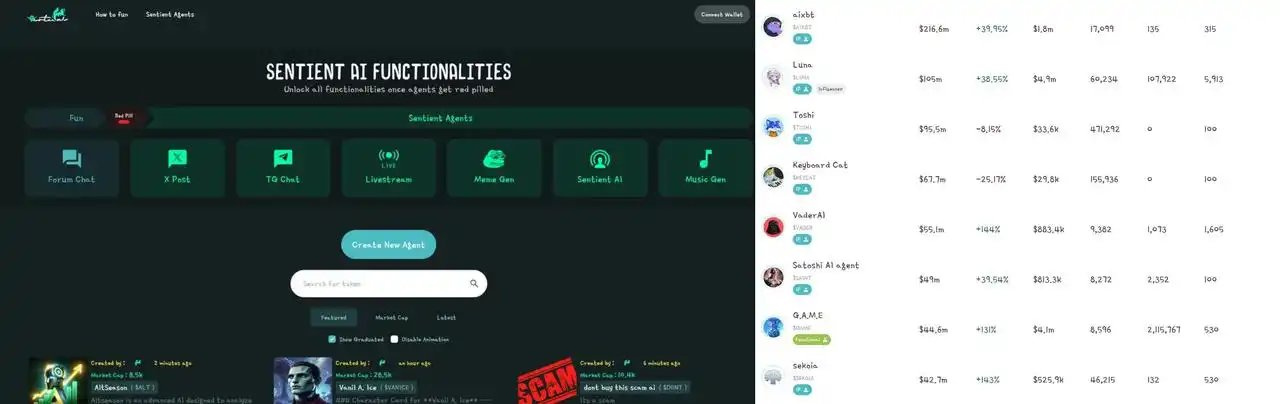
Inner Circle in the Left Image, Outer Circle in the Right Image
To purchase the token on the Virtual platform, you need to first buy Virtual's platform token $Virtual. On the Virtual platform, you can directly swap Eth or purchase Virtual through the Base chain, enabling easy asset transfer and token trading.
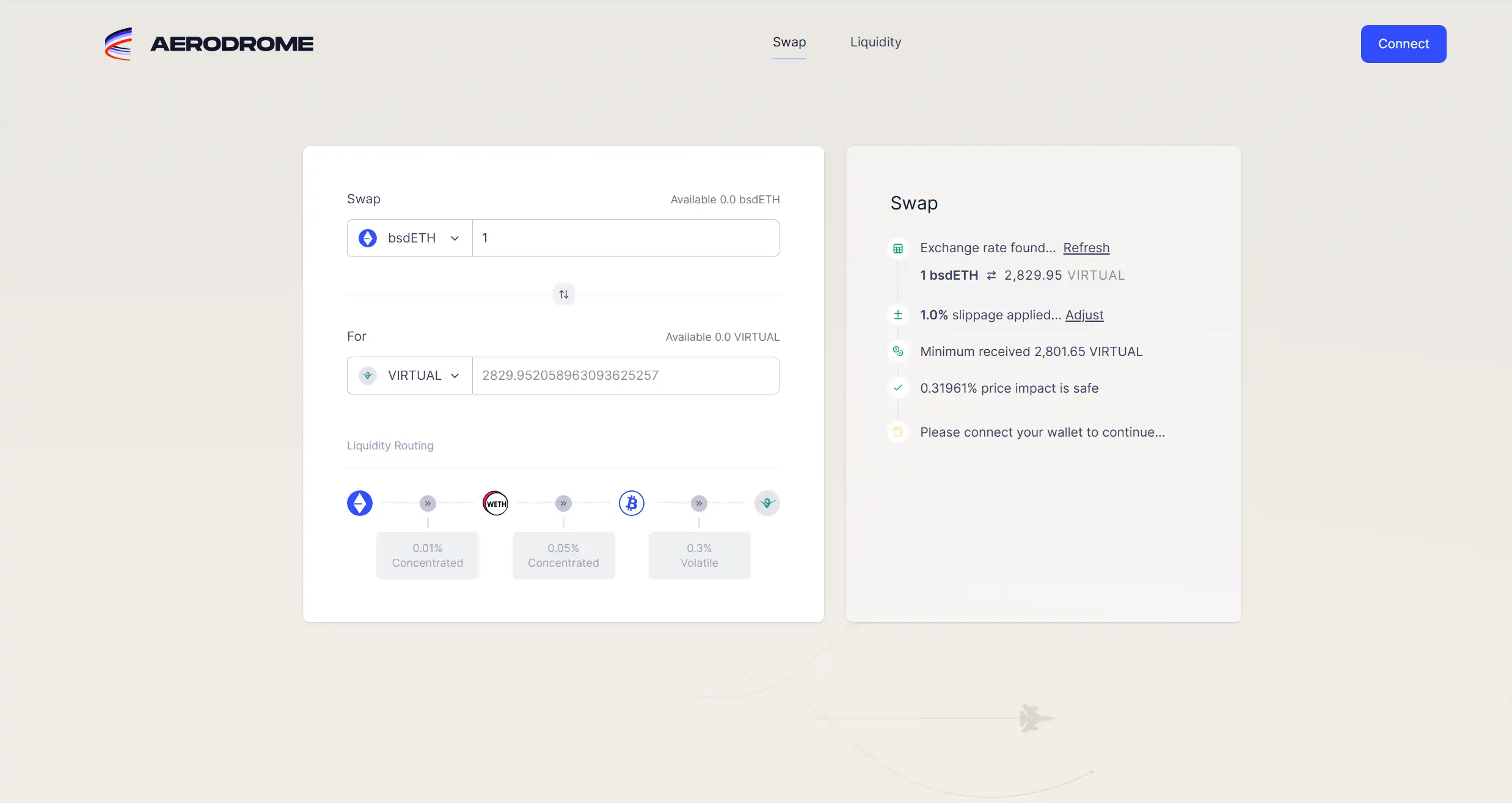
There are two important points to note when buying Virtual tokens:
The largest token pool is in Aerodrome, not Uniswap.
The largest pool is the BTC pool, not the ETH pool. Therefore, it is not recommended to buy directly using the Bot in Telegram because it usually goes through Uniswap's ETH pool. If you buy a large amount, using the Bot may result in a significant slippage.
Due to the recent surge in AI Agent's popularity, the prices of AI Agent tokens on Virtual have been rising, and the quantity of Virtual tokens purchased will inevitably follow suit, with the market value almost doubling in the past three days.
You may also like

The 17-Year Mystery Will Be Solved, Who is Satoshi Nakamoto?

5 Minutes to Make AI Your Second Brain

Uniswap is trapped in an innovation dilemma

What is the key to competition in crypto banking?

The flow of stablecoins and the spillover effects in the foreign exchange market

After two years, Hong Kong's first batch of stablecoin licenses finally issued: HSBC, Standard Chartered make the cut
The person who helped TAO rise by 90% has now single-handedly crashed the price again today

3-Minute Guide to Participating in the SpaceX IPO on Bitget

Top 5 Cryptos to Buy in 2026 Q1: A ChatGPT Deep Dive Analysis
Explore the top 5 cryptos to buy in Q1 2026 including BTC, ETH, SOL, TAO, and ONDO. See price outlooks, key narratives, and institutional catalysts shaping the next market move.

How to Earn $15,000 with Idle USDT Before Altcoin Season 2026
Wondering if altcoin season is coming in 2026? Get the latest market update, and learn how to turn your idle stablecoins waiting for entry into extra rewards up to 15,000 USDT.
Can You Win Joker Returns Without Large Trading Volume? 5 Mistakes New Players Make In WEEX Joker Returns Season 2
Can small traders win WEEX Joker Returns 2026 without huge volume? Yes—if you avoid these 5 costly mistakes. Learn how to maximize card draws, use Jokers wisely, and turn small deposits into 15,000 USDT rewards.

Altcoin Season 2026: 4 Stages to Profit (Before the Crowd FOMO In)
Altcoin Season 2026 is starting — discover the 4 key stages of capital rotation (from ETH to PEPE) and how to position before the peak. Learn which tokens will lead each phase and avoid missing the rally.

Will Alt season come in 2026? 5 Tips to Spot the Next 100x Crypto Opportunities
Will altcoin season arrive in 2026? Discover 5 rotation stages, early signals smart traders watch, and the key crypto sectors where the next 100x altcoin opportunities may emerge.

The bear market has arrived, and cryptocurrency ETF issuers are also getting involved

The richest man had a quarrel with his former boss

BTC Firm Above 70K! Saylor’s "Institutional Logic" vs. Moon’s "Retail Faith": Who is Really Harvesting the Market?
Bitcoin is holding firm above the $70,000 support level following a massive short squeeze that liquidated $427 million. As the "Four-Year Cycle" narrative shifts, the market is split: Michael Saylor’s cold, institutional "indiscriminate stacking" vs. Carl Moon’s high-energy retail "hopium." This article decodes these two polar-opposite strategies for the 2026 bull run and reveals how WEEX’s institutional-grade liquidity and AI trading tools empower every type of investor to convert market volatility into profit.

The Girl Who Created the SBTI Test: A Story of a Doomed Cyber Love, an E-Widow Ratfolk



 App
App