
Vitalik's Latest Speech: Ethereum L1 Scalability Essential, Serving Key Functions



Original Title: "Vitalik's Latest Speech Overview: Building Ethereum L1 as the Core of the 'World Computer'"
Original Author: KarenZ, Foresight News
On April 9, at the "2025 Hong Kong Web3 Carnival" ETHAsia 2025 event, Ethereum co-founder Vitalik Buterin delivered a keynote speech titled "The Future of Ethereum L1." The speech revolved around key topics such as scalability improvements to Ethereum L1, future plans and technical upgrades, the collaborative development of L1 and L2, and the impact of account abstraction on user experience.
Vitalik first analyzed the current state of Ethereum. Currently, L1's throughput is 15 transactions per second (15 TPS). The gas limit has recently been increased to 36 million, representing about a 6x increase over the past 10 years. Meanwhile, L2's throughput has reached around 250 TPS, showcasing significant scalability progress.
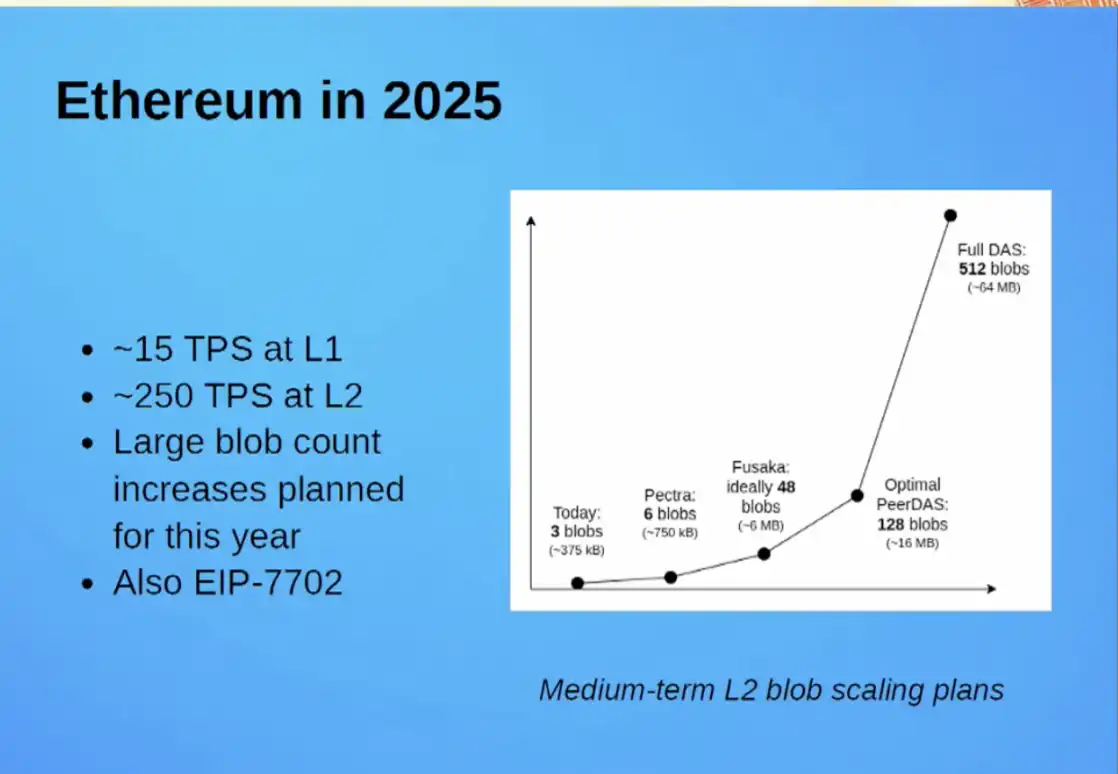
The upcoming Pectra upgrade will increase the Blob count from 3 to 6. Currently, 3 Blobs are approximately 375kb, generating 375kb of data every 12 seconds, roughly 20kb per second, corresponding to TPS of about 250; if the Blob count is increased to 6, TPS is expected to rise to 500. However, the expansion of Blob capacity largely depends on the Fusaka upgrade scheduled for the third or fourth quarter of this year. In an ideal scenario, the Fusaka upgrade could raise the Blob capacity to 48; if DAS is fully implemented, Blob capacity could reach 512, potentially allowing Ethereum L2's TPS to increase to tens of thousands.
Additionally, EIP-7702 has made significant progress, which is essentially the first step in abstracting accounts, giving accounts higher intelligence and security.
Of course, the extension of Ethereum L1 is equally crucial. Even if users widely adopt L2 in the future, L1 will still need to fulfill many key functions. Particularly when L2 experiences failures, L1 needs to provide corresponding remedies or support users in large-scale exit operations.
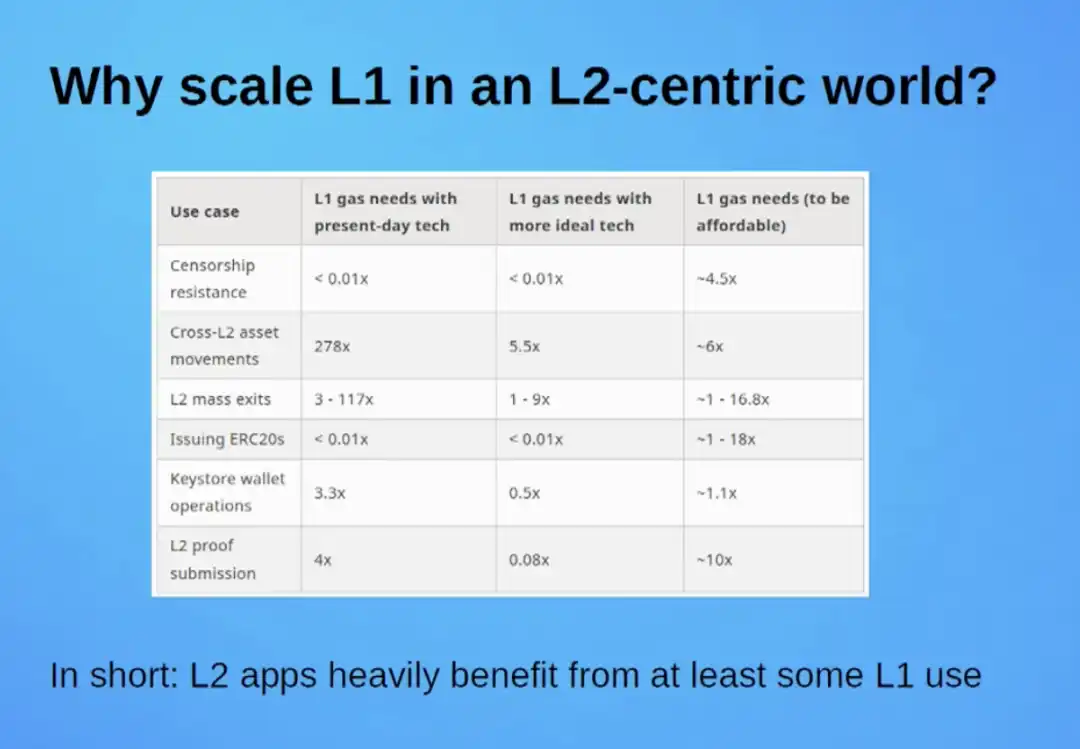
This means that despite the rapid development of L2, enhancing L1's scalability remains crucial to achieve censorship resistance and cross-L2 asset transfers. So, what changes will expanding L1 further bring?
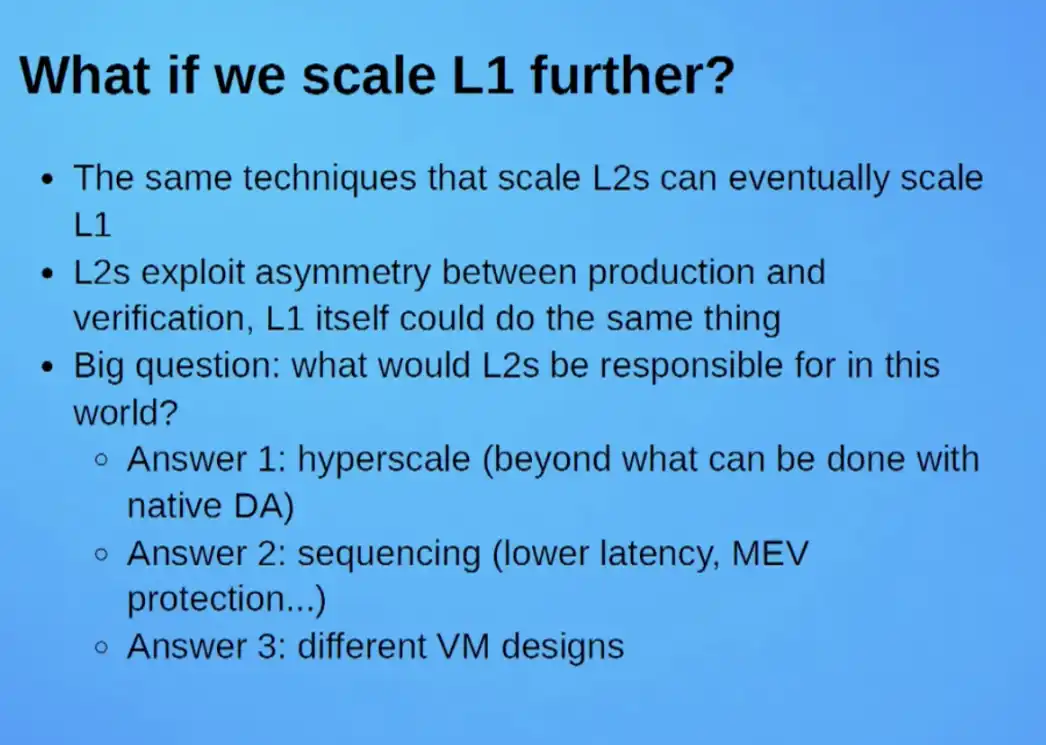
Extension technologies applied to L2 can also be used for L1 scalability in the future; L2 leverages the asymmetry between production and verification, a concept that L1 can also benefit from; in such a world, what responsibilities will L2 take on? 1. Hyperscale (beyond the level achievable by native DA); 2. Orderliness (lower latency, MEV protection, etc.); 3. Different virtual machine (VM) designs.
In other words, L1 can learn from L2's scaling solutions, while L2 continues to focus on processing transactions at hyperscale and experimenting with new technologies.
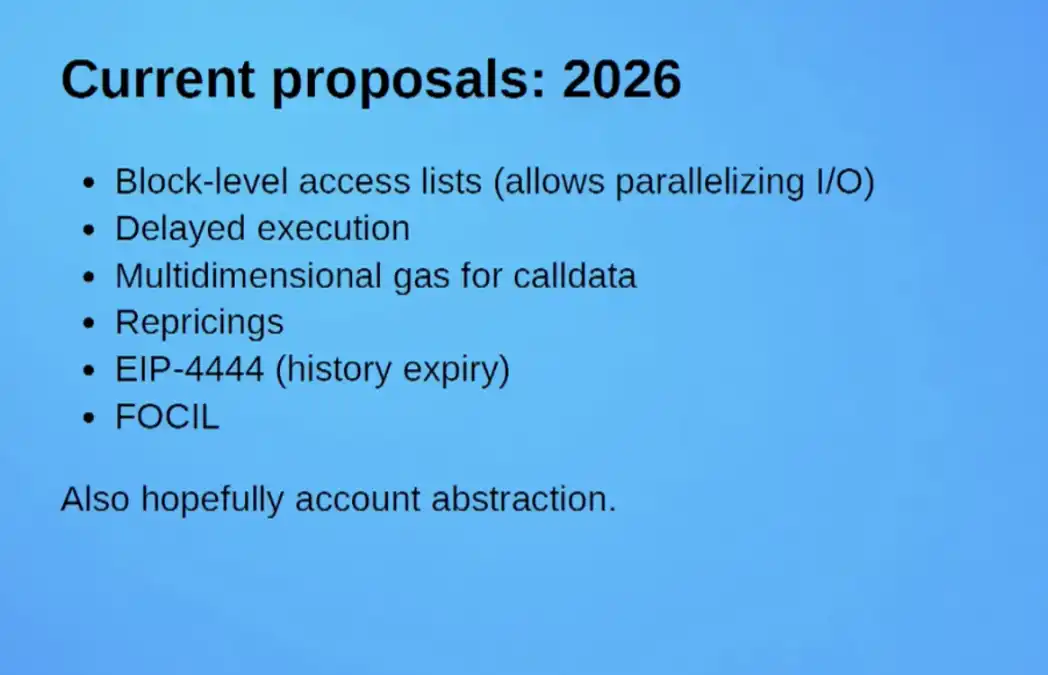
Vitalik expressed that in the short-term roadmap, a series of proposals are expected to be gradually implemented by 2026. Through these proposals, Ethereum is poised to significantly increase the Gas limit and achieve this goal securely while ensuring that node decentralization is not compromised.
Regarding the 2026 plan, some of the proposed initiatives include:
Block-level access lists (allowing I/O parallelization); delayed execution; multi-dimensional calldata Gas; repricing; EIP-4444 (historical data expiry): no longer requiring every Ethereum node to store Ethereum historical records, instead using a peer-to-peer network and distributing historical data in a more decentralized manner; FOCIL.
Vitalik also outlined numerous benefits that account abstraction can bring, including enhanced security and user experience; quantum attack resistance; Paymaster: allowing others to pay Gas fees for you or pay Gas fees with tokens other than ETH; support for smart contract wallets' native use; L1 lead, L1 follow.
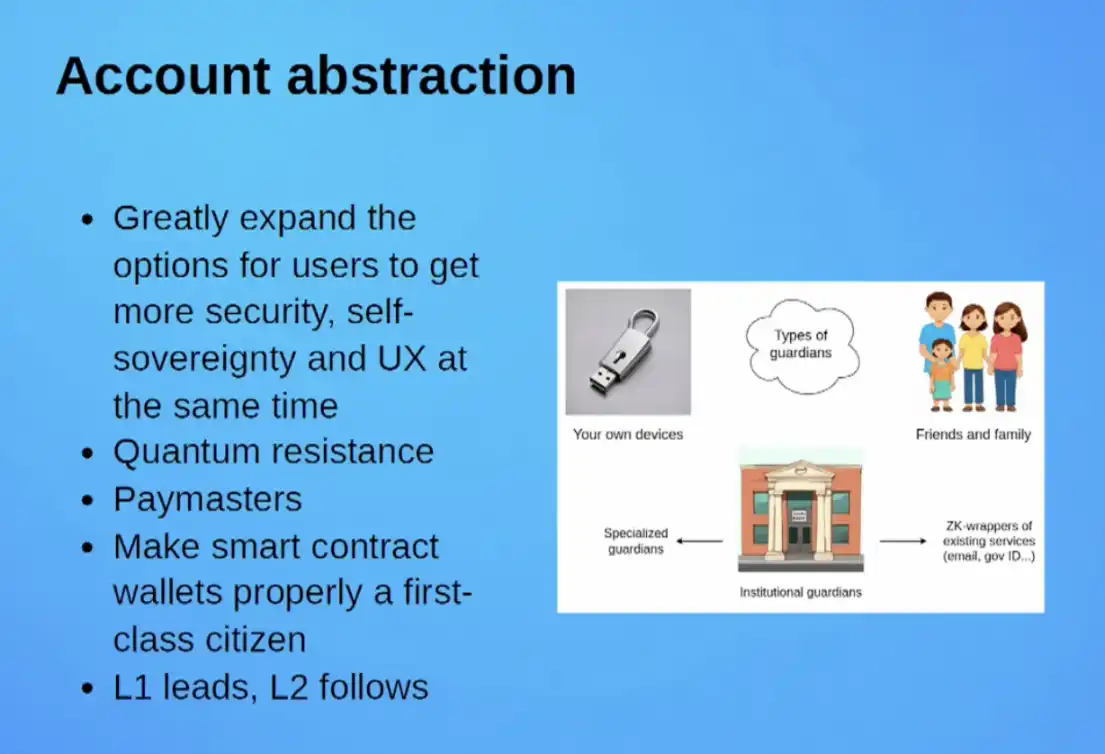
Furthermore, through technologies like Social Recovery and Guardians, Ethereum will provide more decentralized identity verification and asset control solutions.
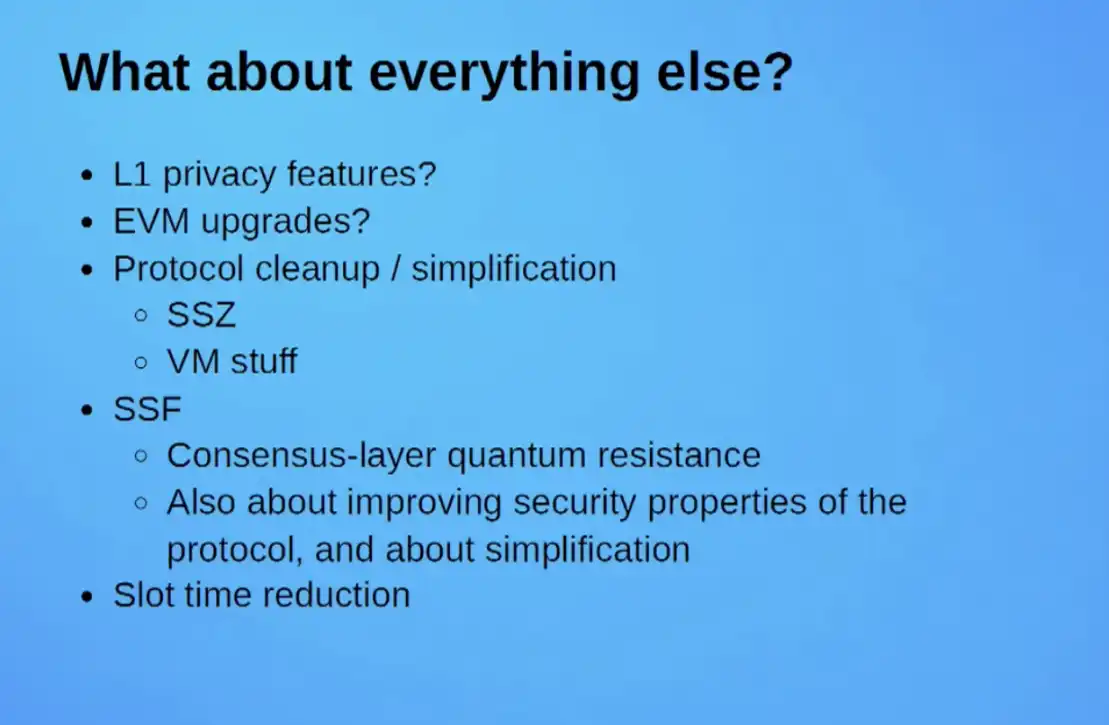
In other aspects, Ethereum is actively exploring L1 privacy enhancement, EVM upgrades, protocol cleanup/simplification, consensus layer quantum resistance improvement, protocol security properties and simplification optimizations, as well as Slot time reduction.
Overall, we need to improve L1, enhance L2, consider Ethereum's diversified development path, including AI-based approaches, improve the application layer, to truly drive the development of the Ethereum ecosystem. Ethereum is striving to be well-prepared for mainstream large-scale applications, with the ultimate goal of making Ethereum L1 the core of the "world computer," supporting a diverse range of applications with high security and efficiency.
You may also like

10 Counterintuitive Insights on Latin American Payments

Perp DEX: The Next Generation Exchange "War"

The AI gamble of mining companies: Valuations enter a phase of differentiation, and it's hard to turn the tide

A letter from Alliance to entrepreneurs: Written on the occasion of Cursor selling for 60 billion dollars

Stablecoins Finally Find Real Returns: On-Chain Reinsurance Re Explained | Interview with Re Founder Karan Saroya

The impossible triangle is simply a pseudo problem

Will MicroStrategy fall into a death spiral? What will the macro trend be in the second half of the year?

Blockchain Capital Partner: The Core Secret of Arbitrage
STRC unanchored by 11%, can the perpetual motion machine of Strategy still operate?

Bitcoin Market Analysis 2026: Can BTC Reach $150K by Year-End?
Bitcoin ETF Outflows Hit a Record $4.4 Billion: What Are Traders Doing With Their Cash?
WEEX App Just Got Smarter – New Tabs for Faster Trades & Easy Asset Management

WEEX All-New Search Features: Find, Trade & Earn Faster Than Ever

Morning Report | Illinois signs the strictest digital asset tax law in the U.S.; RWA tokenization market size surpasses $43 billion, institutions accelerate the migration of on-chain assets
Full version of the debut Q&A! Federal Reserve Chairman Waller: Sticking to the 2% inflation target, establishing five special working groups, individual did not submit the dot plot

From Disruptor to Shadow Market: The Crypto Market is Becoming a Colony of Traditional Finance
Dalio's important long article: How to position in the current market environment?
OKX Star analyzes Binance's competitive advantages: when regulation levels the playing field, competition has just begun
10 Counterintuitive Insights on Latin American Payments
Perp DEX: The Next Generation Exchange "War"
The AI gamble of mining companies: Valuations enter a phase of differentiation, and it's hard to turn the tide
A letter from Alliance to entrepreneurs: Written on the occasion of Cursor selling for 60 billion dollars
Stablecoins Finally Find Real Returns: On-Chain Reinsurance Re Explained | Interview with Re Founder Karan Saroya
The impossible triangle is simply a pseudo problem


