
What Is AI Trading in Crypto Markets and Why WEEX Alpha Awakens Matters in 2026

 Prefer us on Google



If you've been searching for "AI trading for passive income" or evaluating the "Best AI trading platforms 2026", your search ends here. WEEX Alpha Awakens isn't just another algorithmic competition—it's the world's first global AI Trading Hackathon set in a live-market environment, featuring a groundbreaking prize pool exceeding $1,880,000 and a Bentley Bentayga S for the ultimate champion.
In an era where artificial intelligence is transforming everything from data analysis to autonomous decision-making, WEEX Alpha Awakens stands as the definitive arena where code meets capital, strategy meets volatility, and innovators gain recognition on a global stage—a platform that could very well define the best AI trading platforms of 2026.
What is AI Trading — And Why Does It Matter Now?
AI trading refers to the use of artificial intelligence and machine learning models to analyze market data, identify patterns, and execute trades with precision and speed far beyond human capability. By processing vast amounts of historical and real-time data—including price movements, news sentiment, on-chain activity, and macroeconomic indicators—AI trading systems can:
- Remove emotional bias from trading decisions
- Execute complex strategies across multiple markets simultaneously
- Adapt to changing market conditions in real time
- Identify subtle inefficiencies and opportunities invisible to manual traders
- Generate reliable AI trading signals for both active and passive strategies
While many platforms offer AI-powered tools or backtesting environments, few provide what truly matters: a live, liquid, and competitive arena where algorithms face real-world stakes. For those interested in crypto AI trading specifically, this competition offers direct exposure to digital asset markets where AI strategies are proving increasingly dominant.
That’s exactly what WEEX Alpha Awakens delivers.
WEEX Alpha Awakens: Not a Simulation, But a Live Trading Revolution
WEEX Alpha Awakens is more than a competition—it's a global gathering of quants, developers, data scientists, and trading innovators, all competing in a structured yet open environment where every trade happens in real markets with real volatility.
Here’s what sets it apart:
Unprecedented Incentives
- Total Prize Pool: Over $1,880,000 in rewards
- Grand Prize: Bentley Bentayga S for the champion
- Global Exposure: Winners gain recognition from institutional investors, VCs, and leading crypto platforms
Live-Market Validation
Unlike theoretical or sandboxed competitions, WEEX Alpha Awakens tests strategies under actual market conditions. Participants’ AI models trade in real time within a controlled yet dynamic environment, ensuring that winning strategies are not just academically sound, but practically executable—exactly what distinguishes the best AI trading platforms 2026 will need to offer.
A Platform for Storytelling & Influence
For influencers, KOLs, and content creators, the competition provides a rich narrative of human vs. machine, strategy vs. luck, and innovation vs. convention. Each phase—from model submission to live leaderboard updates—becomes engaging content for audiences fascinated by the future of finance, particularly those exploring AI trading for passive income and automated wealth generation.
Who Joined WEEX Alpha Awakens?
- AI & ML Developers with models designed for financial markets
- Quantitative Traders looking to automate and optimize strategies
- Data Scientists interested in real-world fintech applications
- Crypto Innovators building the next generation of crypto AI trading tools
- Students & Researchers in finance, computer science, or AI
- Trading Teams & Funds seeking visibility and performance validation
No matter your background—if you have a vision for smarter, faster, and more adaptive trading, this is your platform to showcase what could become the foundation for the best AI trading platforms of 2026.
-- Price
Live Competition Watch
In AI Wars, time is not simply a constraint — it is a strategic variable.
With Forked Entry now underway, the competition has entered its late-stage phase, where AI trading strategies are tested in real markets and performance differences begin to surface.
In parallel with the live competition, WEEX has launched a match viewing activity, inviting users to follow the Forked Entry battles, engage with live updates, and participate in ongoing discussions around strategy performance and rankings.
Follow the live competition and join the activity: https://x.com/WEEX_Official/status/2013231517007503431
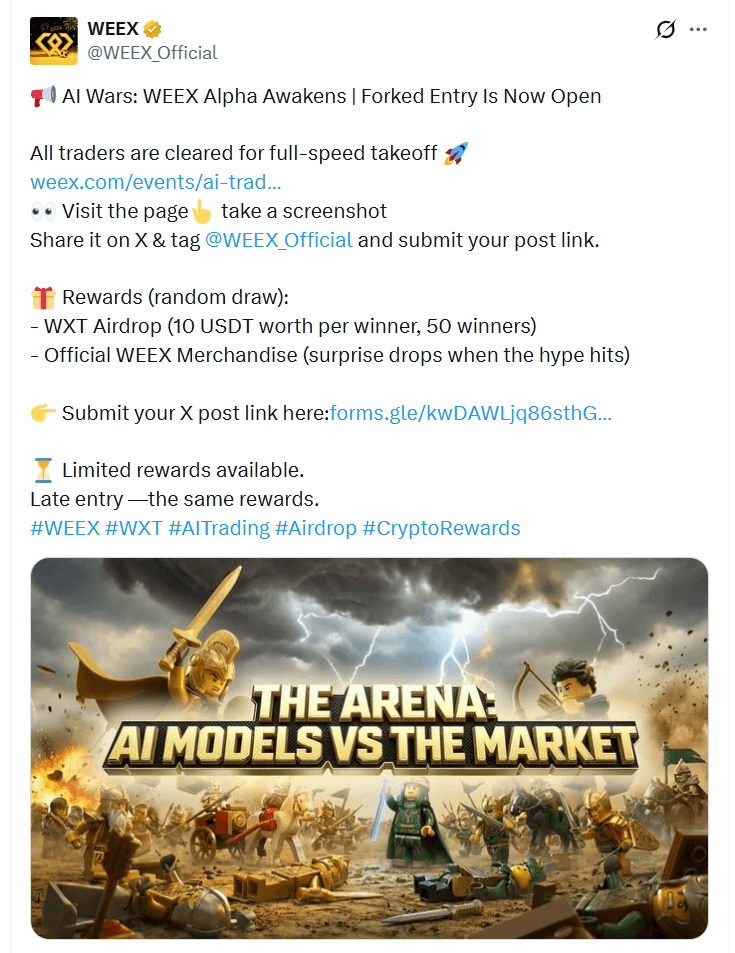
Only strategies proven by the market will move forward.
Why WEEX Alpha Awakens Is the Best AI Trading Competition of 2026?
| Feature | WEEX Alpha Awakens | Typical AI/Quant Competitions |
| Trading Environment | Live markets, real volatility | Sandboxed or historical data only |
| Prize Value | $1,880,000 + Bentley | Usually cash-only, lower amounts |
| Judging Criteria | Real P&L, adaptability, execution | Theoretical returns, backtest results |
| Industry Recognition | Global media, institutional partners | Limited visibility |
| Platform Integration | WEEX exchange liquidity & infrastructure | Standalone simulation |
The Broader Impact: Where AI Meets the Future of Finance
WEEX Alpha Awakens isn’t just a hackathon—it’s a catalyst. By bridging cutting-edge AI research with real-world trading infrastructure, WEEX is fostering:
- Smarter Markets: More efficient, liquid, and adaptive trading ecosystems
- Innovation Acceleration: Shortening the path from theoretical model to live execution
- Talent Discovery: Connecting brilliant developers with funds, investors, and platforms
- Industry Collaboration: Bringing together exchanges, academic institutions, and tech innovators
For the crypto and quantitative finance industry, this marks a turning point—where AI transitions from a tool to a core component of market structure, and where events like this shape what will be considered the best AI trading platforms 2026.
FAQ
Q1: What assets/markets will be traded?
A: The competition will focus on major crypto assets with deep liquidity, ensuring fair and efficient price discovery for all algorithms—an ideal testing ground for AI trading signals in digital assets.
Q2: How is fairness ensured?
A: All participants trade under the same market conditions with transparent, real-time leaderboards. The API environment is standardized and monitored.
Q3: Can this lead to passive income opportunities?
A: Yes. Successful strategies developed here could form the basis for AI trading for passive income products, automated funds, or signal services—showcasing how competitive innovation translates to real-world financial solutions.
About WEEX
Founded in 2018, WEEX has developed into a global crypto exchange with over 6.2 million users across more than 150 countries. The platform emphasizes security, liquidity, and usability, providing over 1,200 spot trading pairs and offering up to 400x leverage in crypto futures trading. In addition to traditional spot and derivatives markets, WEEX is expanding rapidly in the AI era — delivering real-time AI news, empowering users with AI trading tools, and exploring innovative trade-to-earn models that make intelligent trading more accessible to everyone. Its 1,000 BTC Protection Fund further strengthens asset safety and transparency, while features such as copy trading and advanced trading tools allow users to follow professional traders and experience a more efficient, intelligent trading journey.
Follow WEEX on social media
Instagram: @WEEX Exchange
TikTok: @weex_global
YouTube: @WEEX_Global
Discord: WEEX Community
Telegram: WeexGlobal Group
This content is provided for general informational purposes only and doesn't constitute financial, investment, legal, or tax advice. Any events, rewards, online promotions, or related information mentioned herein should not be considered a recommendation, solicitation, or invitation to purchase, sell, trade, or otherwise deal in any crypto assets. Crypto assets are highly volatile and may result in loss. The availability of WEEX services, products, and related events may vary by region. You are responsible for ensuring that your participation is in accordance with applicable local laws and regulations.
You may also like

The euro stablecoin's retail VASP transaction volume increased 12 times to $777 million over 15 months
The Federal Reserve is seeking feedback on the "streamlined master account" framework, proposing to allow cryptocurrency companies to access its payment system
Y Combinator launches the YC Crypto Deals program, with participation from the Solana Foundation and others

Futures Trading Hours Explained: How Smart Traders Cut Futures Fees and Earn More Cryptocurrency in 2026

BNKR’s Recent Surge Marks New Heights in Cryptocurrency Market
Key Takeaways BNKR Token Peak: BNKR reached an all-time high of $0.0011 on July 31, 2025. Significant Market…

Beast Industries Acquires Step – Expanding Fintech Horizons
Key Takeaways Beast Industries, led by YouTube celeb MrBeast, has acquired the teen-focused fintech banking app Step, aiming…
SlowMist’s Latest Alert: A Deep Dive into LiteLLM’s Data Breach
Key Takeaways SlowMist identifies a major breach in the LiteLLM library, with approximately 300GB of sensitive data compromised.…

Steakhouse Financial Experiences Phishing Attack: A Comprehensive Overview
Key Takeaways Steakhouse Financial’s domain experienced a phishing attack, prompting user safety advisories. Depositors’ funds and smart contracts…
FTX/Alameda Wallet Transfers Over $8 Million in ZRO Tokens to Wintermute
Key Takeaways An FTX/Alameda-associated wallet moved 4.126 million ZRO tokens to market maker Wintermute, with an approximate value…

Analysis of Recent Ethereum Short Position Activity on HyperLiquid
Key Takeaways Recently, a newly created wallet deposited $4.89 million into HyperLiquid, opening a short ETH position with…

Upbit and Bithumb Designate DRIFT as a Trading Alert Item
Key Takeaways Upbit and Bithumb have labeled DRIFT as a “trading alert” asset following guidance from the Digital…
“Brother Maji” Faces Potential Liquidation with ETH Long Position
Key Takeaways “Brother Maji” currently holds a substantial 25x leveraged long position of 6,000 ETH. The position was…
Binance’s Strategic Delisting of Trading Pairs Enhances Market Health
Key Takeaways Binance has decided to remove 23 spot trading pairs, focusing on those with low liquidity and…
Renew the Spirit, Reveal the Worth: Insights on U.S. Economic Trends
Key Takeaways U.S. Treasury Secretary Scott Bessent confirms the Federal Reserve plans to eventually lower interest rates. Current…

Hackers in Brazil Use Fake Google Play Store to Steal Cryptocurrency
Key Takeaways Hackers in Brazil are exploiting fake Google Play Store pages to spread Android malware. Infected devices…

Binance to Delist Key Spot Trading Pairs: What You Need to Know
Key Takeaways Binance is set to remove several spot trading pairs on March 27, 2026, at 11:00 AM…
Dragonfly Receives $55.8 Million Worth of LIT Tokens, Locked Until December 2026
Key Takeaways Dragonfly has acquired 55.8 million LIT tokens from Lighter, according to Arkham. The tokens are valued…
Circle and Tether Freeze Iranian Exchange Wallex Wallet with $2.49M Assets on Hold
Key Takeaways Circle and Tether have frozen a significant amount of assets from an Iranian exchange called Wallex,…
Binance to Delist 10 Spot Pairs Including ARB/EUR
Key Takeaways Binance has announced the delisting of 10 spot trading pairs. The affected pairs include ARB/EUR, BANANA/FDUSD,…

SpaceX Stock Prediction: Hitting $1,200 at 2026 IPO?
Key Takeaways Elon Musk confirms SpaceX is advancing its IPO plans, with expected filing as early as weeks…

OpenClaw 3.28 Update: Potential Security Risks with Axios
Key Takeaways Recent findings suggest OpenClaw version 3.28 may contain a compromised version of the Axios library. Dependency…
Massive Whale Movement: Unstaking $84.96 Million in HYPE Tokens
Key Takeaways A crypto whale, known as TechnoRevenant, has unstaked approximately $84.96 million in HYPE tokens. The tokens…

Security Risks of Fake Ledger Nano S+ Devices Emerging Through Chinese E-Commerce
Key Takeaways Counterfeit Ledger Nano S+ devices are being sold on Chinese e-commerce platforms, posing significant risks to…

How Crypto Futures Markets Are Fueling ‘Scam Coin’ Insider Schemes
Key Takeaways: RAVE’s market cap skyrocketed to $6.7 billion before plummeting by 95% due to insider control and…

SEC’s “Innovation Exemption” Sets New Rails for Tokenized Securities
Key Takeaways: SEC Chair Paul Atkins introduces an “innovation exemption” to regulate tokenized securities. A five-category token framework…

Ripple Sets 2028 Deadline for Quantum-Ready XRPL
Key Takeaways: Ripple commits to a 2028 deadline for XRPL’s quantum-readiness, focusing on quantum-resistant cryptographic systems. Google’s research…
Breaking: Crypto Investor Tim Cook Steps Down as Apple CEO
Key Takeaways: Tim Cook will transition from CEO to Executive Chairman on September 1, 2026. John Ternus, a…
UK Fintech Stratiphy Reopens Tax-Free Crypto ETNs Through IF ISAs
Key Takeaways: Stratiphy now offers UK investors tax-free crypto ETNs via Innovative Finance (IF) ISAs. Recent policies restrict…

Stratiphy Reopens Tax-Free Crypto ETNs for UK Investors
Key Takeaways: Stratiphy reintroduces tax-free access to crypto ETNs in the UK, reversing limitations imposed by HMRC’s ISA…
Uzbekistan Launches Tax-Free Crypto Mining Zone in Karakalpakstan
Key Takeaways: Uzbekistan has initiated the “Besqala Mining Valley” in Karakalpakstan, offering a supervised zone for crypto mining…
The euro stablecoin's retail VASP transaction volume increased 12 times to $777 million over 15 months
The Federal Reserve is seeking feedback on the "streamlined master account" framework, proposing to allow cryptocurrency companies to access its payment system
Y Combinator launches the YC Crypto Deals program, with participation from the Solana Foundation and others
Futures Trading Hours Explained: How Smart Traders Cut Futures Fees and Earn More Cryptocurrency in 2026
BNKR’s Recent Surge Marks New Heights in Cryptocurrency Market
Key Takeaways BNKR Token Peak: BNKR reached an all-time high of $0.0011 on July 31, 2025. Significant Market…
Beast Industries Acquires Step – Expanding Fintech Horizons
Key Takeaways Beast Industries, led by YouTube celeb MrBeast, has acquired the teen-focused fintech banking app Step, aiming…

Contents
Latest articles


Latest coin listings on WEEX


