
WLFI Holdings Token Analysis: Did the Trump Family's Crypto Investment Pay Off?



Original Title: Trump's WLFI crypto investments aren't paying off
Original Author: Aaron Wood, CoinTelegraph
Original Translation: Deng Tong, Golden Finance
World Liberty Financial (WLFI), a cryptocurrency company associated with the family of U.S. President Donald Trump, made a sensational debut at the end of last year. WLFI made waves with its launch just before the presidential inauguration. Observers accused the project of insider knowledge of White House cryptocurrency summits and other key cryptocurrency events, leading to allegations of conflicts of interest.
Trump finds himself in a unique position to influence the outcome of his investments, but WLFI has also not been immune to broader market trends, experiencing price declines amid major macroeconomic concerns. The Trump administration is about to reach its first hundred days in office. Here is the latest on WLFI and how the President's cryptocurrency investments have been impacted.
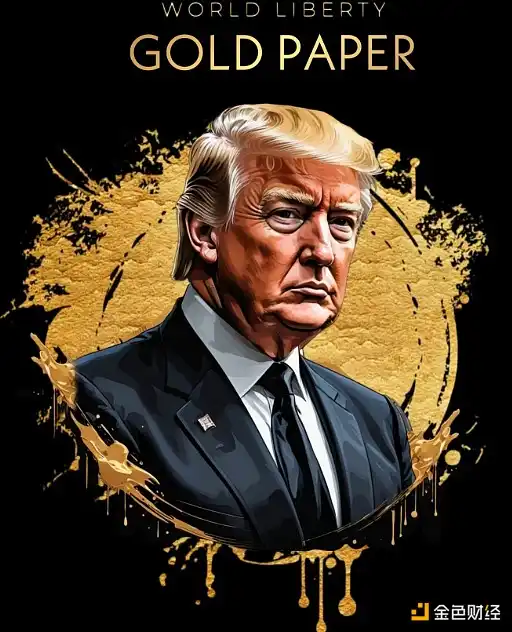
WLFI's "gold paper" featuring a praising image of Trump. Source: WLFI
Trump's Crypto Investment WLFI: Founders and Ownership
WLFI was established on September 16 last year when then-President-elect Donald Trump announced his foray into X. The company was founded under the guidance of real estate tycoon Steve Witkoff and his son Zach, with co-founders including cryptocurrency investor and self-proclaimed "Internet jerk" Chase Herro, as well as social media influencer and former pickup artist Zak Folkman.
The Trump family also holds a prominent position. President Trump is listed as the "Chief Cryptocurrency Advocate," while his sons Eric, Don Jr., and Barron serve as "Web3 Ambassadors."
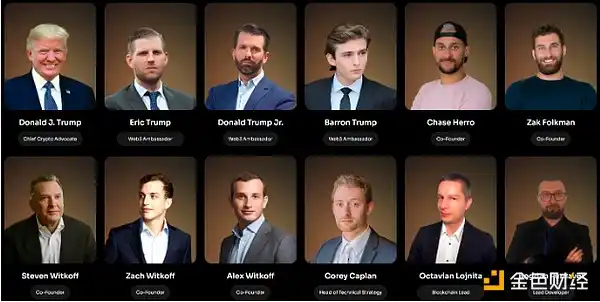
WLFI's leadership team. Source: WLFI
WLFI Token Sale
One of World Liberty Financial's initial moves was to sell its own token. The initial token sale started on October 15, 2024, offering 200 billion WLFI $WLFI tokens at a price of $0.015, which earned the company approximately $3 billion.
On January 20, 2025, the day of Trump's inauguration, WLFI announced its second token sale citing "huge demand and strong interest." The company issued 50 billion tokens at a price of $0.05, a 230% increase from the first sale price. The second sale was completed on March 14, nearly two months later, reaching the full target of $2.5 billion.
According to the project's "gold paper," WLFI tokens will grant holders voting rights on significant protocol matters (e.g., upgrades). The expected token allocation is as follows:
· 35% through token sales,
· 32.5% for incentives and community development,
· 30% for "initial supporters" allocation,
· "Core team and advisors" hold 2.5%.
In summary, WLFI achieved a $550 million token sale revenue. $WLFI is intended for eligible investors' use only and, per terms and conditions, cannot be transferred or traded on a trading platform. The token's listing date has not been announced yet.
WLFI's Investment Portfolio
Aside from token sales, WLFI also acts as a crypto fund, accumulating various tokens over the past few months. Specifically:
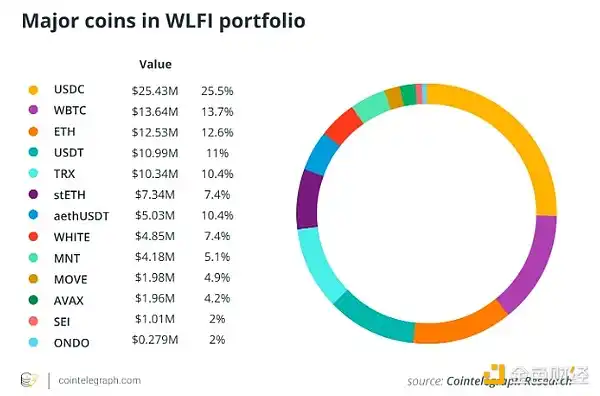
WLFI's portfolio includes a variety of assets, with 13 assets holding the largest share as of the time of writing. Most of its holdings are in the US dollar-backed stablecoin USDC, followed by Wrapped Bitcoin (BTC) and Ether (ETH).
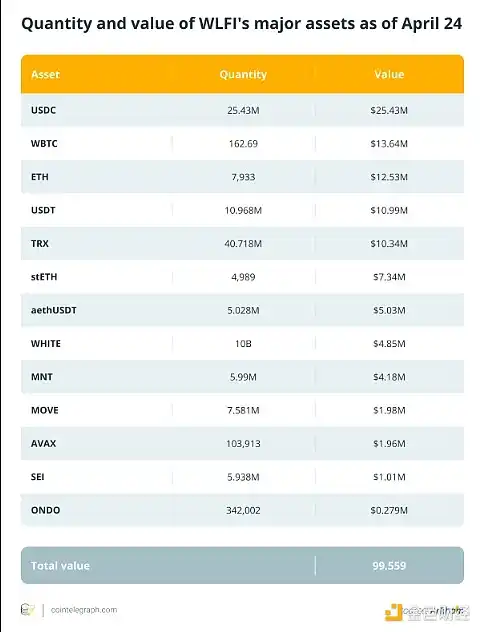
Reportedly, ARKHAM stated that the top 13 assets make up almost $100 million of the company's $103 million investment portfolio. The remaining value is composed of dozens of other tokens, some of which are small tokens worth less than $100,000 collectively.
WLFI holds $5 million worth of Aave Ethereum USDC (aethUSDC), indicating their provision of USDC to Aave's liquidity pool. WLFI's investment portfolio comprises eight cryptocurrencies that are purchased (not received through airdrops) non-stablecoin assets.
· Wrapped BTC (WBTC)
· Mantle (MNT)
· Movement (MOVE)
· Sei (SEI)
· Avalanche (AVAX)
· Tron (TRX)
· Ondo (ONDO)
· Ether (ETH)
Overall, WLFI's holdings of WBTC, SEI, and AVAX have been the most successful. The first WBTC purchase occurred on December 18, when WLFI exchanged 103 WBTC for 103 cbBTC. Nearly a month later, WLFI swapped all assets for ETH. The fund once again started accumulating WBTC, primarily using USDT, and sent it to Coinbase Prime in early February.
On March 15, WLFI made a lump sum purchase of AVAX and made three separate purchases of SEI in February, March, and April, totaling nearly $6 million.
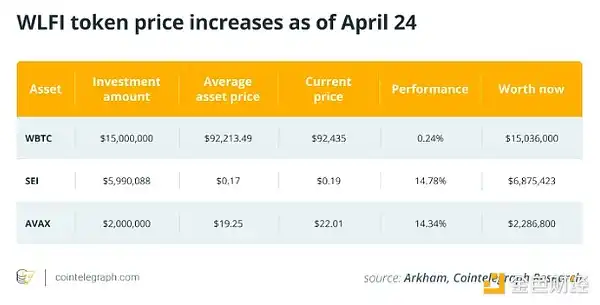
Other performances haven't been as favorable. As of April 24, major investments in MNT, MOVE, ONDO, and ETH have all suffered double-digit losses. MOVE was hit particularly hard, with WLFI's total investment value dropping over 50%, resulting in a loss of around $2,100,000.
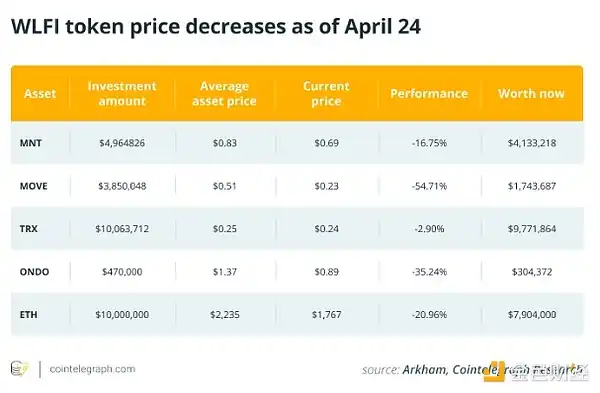
Considering the average purchase price of WLFI's tokens and the current prices of its assets, the investment is averaging a loss of $4,280,000. It's worth noting that WLFI also deposited several early token purchases into Coinbase Prime in December and January.
Well before the main action began, the WLFI wallet slowly accumulated ETH. Starting in late November, WLFI acquired large sums of funds worth over $1 million every few days until December 21. Then, on January 14, it transferred all the acquired ETH (including 3,700 ETH deposited in October) to Coinbase Prime.
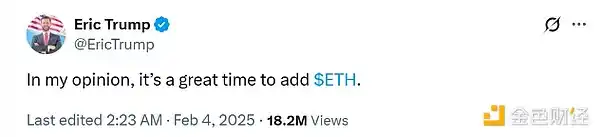
Between January 19 and January 21, it bought nearly 57,000 ETH and continued these purchases until February 3, when most of the ETH was moved to Coinbase Prime. Interestingly, Eric Trump was promoting Ethereum on X at the time.
Conflict of Interest and Stablecoin
WLFI transferring tokens to a cryptocurrency exchange as well as Eric Trump's post at a peculiar time has raised questions about the Trump family's ability to influence the tokens they hold. At the end of March, a group of senators from the Banking Committee wrote an open letter urging regulators to consider WLFI's potential conflict of interest, especially regarding the project's stablecoin USD1.
According to CoinMarketCap, USD1 was launched in early March and, at the time of writing, is already trading on centralized exchanges Kinesis Money and ChangeNOW. Senators are concerned that Trump is uniquely positioned to influence and benefit his own stablecoin project, especially as Congress is about to consider a stablecoin regulatory framework bill.
After Trump announced tariffs on "Liberation Day," causing a market crash, the president posted on the right-wing social media platform Truth Social, stating, "Now is a good time to buy!!" This further fueled concerns about insider trading and market manipulation.
Despite these concerns, the Trump administration's ties to cryptocurrency are strengthening. His administration has dismissed several high-profile enforcement cases against cryptocurrency companies, and his congressional allies are drafting industry-friendly legislation. Cryptocurrency companies seem confident in the project. On April 16, cryptocurrency market maker DWF Labs announced a $25 million investment in WLFI and agreed to provide $150 million in liquidity.
You may also like

Morning News | The draft amendment to the People's Bank of China Law aims to clarify the legal status of digital renminbi; South Korea will transfer about 40 unregistered virtual asset service providers to law enforcement agencies

Interpreting the Ethereum Foundation's new structure: Reaffirming self-sovereignty amid institutional trends

Interview with NDV Founder Jason Huang: Popping the AI Bubble and the Myth of Microstrategy, Seeking the Ultimate Ace in the Crypto Market
Morning Report | Former Ethereum Foundation researcher establishes Ethlabs; EU Parliament Economic Committee passes digital euro regulatory proposal

Dragonfly partner Haseeb: The fastest-growing companies in the future may all be stuck at 149 people

How xBubble Breaks the Deadlock in VC's Heavy Investment in the OPC Economy

The encrypted unicorn Blockstream is deeply embroiled in a serious fraud case

Morning Report | The South Korean Financial Services Commission plans to expand the regulatory sandbox to include virtual assets; the parent company of the New York Stock Exchange, ICE, has reached a partnership with OKX to jointly establish a cryptocu...

Exclusive Interview with Strategy CEO: Putting Aside the Sale of 32 BTC, the 60 Trillion AI Intelligence is the Ultimate Fate of Bitcoin

TRON revitalizes the image of the bull, creating a more approachable brand character

Will the STRC issuance price discussed with ChatGPT really fall into a death spiral?

The foundation retreats, Ethlabs steps forward: Ethereum welcomes its largest restructuring in history

NYSE Parent ICE and OKX Launch Joint Venture: What It Means for Tokenized Stocks
ICE and OKX have announced a joint venture focused on tokenized stocks, but stock futures are already live across crypto markets. Here's what the partnership means, how stock futures work, and why traders are paying attention.

How to Trade Apple and Nvidia on a Crypto Exchange in 2026 (Without Buying Shares)
Morning Report | Secret Network loses $4.67 million due to cross-chain vulnerability; Michael Saylor releases Bitcoin Tracker information again, may disclose increased holdings data next week
Kalshi's biggest competitor is not Polymarket

The second half of the computing power battle: Intel CEO Pat Gelsinger reveals how AI is reshaping the global semiconductor supply chain
B.AI partners with MiniMax to launch a limited-time free experience of M3, enabling zero-threshold implementation of Agentic productivity through full-stack infrastructure
Morning News | The draft amendment to the People's Bank of China Law aims to clarify the legal status of digital renminbi; South Korea will transfer about 40 unregistered virtual asset service providers to law enforcement agencies
Interpreting the Ethereum Foundation's new structure: Reaffirming self-sovereignty amid institutional trends
Interview with NDV Founder Jason Huang: Popping the AI Bubble and the Myth of Microstrategy, Seeking the Ultimate Ace in the Crypto Market
Morning Report | Former Ethereum Foundation researcher establishes Ethlabs; EU Parliament Economic Committee passes digital euro regulatory proposal
Dragonfly partner Haseeb: The fastest-growing companies in the future may all be stuck at 149 people
How xBubble Breaks the Deadlock in VC's Heavy Investment in the OPC Economy


