
WSJ Reveals: A Silicon Valley-Clad Startup Has Become Venezuela's Crypto Hub

Original Article Title: How a Silicon Valley Startup Became a Crypto Lifeline for Venezuela
Original Article Author: Ben Foldy, The Wall Street Journal
Original Article Translation: Luffy, Foresight News
The founder of the financial technology startup Kontigo enthusiastically embraced Silicon Valley's playbook: moving the company into a San Francisco residential building, hosting hackathons suitable for viral TikTok spreads, using buzzwords in pitches claiming to build the "New Bank of Latin America," and even making grandiose statements about pioneering the Martian economy.
This approach allowed this small-scale, flamboyant crypto startup to successfully join the top-tier Y Combinator accelerator and raise over $20 million in funding in December last year from well-known Silicon Valley investors like Coinbase Ventures.
However, recent U.S. military actions in Venezuela have thrust Kontigo's business's highly contentious side into the spotlight: it has become a critical channel for funds in and out of Venezuela's heavily sanctioned economy.
Now, Kontigo is facing disruptions in banking and payment network services, including JPMorgan Chase, Stripe, and Bridge, while also dealing with undisclosed allegations of ties to the ousted Maduro regime, which Kontigo denies.
A Kontigo spokesperson declined to answer questions about business details but stated in a release that the company is reviewing its operational model.
"Kontigo is committed to expanding financial access to underserved populations," the spokesperson said. "We are conducting an internal review and will provide updates at the appropriate time. We abide by U.S. laws, including regulations related to U.S. sanctions, and are evaluating existing sanctions compliance processes and mechanisms to improve them if necessary."
Founded in 2023 by Venezuelan Jesus Castillo, Kontigo positioned himself as a "David" about to defeat mainstream banking giants. The company claims its 1.2 million users in Latin and South America have processed over $1 billion in funds through the platform. The app allows users to convert fiat currency into a U.S. dollar-pegged stablecoin to facilitate payments and access the traditional banking system.
Outside of Venezuela, the image the company portrays to investors is that of a platform helping the average Latin American facing hyperinflation. But within Venezuela, it has become a workaround for U.S. sanctions, which aim to sever key sectors of the Maduro regime from the international financial system.
According to a presentation slide shown at an invitation-only partner introduction event in Caracas last December, an economist invited by Kontigo explained how the company's technology helps the Maduro regime evade U.S. sanctions on the country's oil exports and repatriate oil sales revenue back into the domestic economy in cryptocurrency form.
With sanctions cutting off Venezuela's traditional financial channels, the government has increasingly relied on stablecoins for oil sales. The economist showcased at the event that in the second half of last year, nearly 80% of the country's oil revenue was received in stablecoin form. These funds were then exchanged into bolivars through banks, informal exchange desks, and government-authorized crypto trading platforms like Kontigo.
One slide read: "Crypto Market to the Rescue."
For months, Kontigo facilitated transfers between users' accounts at JPMorgan Chase, most of which were subject to sanction prohibitions, through intermediary channels.
At the end of last year, JPMorgan Chase suddenly took steps to cut off these channels. Sources revealed that Stripe, which had processed payments and transactions for Kontigo, has also terminated its cooperation with the company.
Sources stated that when Kontigo reached an agreement with another U.S. financial institution, company executives informed them that they had no actual operations within Venezuela. The recent partner has taken steps to terminate its relationship with Kontigo.

Amid U.S. Sanctions, Venezuela Turns to Stablecoins for Oil Sales
Domestically in the U.S.: A High-Profile Startup
Castillo co-founded Kontigo with the aim of using blockchain technology to address Venezuela's daily financial woes, where hyperinflation and lack of credit make it difficult for people to preserve their savings. The platform allows users to convert bolivars into a USD-pegged, more stable cryptocurrency.
To U.S. investors, Castillo packaged his startup as a group of immigrant dreamers working hard, early investors said they were drawn to this vision of helping those truly in need.
In promotional materials, the company referred to Castillo and colleagues taking turns driving for Uber to make ends meet while building the company, with a focus on creating a financial system adapted to the "multi-planetary abundance era" to avoid "exporting Earth's monetary and economic failures to Mars."
In mid-2025, according to a promotional video released on LinkedIn, Kontigo began offering users a JPMorgan Chase-sponsored free "virtual" U.S. bank account. Sources familiar with the matter stated that these accounts were provided through another fintech startup called Checkbook, and JPMorgan Chase had no direct banking relationship with Kontigo. Nevertheless, Kontigo still used the Chase bank brand logo in its advertising.
In December of last year, just weeks before the attempted U.S. invasion to overthrow the Maduro regime, Kontigo announced that it had secured a $20 million funding round, with investors including Coinbase Ventures, Alumni Ventures, and DST Capital. Coinbase, Alumni, and DST did not respond to requests for comments.
Following the funding round, Castillo posted a video on LinkedIn boasting about his purported "$23 million" Silicon Valley mansion, where he and his team of 7 would reside without external interruptions, aiming to increase their annual revenue to $100 million within 60 days.
"If you are not willing to move the entire team to San Francisco, lock yourself in a house until the goal is met, then you are not serious enough, you do not have our level of thirst for success, you are bound to fail," Castillo stated.
According to a promotional video, the funding coincided with a rebranding effort for the company, with Kontigo claiming to enable users worldwide to buy and sell USD-pegged cryptocurrency without providing identification documents.
"Jamie Dimon, here we come," Castillo posted on LinkedIn, calling out the JPMorgan Chase CEO and once again boasting about building the "world's largest bank."
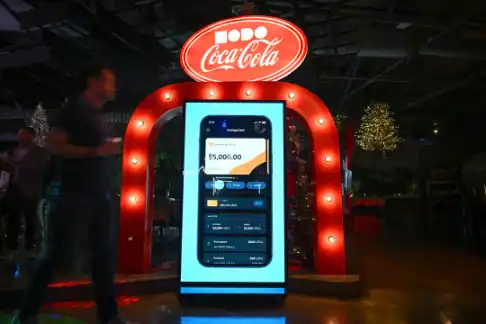
Display of a large screen showcasing the Kontigo cryptocurrency app interface, with a $5,000 balance and transaction history
Within Venezuela: Another Narrative
In Venezuela, Kontigo operates with a license issued by the country's cryptocurrency regulator, Sunacrip, and has government approval to conduct crypto business. The license was granted to a Venezuelan company named Oha Technology, signed by the Venezuelan Minister of Finance.
Afterwards, Kontigo seemed to attempt to distance itself from Oha, stating that it collaborates with local institutions in all markets. However, until recently, Kontigo's official website still displayed its operational license issued by Sunacrip and listed Oha as a subsidiary in Venezuela. Castillo's personal website shows that he served as the Chief Operating Officer of Oha AI. In private group chat messages seen by The Wall Street Journal, Castillo celebrated obtaining the Sunacrip license in January 2025 and shared the license documents.
During an invitation-only launch event in Caracas, a company spokesperson emphasized the increasingly important role of cryptocurrency in the Venezuelan economy. Economist Asdrúbal Oliveros told the audience that revenue from sanctioned oil sales is received in stablecoin form, which then flows into Kontigo and its licensed crypto platform competitors like Crixto.
Venezuelan Kontigo users can use the application to transfer funds to their Venezuelan bank accounts, even if the bank is under sanctions by the U.S. Department of the Treasury.
Turning Point
Shortly after announcing a successful funding round, Kontigo's situation took a sharp turn.
At the end of last December, an article in The Information exposed the news that Kontigo had been cut off from services by JPMorgan Chase.
Days later, a U.S. military operation overthrew President Maduro. Shortly after, influential independent fintech journalist Jason Mikula wrote an article accusing Kontigo of having a secret relationship with one of Maduro's sons.
Kontigo promptly fought back.
When Sebastian Siemiatkowski, CEO of the payment platform Klarna, shared Mikula's article on Platform X, Kontigo's official account replied, stating that the company "will hold accountable those spreading this false information as they harm the company's business reputation."
Subsequently, Kontigo informed users that the platform had suffered a hacker attack, with a total of 1005 users losing approximately $341,000. The company stated that it had fully compensated users for their losses.
In a 9-minute video posted on social media on January 12th, Castillo stated in Spanish that the platform was under simultaneous attack by hackers and critics and denied any association between Kontigo and the Maduro regime.
“The fact is, Kontigo's success is the result of years of hard work, resilience, and perseverance. We are not anyone's son-in-law, nephew, or cousin,” he said.
Nevertheless, as the issue continued to escalate, the company's operations seemed to be facing increasing challenges. According to sources familiar with the matter, both Stripe and Bridge have terminated their partnerships with Kontigo, and users reported that PayPal is no longer processing payments for the app. The Venezuelan crypto regulatory license held by Oha Technology expired on January 8.
The main public encrypted wallet featured on Kontigo's official website has seen little to no transaction activity in the past few days. In the preceding months, the wallet had a weekly transaction volume in the hundreds of thousands of dollars, but since January 19, only a few transactions of about $1 each have been recorded.
You may also like

In the name of charity, for the benefit of the family: How the Trump family turned charity into profit?

Will Gold Break $4,500 After Tonight's Fed Decision? What XAUT and PAXG Traders Need to Know

Cursor, why did you get on Musk's spaceship?

Morning Report | DeepSeek completes over $7 billion in financing, with a valuation exceeding $50 billion; Musk's personal wealth has surpassed the total market value of Bitcoin

SharpLink CEO: How to understand that Ethereum developers have just surpassed 1 million?

Morning Report | MiCA grace period expires on July 1; Kalshi's trading volume in the first week of the World Cup breaks $5.1 billion, setting a record

The foundation of SpaceX's trillion-dollar valuation: Who is dividing Musk's annual capital expenditure of tens of billions?

How to exit after asset tokenization?

The stablecoin positioning battle escalates: When compliance is just a ticket to entry, will USD1 become the biggest winner?

A16Z: The sun bears witness, SpaceX is worth 7.5 trillion
Mergers and acquisitions in the cryptocurrency market are exceptionally active

Concerns Behind the Binance Customer Service Controversy

SpaceX Stock Prediction After the IPO: Can SPCX Reach $200 Before QQQ Inclusion?

Congratulations to Carl Moon on His Historic Ferrari Challenge Le Mans Podium Triumph
Crypto influencer and racing enthusiast Carl Moon finished third in the Ferrari Challenge Le Mans Coppa Shell class, marking his best result of the year. As his racing partner and sponsor, WEEX celebrates this remarkable achievement and continues to lead crypto’s journey beyond boundaries, uniting the innovation of digital assets with the passion of motorsport.
Can the CLARITY Act Become Law by July 4? Everything You Need to Know About the Final Battle

France vs Senegal World Cup 2026: Mbappe’s New Era Begins Against a Historic Rival
What is the connection between Huang Zheng of Pinduoduo and blockchain?

Morning Report | Prediction market platforms like Kalshi and Polymarket jointly sue Kentucky over 14.25% trading tax; Bridgewater founder discusses decision-making in the AI era: principled thinking should run parallel to AI, human insight remains irre...
In the name of charity, for the benefit of the family: How the Trump family turned charity into profit?
Will Gold Break $4,500 After Tonight's Fed Decision? What XAUT and PAXG Traders Need to Know
Cursor, why did you get on Musk's spaceship?
Morning Report | DeepSeek completes over $7 billion in financing, with a valuation exceeding $50 billion; Musk's personal wealth has surpassed the total market value of Bitcoin
SharpLink CEO: How to understand that Ethereum developers have just surpassed 1 million?
Morning Report | MiCA grace period expires on July 1; Kalshi's trading volume in the first week of the World Cup breaks $5.1 billion, setting a record


