
 Buy Crypto
- Markets
 Futures
- Spot
- Copy Trade
- Earn
- More
XRP Market Cap Returns to Crypto Third, What's Driving Its Surge?

Original Article Title: "XRP Market Cap Returns to Third in Crypto, XRP ETF One Step Ahead?"
Original Article Author: Wenser, Odaily Planet Daily
Latest data shows that XRP's market cap once surpassed $136.2 billion, surpassing USDT to reclaim its position as the "third largest cryptocurrency by market capitalization," returning to the level before the 2020 SEC/Ripple lawsuit.
Previously, Odaily Planet Daily elaborated on the "US Court ruling that Ripple did not violate federal securities laws" in August, as detailed in the article "XRP Surges Over 20%, Another Milestone Victory for Ripple in SEC Lawsuit." Nearly four months later, XRP's price has surpassed $2.30, nearly quadrupling, and the market is optimistic about XRP's future performance.
In this article, Odaily Planet Daily will summarize the recent situation and relevant information about Ripple and XRP for readers' reference.
Macro and Micro Factors Combine, XRP Market Cap Surges
According to Infinite Market Cap data, calculated with a market cap of $136.2 billion, XRP's market cap briefly exceeded China Life and ranked 139th in global assets; currently, its market cap has fallen to around $132.8 billion. Overall, XRP's market cap surge is mainly due to multiple positive factors at the macro and micro levels:
Macro Level: Trump's Presidency Expected to Help Settle the "XRP vs. SEC Dispute"
With Trump's successful election as the new US president, Ripple's 6-year debate with the SEC on "Is XRP a security" may finally see a final ruling, after all, as a "crypto-friendly president," Trump will play a positive role in the industry's future development.
At the same time, as an active participant in the US presidential campaign, Ripple had previously donated $45 million to PAC before the 2024 election, making it one of the largest donors to Fairshake alongside cryptocurrency exchanges Coinbase, Jump Crypto, and Andreessen Horowitz. Recently, it donated another $25 million to Fairshake, once again demonstrating its strong ambition to influence crypto political inclinations.
On the other hand, in the cryptocurrency advisory council that former President Trump is preparing to establish, a range of cryptocurrency companies including Circle, Ripple, Kraken, Coinbase, a16z, and Paradigm are vying for positions, seeking to have a voice in his planned U.S. policy reform, which has also set the stage for XRP's recent strong market performance.
Ripple CEO Brad Garlinghouse has also spoken out frequently, emphasizing the potential changes in cryptocurrency regulation under President-elect Trump's leadership, where he mentioned, "Ripple and XRP may be at a turning point, as the new pro-cryptocurrency regulatory shift is expected to bring new hope and possibly resolve years-long legal disputes."
He then pointed out, "The SEC has been intervening in the cryptocurrency market, picking winners and losers for 6 years now... and it has been 4 years since the SEC sued Ripple... Now, as these external (frankly unnatural and manipulative) market forces gradually dissipate, we finally see the light at the end of the tunnel. The tide is turning, headwinds are becoming tailwinds, and for those of us who believe in the future of XRP, the opportunity is immense." Moreover, in a previous interview, FOX Business reporter Liz Claman indirectly confirmed from his mouth that he had met with and discussed cryptocurrency with Trump.
In November, the U.S. SEC's lawsuit against Ripple progressed to "The Second Circuit Court of Appeals issuing an order requiring the SEC's litigation brief to be submitted by January 15, 2025." Subsequently, Judge Phyllis Hamilton approved a final judgment on the settled Ripple class-action lawsuit and ordered a stay on the remaining unresolved litigation, shortening the timeline for the class action lawsuit and paving the way for the trial to begin on January 21, 2025. Additionally, the current SEC Chairman Gary Gensler's previous statement of resigning around the time Trump takes office also fueled XRP's previous price surge.
Coincidentally, January 20th, the day before January 21st, is precisely Trump's first day in office. Thus, it can be said that Trump will play the role of the "key gentleman" in this "crypto industry versus regulatory agencies" showdown.
Micro Level: 1 Billion XRP Escrow Lockup, Stablecoin Launch Imminent
From the project's own development perspective, XRP may also be about to "turn over a new leaf."
One of the key reasons directly boosting XRP's price surge may be today's early morning "1 Billion XRP Token Lockup." According to Whale Alert monitoring, starting at 2:21 AM today, Ripple relocked 1 billion XRP in a custody wallet, worth approximately $15.46 billion. Previously, Ripple stated that it uses a custody account system to provide transparency and certainty to the XRP market. The company locks up the majority of its XRP holdings to ensure it does not oversupply the market and manipulate prices. However, the company also uses the XRP in custody accounts to invest in and support projects in the Ripple ecosystem. Releasing 1 billion XRP tokens per month from the custody account does not necessarily mean all of them will enter the market. Ripple may choose to sell some to institutions or retail investors, use some for its own purposes, or return some to the new trust.
Additionally, as a crypto payment company, Ripple plans to expand its footprint into the stablecoin space. In mid-November, according to official announcements, Ripple revealed it is set to launch the dollar-pegged stablecoin Ripple USD (RLUSD). RLUSD is a stablecoin designed for enterprise use cases such as payments, focusing on stability, efficiency, and transparency to enhance Ripple's cross-border payment solutions and meet the growing demand for USD-denominated transactions. There are reports that this stablecoin may launch on December 4th.
Previously, Ripple has also taken significant steps in driving industry partnerships. In October, digital asset infrastructure provider Ripple designated Uphold, Bitstamp, Bitso, MoonPay, Independent Reserve, CoinMENA, and Bullish as trading partners for the upcoming Ripple USD (RLUSD) stablecoin, supported by market B2C2 and Keyrock to provide liquidity. Additionally, according to official announcements, crypto payment infrastructure company MoonPay had previously announced a partnership with Ripple to enable users to purchase, store, and manage XRP using MoonPay accounts. In late November, Ripple also announced a partnership with Archax and UK asset management firm ABRDN PLC, planning to launch the first tokenized money market fund on the XRP Ledger.
With a series of positive news driving the momentum, Ripple and XRP are experiencing a "crypto spring."
Moreover, the XRP ETF will also take center stage in the cryptocurrency market, continuing to attract market attention.
Industry Insiders Positive About XRP ETF Going Live First?
As early as late October, Ripple CEO Brad Garlinghouse had previously stated that an XRP ETF is "inevitable." The main rationale behind this comes from the growing shares of Bitcoin spot ETFs. According to the latest data, the total on-chain holdings of the US Bitcoin spot ETF have surpassed 1.12 million BTC (approximately 1.128 million BTC), accounting for 5.7% of the current BTC supply; with an on-chain holding value of $108.9 billion.
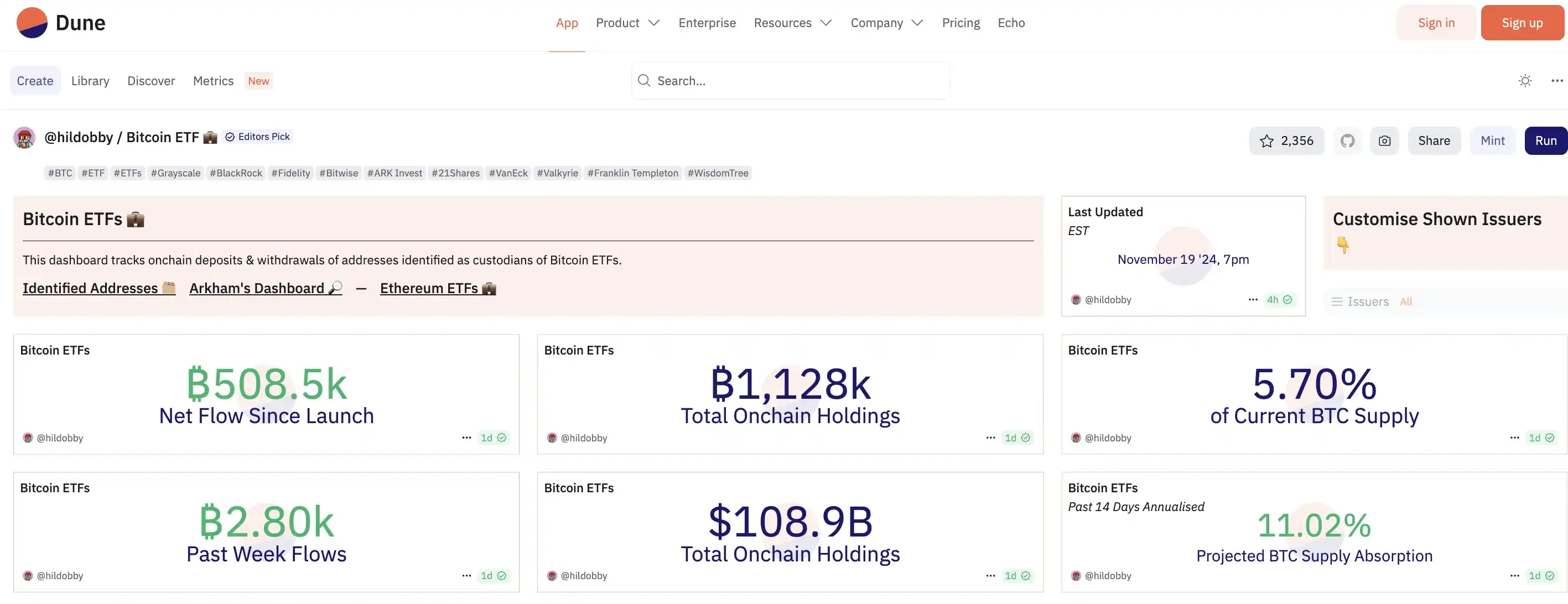
Dune Data Panel
At the same time, XRP has also received strong support from industry experts in various fields, mainly reflected in the following aspects:
XRP ETF Registrations Underway: WisdomTree Takes the Lead, Followed by Bitwise, Canary, 21 Shares
In late November, Fox Business reporter Eleanor Terrett wrote that global ETF provider WisdomTree has registered an XRP ETF in Delaware, USA. Currently, the company has confirmed that it is a legitimate filing, and it is known that WisdomTree manages assets over $100 billion.
Meanwhile, according to The ETF Store's President Nate Geraci's post: "There are currently 3 ETF applications holding the third largest cryptocurrency by market value, XRP.
Bitwise, Canary, and 21 Shares have all submitted applications for a spot XRP ETF. Speculation is that other issuers will join in as well."
"Grayscale Selects": XRP Now Included in Cryptocurrency Investment Portfolio
In early November, Grayscale officially announced that its XRP Trust Fund is now open to eligible accredited investors, providing investment opportunities to access XRP. XRP is the core token of the XRP Ledger, a distributed network that supports cross-border payments. Subsequently, at the end of November, Grayscale once again wrote that private placements for 17 token trust funds, including XRP, are now open to eligible accredited investors.
And the results have proved to be very wise: it turns out Grayscale's choice was spot on. According to statistics, Grayscale's cryptocurrency holdings saw a significant increase in value in November. According to Cryptorank data, its cryptocurrency holdings increased in market value by over 85% in the past month, with the increase mainly driven by tokens including XRP (which saw a price surge of over 262% during the same period).
Asset Management Giant Bitwise Becomes Ripple Partner
In November, Ripple announced its investment in the Bitwise Physical XRP ETP, with the specific investment amount undisclosed. It is understood that the Bitwise Physical XRP ETP, previously known as the "European XRP ETP," is part of Bitwise's suite of cryptocurrency funds.
Ripple CEO Brad Garlinghouse stated that the decision to invest in Bitwise's fund aligns well with the growing interest in exchange-traded products related to cryptocurrency assets. Subsequently, Bitwise officially announced that the Bitwise Physical XRP ETP (GXRP) has over $80 million in assets under management, with Ripple being one of the investors. The product is listed for trading on Deutsche Börse Xetra, allowing European investors to gain XRP exposure through GXRP.
Industry Figures Make Statements: Solana Ecosystem, BNB Ecosystem, ADA Ecosystem, and More Show Support
Just today, Solana co-founder toly made a post stating, "We need a national XRP reserve." This statement was also seen as echoing Trump's previous emphasis on "building a national strategic reserve of Bitcoin."
At the end of November, CZ retweeted news stating that due to XRP being classified as a commodity under the jurisdiction of the U.S. Commodity Futures Trading Commission, not a security, the U.S. Securities and Exchange Commission may drop the Ripple case. This information stemmed from a previous interview with former CFTC Chairman Chris Giancarlo.
Prior to this, Cardano (ADA) founder Charles Hoskinson had praised Ripple CEO Brad Garlinghouse in a post, referring to him as a "great CEO" and describing their interactions as "extremely cooperative." This public exchange sparked speculation that Cardano and Ripple might explore establishing a strategic partnership.
Data Perspective: Market Trading Activity High, Multiple Data Reach All-Time High
From a market data perspective, XRP is also one of the top performers.
In terms of the Korean market, Upbit's trading volume had increased by over 100% in seven days, with the major contributor being cryptocurrencies including XRP. In the fourth quarter, XRP's trading volume reached as high as $38.6 billion, far exceeding Bitcoin's $30.1 billion trading volume.
On the price front, XRP briefly broke through $2.29 USDT today, reaching a new high since January 2018.
Furthermore, in terms of futures contract data, according to Coinglass data, the global XRP futures contract open interest is 1.739 billion ETH, equivalent to about $40.51 billion, reaching an all-time high with a 24-hour increase of 20.34%. Among them, Bybit's XRP futures contract open interest is 548 million XRP (approximately $1.277 billion), ranking first with a 24-hour increase of 19.13%.
In terms of trading volume, as XRP broke $2, its 24-hour trading volume also exceeded $25 billion, currently reaching $25,338,798,676, with a trading volume to market cap ratio of 18.4%, indicating a high level of trading activity relative to its market cap.
On a side note, influenced by various positive news, the number of XRP-related posts on Platform X has reached a high of 480,000 posts, even surpassing the highly meme-able DOGE-related content.
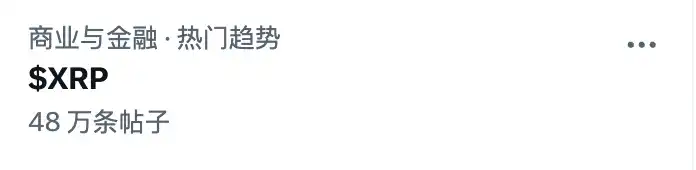
One of the Platform X content metrics
If all goes well, an XRP ETF may become the "third cryptocurrency ETF" in the U.S. market following the BTC ETF and ETH ETF.
Conclusion: Where Is Ripple Headed With XRP?
As XRP's market cap once again reached pre-SEC/Ripple lawsuit levels, this six-year-long "first cryptocurrency regulatory case" originating from 2018 is about to reach its conclusion. Regarding the future of Ripple and XRP, there are different opinions in the market.
Previously, Yoshitaka Kitao, the CEO of the major Japanese financial services firm SBI Holdings, had stated that once the SEC issue is resolved, Ripple should prepare for an IPO as soon as possible. (Note: SBI Holdings has been collaborating with Ripple since 2017 to drive innovation in cross-border payments. Kitao is a key figure in the Ripple-SBI collaboration, having joined the Ripple board in April 2019. His long-term support for Ripple and XRP dates back to 2017 when he predicted XRP to be the global standard for digital currencies, emphasizing its efficiency, low transaction costs, and scalability.) Although similar proposals were previously put on hold by Ripple CEO Brad Garlinghouse, it can also be seen as one of the possibilities for Ripple's future direction.
After all, with the further improvement of the cryptocurrency regulatory environment, there may be more "cryptocurrency concept stocks" landing on the US stock market. At that time, Ripple and XRP may usher in another wave of development peaks.
You may also like

The 17-Year Mystery Will Be Solved, Who is Satoshi Nakamoto?

5 Minutes to Make AI Your Second Brain

Uniswap is trapped in an innovation dilemma

What is the key to competition in crypto banking?

The flow of stablecoins and the spillover effects in the foreign exchange market

After two years, Hong Kong's first batch of stablecoin licenses finally issued: HSBC, Standard Chartered make the cut
The person who helped TAO rise by 90% has now single-handedly crashed the price again today

3-Minute Guide to Participating in the SpaceX IPO on Bitget

Top 5 Cryptos to Buy in 2026 Q1: A ChatGPT Deep Dive Analysis
Explore the top 5 cryptos to buy in Q1 2026 including BTC, ETH, SOL, TAO, and ONDO. See price outlooks, key narratives, and institutional catalysts shaping the next market move.

How to Earn $15,000 with Idle USDT Before Altcoin Season 2026
Wondering if altcoin season is coming in 2026? Get the latest market update, and learn how to turn your idle stablecoins waiting for entry into extra rewards up to 15,000 USDT.
Can You Win Joker Returns Without Large Trading Volume? 5 Mistakes New Players Make In WEEX Joker Returns Season 2
Can small traders win WEEX Joker Returns 2026 without huge volume? Yes—if you avoid these 5 costly mistakes. Learn how to maximize card draws, use Jokers wisely, and turn small deposits into 15,000 USDT rewards.

Altcoin Season 2026: 4 Stages to Profit (Before the Crowd FOMO In)
Altcoin Season 2026 is starting — discover the 4 key stages of capital rotation (from ETH to PEPE) and how to position before the peak. Learn which tokens will lead each phase and avoid missing the rally.

Will Alt season come in 2026? 5 Tips to Spot the Next 100x Crypto Opportunities
Will altcoin season arrive in 2026? Discover 5 rotation stages, early signals smart traders watch, and the key crypto sectors where the next 100x altcoin opportunities may emerge.

The bear market has arrived, and cryptocurrency ETF issuers are also getting involved

The richest man had a quarrel with his former boss

BTC Firm Above 70K! Saylor’s "Institutional Logic" vs. Moon’s "Retail Faith": Who is Really Harvesting the Market?
Bitcoin is holding firm above the $70,000 support level following a massive short squeeze that liquidated $427 million. As the "Four-Year Cycle" narrative shifts, the market is split: Michael Saylor’s cold, institutional "indiscriminate stacking" vs. Carl Moon’s high-energy retail "hopium." This article decodes these two polar-opposite strategies for the 2026 bull run and reveals how WEEX’s institutional-grade liquidity and AI trading tools empower every type of investor to convert market volatility into profit.

The Girl Who Created the SBTI Test: A Story of a Doomed Cyber Love, an E-Widow Ratfolk



 App
App