
 Buy Crypto
- Markets
 Futures
- Spot
- Copy Trade
- Earn
- More
ZORA Airdrop Disaster: Early Users "HODL" for Four Years, Average Per Person Less Than $40

Original Title: "Zora Airdrop Faces On-Chain Backlash: Early Users Feel Betrayed, Average Airdrop Only $37"
Original Author: Nancy, PANews
After years of anticipation, the long-awaited Zora airdrop finally took place. However, community members who had eagerly awaited this moment were left disappointed. Upon opening their wallets, all they found was a reward that couldn't even cover the gas fee, let alone a token with no utility. The community's emotions reached a boiling point, and the on-chain reputation protocol Ethos unexpectedly became the outlet for users to express their dissatisfaction. Zora's "car crash scene" was permanently recorded on the blockchain, leaving a mark of shattered trust.
Airdrop Backfires on Early Users, Token Distribution Accused of Abandoning the Community
Last month, Zora announced the upcoming launch of its native token, ZORA, creating high expectations within the community that had been waiting for years. In the days leading up to the airdrop, Base, the official platform, issued a series of tweets to hype up Zora, attracting a lot of attention with various memes and skyrocketing data metrics.
However, this airdrop turned out to be a massive disappointment. On April 23, Zora opened the airdrop claiming to distribute 1 billion ZORA tokens to 2,415,024 addresses. Most of the airdropped tokens were based on the first snapshot distribution (from January 1, 2020, 8:00, to March 3, 2025, 22:00), with a smaller portion based on the second snapshot distribution (from March 3, 2025, 22:00, to April 20, 2025, 8:00), which also covered activity on Zora's latest Coins protocol. The specific distribution amounts were calculated based on user activity on Zora and their overall participation in the current protocol and its older versions, including but not limited to minting, trading, and referrals.
Simultaneously, the ZORA token was listed on Binance Alpha, with eligible users receiving a 4276 ZORA token airdrop. However, this airdrop result angered many long-time participants in the Zora ecosystem, as they received only a small amount of tokens, barely enough to cover the gas fee.
Recent speculators and Binance Alpha users easily walked away with a large number of tokens. This severe imbalance in distribution not only sparked widespread anger in the community but was also seen as a betrayal of early supporters. What exacerbated the community's dissatisfaction was that the Zora airdrop snapshot was divided into two parts, yet the specific distribution criteria were never made public, leading to a lack of transparency throughout the process.
Moreover, Zora has also faced strong community scrutiny due to its highly concentrated and opaque distribution ratio. According to Zora's disclosed tokenomics, the community airdrop accounts for only 10%, while the team, treasury, and strategic contributors allocation stands at a high 65%, with a mere 6-month lock-up period before unlocking commences, and the specific unlocking schedule is similarly not clearly stated.
Furthermore, the Zora team has officially stated that the ZORA token is merely a "just for fun" MEME coin, carrying no technical or governance functions, primarily used for community rewards and ecosystem incentives. This positioning has sparked a series of questions from the community: Since the token does not have any substantial utility, why does the team still need to occupy such a high percentage? And on what basis does the community trust that ZORA holds long-term value?
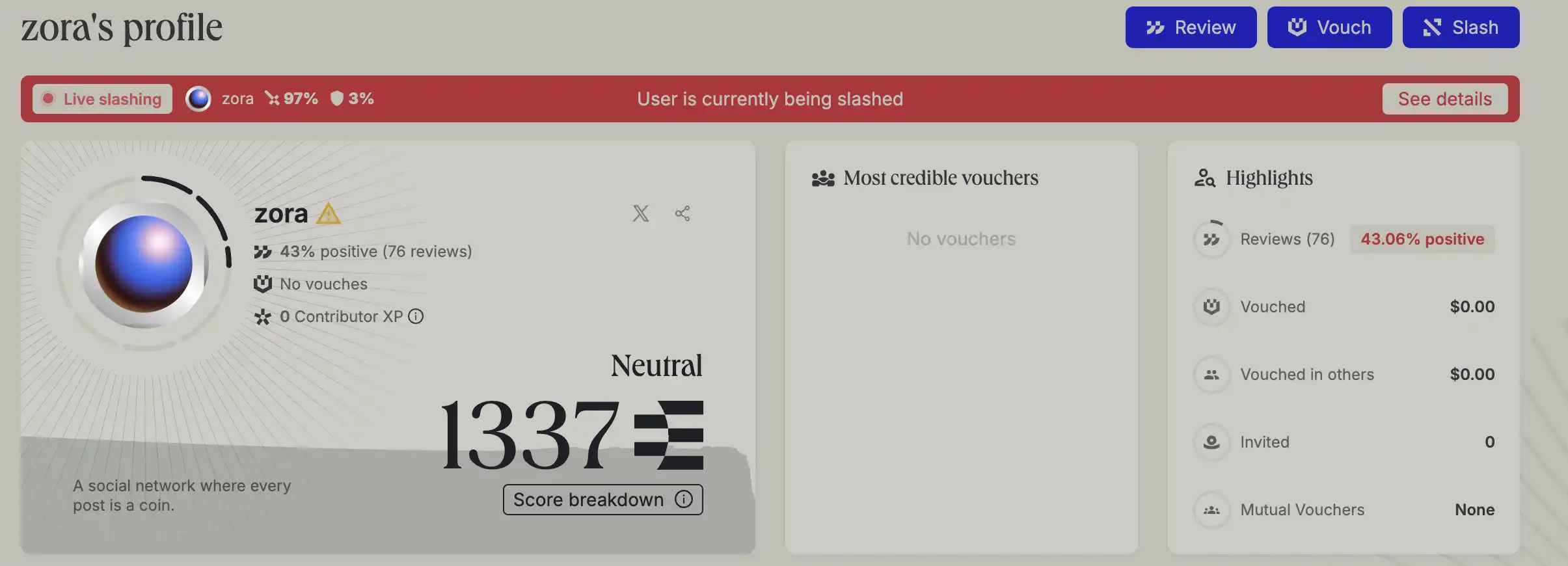
Amidst multiple disappointments, Ethos's negative review feature has been seen as an outlet for emotional value expression, with community users leaving "downvotes" en masse, leading to a rapid decline in Zora's credibility score. Many users have been outspoken, stating, "On-chain records are immutable; malicious projects must be recorded in history."
Airdrop Progress: Over Halfway with User Claim Rate Below 20%, Average User Receives Only $37
In terms of price performance, Binance data shows that after ZORA was listed, it briefly surged to $0.0466, only to plummet to a low of $0.0172 the next day, a nearly 63% decline, cooling off the market hype rapidly.
According to Dune data, as of the time of writing, over 514 million tokens have been successfully claimed by users in the ZORA airdrop. Among them, the top 50 addresses have collectively claimed more than 190 million tokens, with an average of about 3.931 million tokens per address. Based on the current price (approximately $0.0235), this is worth around $9,200, accounting for 36.9% of the total claimed amount. This indicates a significant concentration of distribution toward the top wallet addresses.
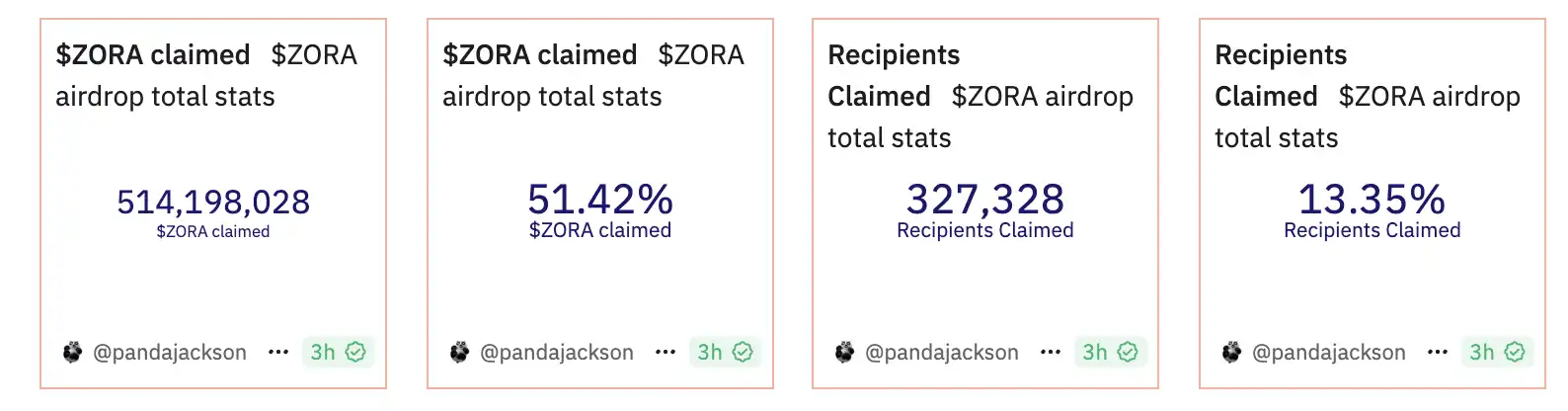
At the same time, in terms of the number of participating users, there are already over 320,000 users participating in the claim, but the average user has only claimed 1,571.1 ZORA, equivalent to about $37. This stark contrast highlights the extreme imbalance in the distribution structure—large holders receive a substantial airdrop, while regular users receive a very limited allocation.
In terms of claim progress, approximately 51.42% of the total token supply has been claimed, but only 13.35% of eligible users have actually completed the claim process, further indicating that the proportion of users actively claiming is very low, with most users tending to forego claiming.
Significant Drop in User Engagement as Controversy Arises over Transition to On-Chain Social
Founded in 2020, Zora was originally positioned as an NFT marketplace protocol. Public data shows that the project has raised at least $52 million in funding, with investment firms including Coinbase Ventures, Paradigm, Haun Ventures, among others, with the latest funding round valuing the project at $6 billion. However, as the NFT market cooled off and competition intensified, Zora gradually evolved to focus on on-chain social and the creator economy ecosystem, including the introduction of the "Coins" feature, which automatically mints each piece of social content (such as images, videos, text) into an ERC-20 token, and the launch of its own Layer2 network, Zora Network.
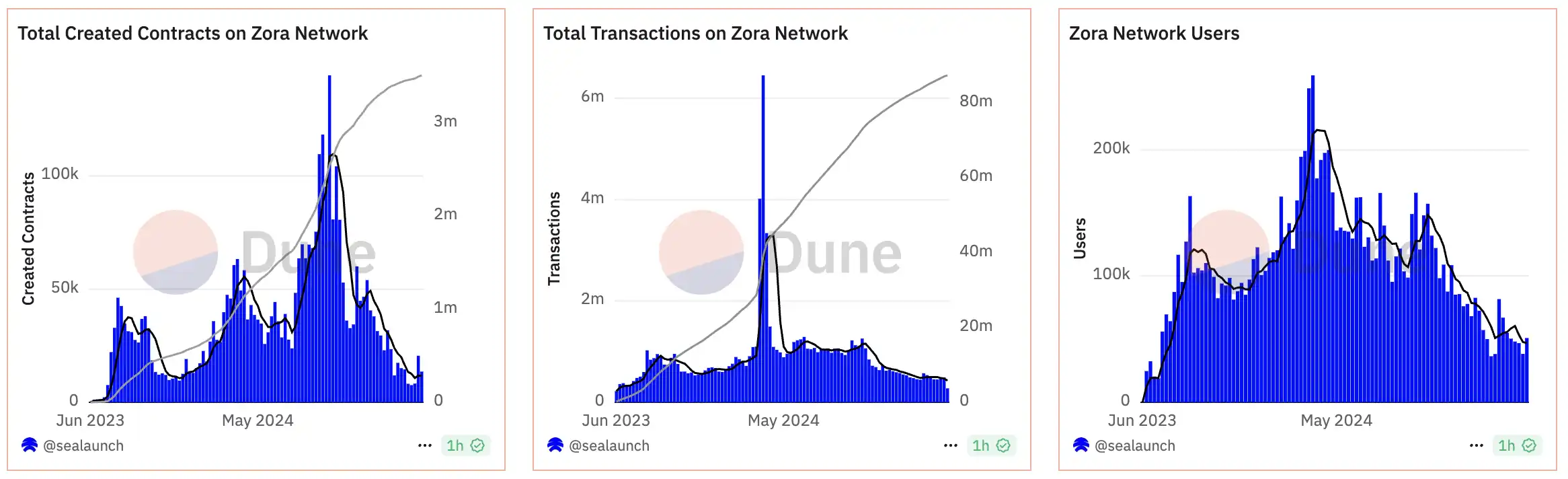
Despite continuously exploring new narrative directions, the overall ecosystem activity of Zora has significantly declined. According to Dune data, as of April 24, the total smart contracts created on the Zora network have exceeded 3.51 million, but looking at the daily contract creation numbers, the data has dropped from the early peak of 144,000 transactions to around 13,000 transactions, which is less than ten percent of the peak; similarly, the cumulative transaction volume on the Zora network has surpassed 87.4 million transactions, however, the daily transaction volume has dropped from a historical peak of 3.338 million transactions to the current approximately 428,000 transactions; although the total number of active addresses has reached 470,000, comparing to the daily active users of about 259,000 at the peak last year, it has now decreased to 50,900, showing a decrease in user engagement.
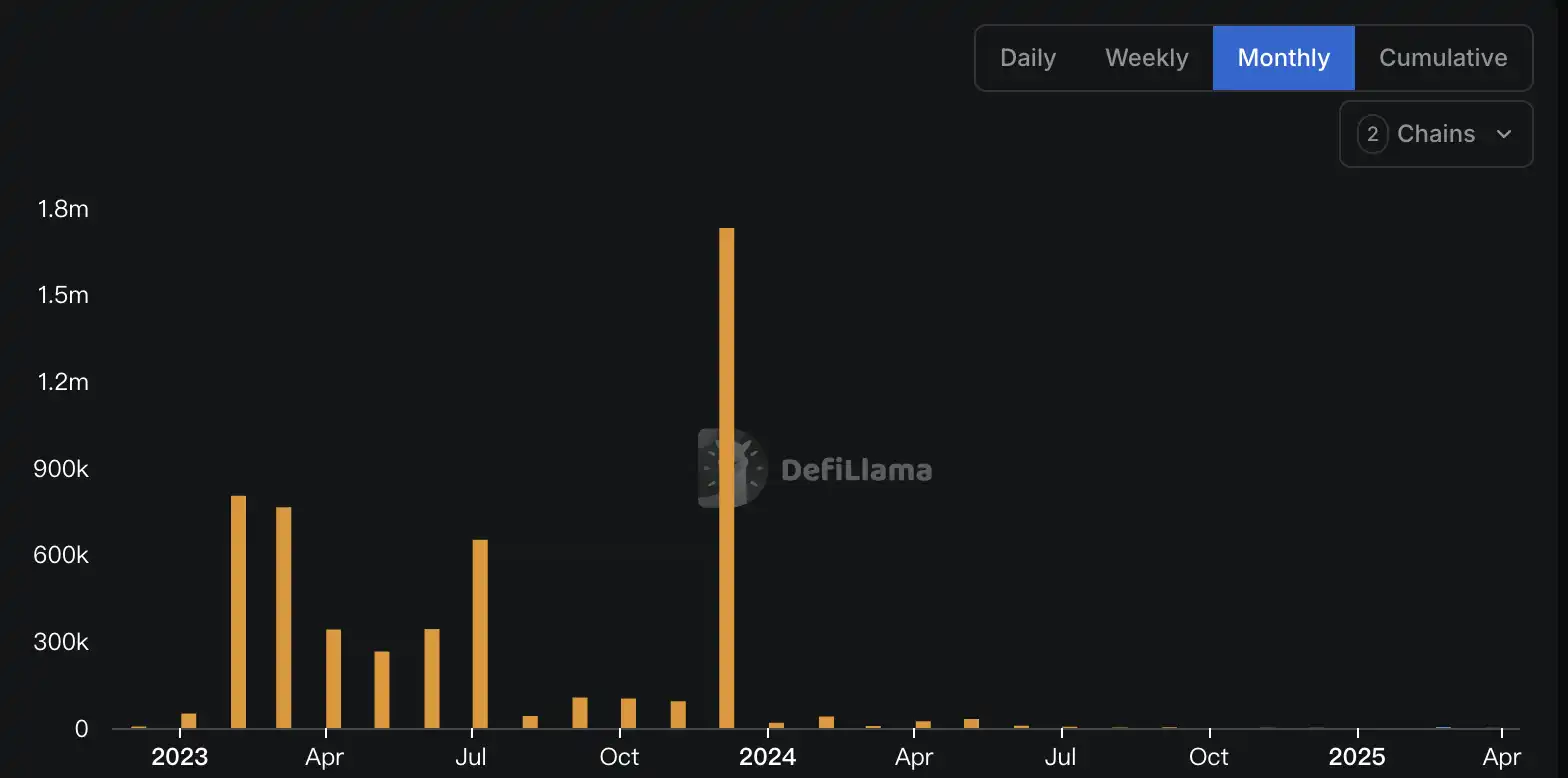
In terms of revenue, according to DeFiLlama and Dune data, Zora's accumulated revenue is only $5.4 million, and Zora Network's profit is only 527.74 ETH. It is also believed by the community that this is far from the market expectations corresponding to its $6 billion valuation.
Furthermore, although Zora claims to have brought tens of millions of dollars in revenue to creators, its on-chain experimental and tokenized narrative has sparked controversy. For example, Jesse Pollak, the head of Base Protocol, recently praised the record-breaking active users of Zora Coins, but ZachXBT criticized these tokens as "viruses," with a market cap of less than $5 million. In response, Jesse admitted that most content is nearly worthless, with a small amount of content having huge value, but ZachXBT questioned why creators would issue a large number of tokens to dilute their brand. Jesse rebutted that on-chain creation does not dilute the brand, good content will naturally spread, and the market and algorithms determine its value.
Overall, Zora is attempting to reshape itself through on-chain social interactions and tokenized storytelling, but its overinflated valuation and increasingly cooling ecosystem have long planted the seeds of a trust crisis. This lackluster airdrop may very well be the final straw that breaks the community's confidence.
You may also like

Consumer-grade Crypto Global Survey: Users, Revenue, and Track Distribution

Prediction Markets Under Bias

Stolen: $290 million, Three Parties Refusing to Acknowledge, Who Should Foot the Bill for the KelpDAO Incident Resolution?

ASTEROID Pumped 10,000x in Three Days, Is Meme Season Back on Ethereum?

ChainCatcher Hong Kong Themed Forum Highlights: Decoding the Growth Engine Under the Integration of Crypto Assets and Smart Economy

Why can this institution still grow by 150% when the scale of leading crypto VCs has shrunk significantly?

Anthropic's $1 trillion, compared to DeepSeek's $100 billion

Geopolitical Risk Persists, Is Bitcoin Becoming a Key Barometer?

Annualized 11.5%, Wall Street Buzzing: Is MicroStrategy's STRC Bitcoin's Savior or Destroyer?

An Obscure Open Source AI Tool Alerted on Kelp DAO's $292 million Bug 12 Days Ago

Mixin has launched USTD-margined perpetual contracts, bringing derivative trading into the chat scene.
The privacy-focused crypto wallet Mixin announced today the launch of its U-based perpetual contract (a derivative priced in USDT). Unlike traditional exchanges, Mixin has taken a new approach by "liberating" derivative trading from isolated matching engines and embedding it into the instant messaging environment.
Users can directly open positions within the app with leverage of up to 200x, while sharing positions, discussing strategies, and copy trading within private communities. Trading, social interaction, and asset management are integrated into the same interface.
Based on its non-custodial architecture, Mixin has eliminated friction from the traditional onboarding process, allowing users to participate in perpetual contract trading without identity verification.
The trading process has been streamlined into five steps:
· Choose the trading asset
· Select long or short
· Input position size and leverage
· Confirm order details
· Confirm and open the position
The interface provides real-time visualization of price, position, and profit and loss (PnL), allowing users to complete trades without switching between multiple modules.
Mixin has directly integrated social features into the derivative trading environment. Users can create private trading communities and interact around real-time positions:
· End-to-end encrypted private groups supporting up to 1024 members
· End-to-end encrypted voice communication
· One-click position sharing
· One-click trade copying
On the execution side, Mixin aggregates liquidity from multiple sources and accesses decentralized protocol and external market liquidity through a unified trading interface.
By combining social interaction with trade execution, Mixin enables users to collaborate, share, and execute trading strategies instantly within the same environment.
Mixin has also introduced a referral incentive system based on trading behavior:
· Users can join with an invite code
· Up to 60% of trading fees as referral rewards
· Incentive mechanism designed for long-term, sustainable earnings
This model aims to drive user-driven network expansion and organic growth.
Mixin's derivative transactions are built on top of its existing self-custody wallet infrastructure, with core features including:
· Separation of transaction account and asset storage
· User full control over assets
· Platform does not custody user funds
· Built-in privacy mechanisms to reduce data exposure
The system aims to strike a balance between transaction efficiency, asset security, and privacy protection.
Against the background of perpetual contracts becoming a mainstream trading tool, Mixin is exploring a different development direction by lowering barriers, enhancing social and privacy attributes.
The platform does not only view transactions as execution actions but positions them as a networked activity: transactions have social attributes, strategies can be shared, and relationships between individuals also become part of the financial system.
Mixin's design is based on a user-initiated, user-controlled model. The platform neither custodies assets nor executes transactions on behalf of users.
This model aligns with a statement issued by the U.S. Securities and Exchange Commission (SEC) on April 13, 2026, titled "Staff Statement on Whether Partial User Interface Used in Preparing Cryptocurrency Securities Transactions May Require Broker-Dealer Registration."
The statement indicates that, under the premise where transactions are entirely initiated and controlled by users, non-custodial service providers that offer neutral interfaces may not need to register as broker-dealers or exchanges.
Mixin is a decentralized, self-custodial privacy wallet designed to provide secure and efficient digital asset management services.
Its core capabilities include:
· Aggregation: integrating multi-chain assets and routing between different transaction paths to simplify user operations
· High liquidity access: connecting to various liquidity sources, including decentralized protocols and external markets
· Decentralization: achieving full user control over assets without relying on custodial intermediaries
· Privacy protection: safeguarding assets and data through MPC, CryptoNote, and end-to-end encrypted communication
Mixin has been in operation for over 8 years, supporting over 40 blockchains and more than 10,000 assets, with a global user base exceeding 10 million and an on-chain self-custodied asset scale of over $1 billion.

$600 million stolen in 20 days, ushering in the era of AI hackers in the crypto world
Vitalik's 2026 Hong Kong Web3 Summit Speech: Ethereum's Ultimate Vision as the "World Computer" and Future Roadmap
On the same day Aave introduced rsETH, why did Spark decide to exit?
Full Post-Mortem of the KelpDAO Incident: Why Did Aave, Which Was Not Compromised, End Up in Crisis Situation?

After a $290 million DeFi liquidation, is the security promise still there?
ZachXBT's post ignites RAVE nearing zero, what is the truth behind the insider control?




 App
App