
 Buy Crypto
- Markets
 Futures
- Spot
- Copy Trade
- Earn
- More
The Trader's Playbook: 7 Market Cycle Lessons From LALIGA’s 90 Minutes


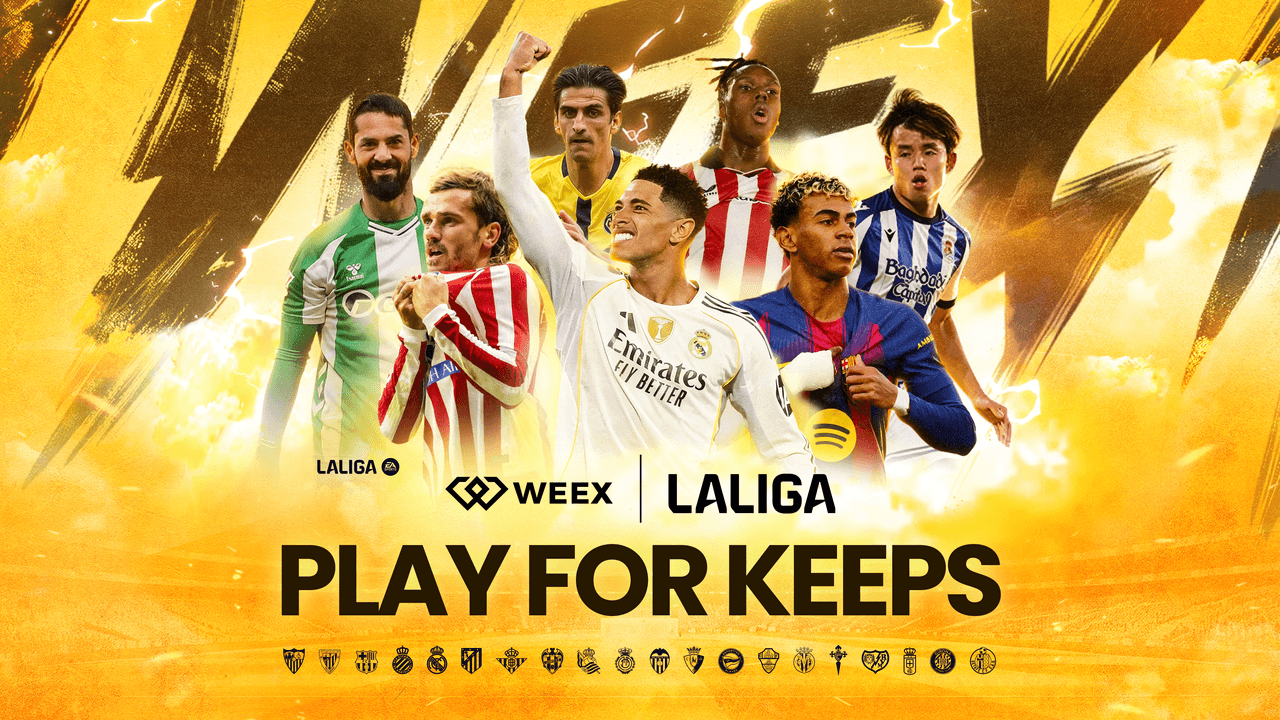
Anyone who follows LALIGA understands one simple truth: LALIGA matches are rarely decided in the opening minutes.
Football unfolds in phases. Early caution evolves into tactical adjustments, pressure intensifies, and outcomes are often shaped late in the game. Victory is rarely defined by a single moment, but by how teams manage transitions across the full 90 minutes — a pattern consistently reflected across long-term LALIGA results.
Markets operate in a similar rhythm. As an Official LALIGA Partner, WEEX recognizes that elite sport and financial markets both reward structure, timing, adaptability, and emotional discipline.
A trading session, breakout attempt, or full market cycle develops through stages, each carrying different signals, risks, and behavioral challenges. Understanding where the market sits within its cycle often matters more than reacting to recent price action.
The First Half: Why Quiet Markets Trap Traders Before the Breakout
In LALIGA matches, the first half is rarely about dominance. Teams focus on structure, ball control, and defensive stability. The tempo remains controlled and risk is carefully rationed.
Markets often open in a comparable environment. Liquidity is present but directional conviction is limited. Prices fluctuate within narrow ranges, reflecting collective indecision between buyers and sellers. This is the consolidation phase, where information builds but momentum remains suppressed.
For traders, this stage can be psychologically challenging. Low volatility encourages impatience, and impatience frequently leads to overtrading or premature positioning.
Key insight: Not every quiet market presents opportunity. Sometimes, restraint is the correct response.
Half-Time in Crypto Markets: How Smart Money Positions Before a Breakout
Half-time serves as a key tactical adjustment window, where teams recalibrate strategy and momentum can begin to shift before outcomes become visible. Tactical adjustments occur away from public view, subtly shifting momentum before results become visible.
Markets experience similar transition points. Sentiment, macro narratives, and institutional positioning often shift before price reflects those changes. Sophisticated participants adjust exposure early, while others wait for confirmation after the move has already begun.
One of the most common trading errors is assuming price leads information flow. In reality, price is frequently the final expression of earlier expectation shifts.
Key insight: Context reduces emotional reaction when volatility emerges.
Second Half: How to Trade Momentum in High-Volatility Crypto Markets
As matches progress into later stages, tactical execution, physical demand, and decision pressure tend to become increasingly influential. Fatigue creates additional space, pressure intensifies, and decision-making becomes increasingly critical. Momentum becomes more visible as the tempo of the game accelerates.
Markets behave similarly during expansion phases. Volume rises, volatility increases, and breakout moves attract broader participation. This stage often generates the strongest trends — and the greatest behavioral risk.
Momentum validates preparation but punishes emotional execution. Traders who enter without structured planning frequently become liquidity for more prepared participants.
Key insight: The best player leads the second half. The best trader survives volatile markets.
Stoppage Time in Crypto Markets: Navigating Late-Cycle Volatility with Discipline
Stoppage time in football is highly dynamic and unpredictable, often reshaping final LALIGA results within moments. With limited time and maximum pressure, outcomes can reverse within seconds.
Markets experience equivalent late-cycle conditions. Sharp price spikes, rapid market movements, or sudden news catalysts often emerge near the end of extended moves. During these moments, market structure weakens and emotional trading intensifies.
Participating aggressively at this stage often means assuming peak risk with minimal informational advantage.
Key insight: Late-stage volatility tests discipline, not strategy.
Beyond the Scoreline: How Football’s Discipline Mirrors Crypto Market Cycles
Football seasons are not defined by isolated moments. Sustained success depends on consistency, adaptability, and disciplined execution across every match phase.
Markets reward identical characteristics. A profitable trade does not guarantee a sound decision, just as a loss does not necessarily indicate flawed strategy. Long-term performance depends on process quality rather than individual outcomes.
Viewing market cycles through structural analysis instead of emotional reaction allows traders to operate with clarity rather than urgency.
3 Football-Inspired Trading Rules for Crypto Markets: From Game Phases to Market Cycles
Markets, like LALIGA matches, are decided through phases rather than isolated moments.
There are three core lessons traders can apply:
First, identify the market phase before acting. Markets rotate between consolidation, transition, and volatility expansion, and strategies that work in one phase often fail in another. Second, let context guide decisions instead of reacting to short-term price noise. Understanding expectations and positioning reduces emotional trading when volatility appears. Third, consistency in process outweighs individual trade outcomes. Patience during quiet conditions and discipline during volatile phases tend to outperform reaction-driven decision-making over time.
Sustainable performance, like success across a football season, depends on disciplined execution across the full 90 minutes.
From Theory to Live Trading: Experience WEEX's Exclusive LALIGA Trading Platform
Building on these shared dynamics between football and market cycles, WEEX is strengthening this connection through interactive fan engagement experiences developed with LALIGA. The initiative introduces a data-driven participation environment where real-time match developments can inspire structured analysis and informed decision-making among fans and traders alike.
By linking live match moments with guided participation tools, users can interpret game dynamics, form perspectives, and engage with outcome-based interactive features supported by WEEX’s trading infrastructure.
Users interested in exploring this experience can access the dedicated LALIGA event hub through WEEX’s platform.
Join WEEX’s LALIGA Fan Economy: https://www.weex.com/events/draw/shoot-1
Related article
From Elite Football to Professional Crypto Trading: Why WEEX Partners with LALIGA
About WEEX & LALIGA
Established in 2018, WEEX empowers over 6.2 million users in 150+ countries with secure, liquid, and easy-to-use crypto trading. With 2,000+ pairs and up to 400× futures leverage, WEEX delivers a professional-grade experience for every trader.
LALIGA is the largest football ecosystem in the world. It is a private sports association, made up of 20 football clubs/SADs in LALIGA EA SPORTS and 22 in LALIGA HYPERMOTION, and is responsible for the organization of professional and national football competitions. It has over 240 million followers on social networks globally, across 16 platforms and in 20 different languages; and has the most extensive international network of any sports property, through which it is present in 41 countries and 11 offices, with headquarters in Madrid (Spain). The association is socially active through its Foundation and is the first professional football league in the world with a competition for players with intellectual disabilities: LALIGA GENUINE
Disclaimer
This article is for educational and informational purposes only and does not constitute financial, investment, legal, tax, or other professional advice.
You may also like

56% Spike in Memecoin Trading Volume, Yet Shiba Inu (SHIB) Remains Static With 0 Netflow
Key Takeaways: Recent memecoin market saw a volume increase of 56%, highlighting a shift in investor interest towards…

American Airlines Praises Ripple, Surprising XRP Community
Key Takeaways: American Airlines reports exceptional results from Ripple Treasury usage. Ripple Treasury aids treasury efficiency without needing…

USDT Supply Surges to $188B as Tether Solidifies Stablecoin Dominance
Key Takeaways: Tether’s USDT supply reaches an all-time high of $188 billion, maintaining its dominance in the stablecoin…

North Korea’s $500M DeFi Heist Unveils New Cyber Warfare Tactics
Key Takeaways: North Korean operatives have obtained over $500 million from DeFi platforms in under three weeks. The…

How Crypto Futures Markets Are Fueling ‘Scam Coin’ Insider Schemes
Key Takeaways: RAVE’s market cap skyrocketed to $6.7 billion before plummeting by 95% due to insider control and…

XRP Price Prediction: Wall Street Giants Eye Ripple – Should You?
Key Takeaways: Wall Street players like Mastercard and BlackRock are adopting bullish XRP positions. XRP Ledger sees a…
WOJAK Crypto Meme Coin Pumps 87% as MAXI Targets $5M: Unveiling the Trading Insights of 2026
Key Takeaways: WOJAK crypto surged 87% in 24 hours, driven by aggressive accumulation, signaling renewed interest in meme…

XRP Price Prediction: Wall Street Giants Back Ripple’s Future – Should You?
Key Takeaways: Leading Wall Street firms are showing bullish interest in XRP’s price potential. At the Digital Assets…

XRP Price Prediction: Wall Street Giants Shift Focus to Ripple
Key Takeaways: XRP Ledger is seeing massive institutional interest from giants like Mastercard and BlackRock, aligning with overall…

Protect Your Crypto: Practical Steps to Avoid Scams
Key Takeaways: Recognize red flags early by knowing scams like phishing and rug pulls. Secure your assets with…

How Much Is Blueface Worth? Latest Net Worth Revealed (2026)
Key Takeaways: Blueface’s net worth in 2026 ranges from $4 million to $7 million, reflecting both his musical…

Google’s Quantum AI Sparks Ripple’s 2-Year Plan for XRP: What’s the Impact on Holders?
Key Takeaways: Ripple’s multi-phase plan targets quantum cryptography readiness for XRP Ledger by 2028 due to Google Quantum…
Eightco Holdings (NASDAQ: ORBS) Reveals $336M in Digital Assets and Equity Investments
Key Takeaways: Eightco’s treasury includes $90M in OpenAI, $25M in Beast Industries, 11,068 ETH, and $283 million WLD…

DeFi Losses Top $600 Million Amid Kelp DAO Exploit and TVL Decline
Key Takeaways: Total DeFi losses have skyrocketed to approximately $1 billion recently, with $600M+ linked directly to the…

SEC’s “Innovation Exemption” Sets New Rails for Tokenized Securities
Key Takeaways: SEC Chair Paul Atkins introduces an “innovation exemption” to regulate tokenized securities. A five-category token framework…

Ripple Sets 2028 Deadline for Quantum-Ready XRPL
Key Takeaways: Ripple commits to a 2028 deadline for XRPL’s quantum-readiness, focusing on quantum-resistant cryptographic systems. Google’s research…

Key NFT Projects to Watch in 2026
Key Takeaways: Successful NFT investing in 2026 revolves around real-world utility, team credibility, and regulatory compliance. Top picks…
How Syncro Sender Optimizes Solana Transactions for High-Stakes Teams
Key Takeaways: Syncro Sender uses multi-path delivery and staked validator connections to enhance Solana transaction efficiency. It significantly…
56% Spike in Memecoin Trading Volume, Yet Shiba Inu (SHIB) Remains Static With 0 Netflow
Key Takeaways: Recent memecoin market saw a volume increase of 56%, highlighting a shift in investor interest towards…
American Airlines Praises Ripple, Surprising XRP Community
Key Takeaways: American Airlines reports exceptional results from Ripple Treasury usage. Ripple Treasury aids treasury efficiency without needing…
USDT Supply Surges to $188B as Tether Solidifies Stablecoin Dominance
Key Takeaways: Tether’s USDT supply reaches an all-time high of $188 billion, maintaining its dominance in the stablecoin…
North Korea’s $500M DeFi Heist Unveils New Cyber Warfare Tactics
Key Takeaways: North Korean operatives have obtained over $500 million from DeFi platforms in under three weeks. The…
How Crypto Futures Markets Are Fueling ‘Scam Coin’ Insider Schemes
Key Takeaways: RAVE’s market cap skyrocketed to $6.7 billion before plummeting by 95% due to insider control and…
XRP Price Prediction: Wall Street Giants Eye Ripple – Should You?
Key Takeaways: Wall Street players like Mastercard and BlackRock are adopting bullish XRP positions. XRP Ledger sees a…


 App
App