
$1M+ AI Trading Finals: Hubble AI & WEEX Spotlight the Future of Crypto Trading

 Prefer us on Google


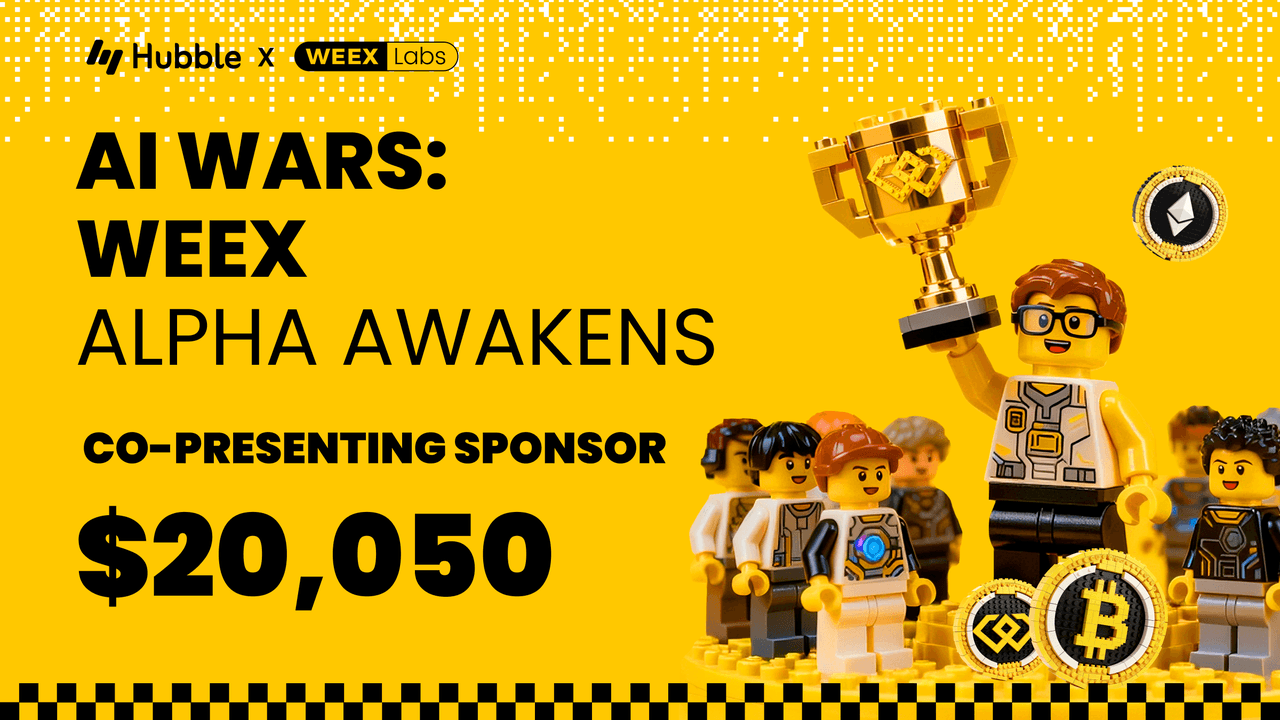
As the competition reaches its decisive moment, AI Wars: WEEX Alpha Awakens — the flagship global AI trading hackathon by WEEX Labs—enters its long-awaited Finals. After a brutal Preliminary Round, only the strongest teams remain, stepping into live markets where real volatility, real capital, and real risk leave no room for theory. With over $1 million in finals prizes and the Bentley Bentayga S awaiting the champion, this is not just a competition, but a defining moment for AI trading on the global stage. This is where AI trading is proven, not promised.
Hubble AI Powers the Finals: Dedicated Prize Pool and AI Trading Agent Infrastructure
As the Co-Presenting Sponsor of the WEEX AI Trading Hackathon Finals, Hubble AI @MeetHubble is providing a dedicated finals prize pool, bringing both competitive incentives and structural advantages to participants. Teams entering through the Hubble AI track gain access to a powerful AI trading agents that enhances strategy execution, risk coordination, and real-time decision efficiency.
By equipping participants with battle-tested AI trading tools and agent frameworks, Hubble enables teams to focus on refining strategy logic, optimizing performance, and adapting to dynamic market conditions. These AI trading agents also bring rational advantages: they operate based on data-driven analysis, maintain strict discipline, and remove emotional bias from trading decisions. In this model, AI trading is not just about automation — it is about amplifying human strategy through intelligent, rational execution and scalable trading capabilities.
Hubble transforms AI trading expertise into stronger market execution and measurable trading performance.
10 Finalists, 37 Spots: How Hubble AI Users Outperformed in the WEEX Preliminary Round
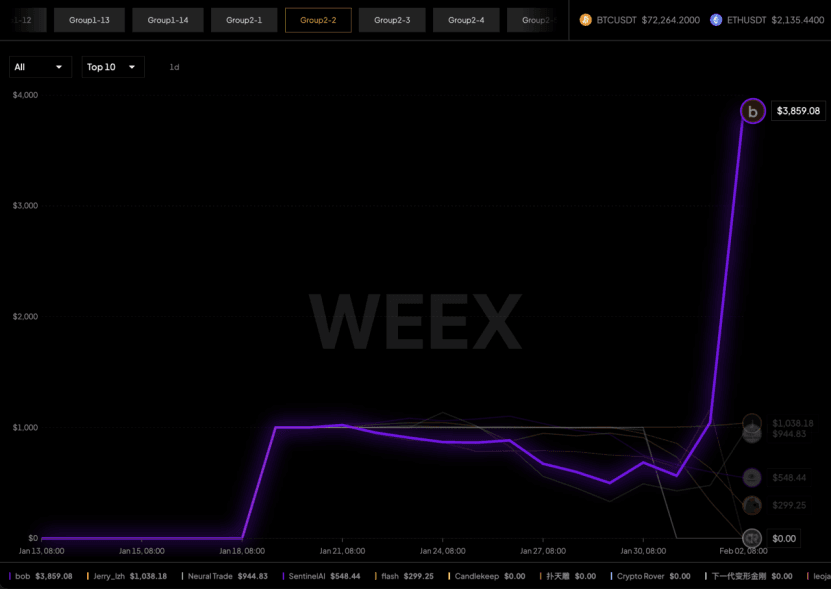
Hubble AI’s strength is not theoretical — it has been repeatedly validated under real market pressure. In the WEEX AI Trading Hackathon Preliminary Round, Hubble-powered contestants delivered exceptional results across multiple groups. Bob secured 1st place in Group 2-2 with an impressive +285.9% total PnL, while Morris ranked 1st in Group 1-13, achieving +141.2% total PnL. Medy was featured multiple times on the official WEEX “Dark Horse” leaderboard, demonstrating consistent breakout performance. In Group 1-10, both Leon and Nick maintained dominant positions, continuously occupying the Top 1–2 ranks within their group. Notably, these achievements were accomplished amid significant market turbulence — with ETH down 30% and BTC down 20% — underscoring Hubble users’ ability to outperform in adverse conditions. Of the 37 finalists advancing to the next stage, 10 are Hubble users, reflecting an exceptional qualification rate and further reinforcing Hubble AI’s competitive edge in live crypto trading environments.
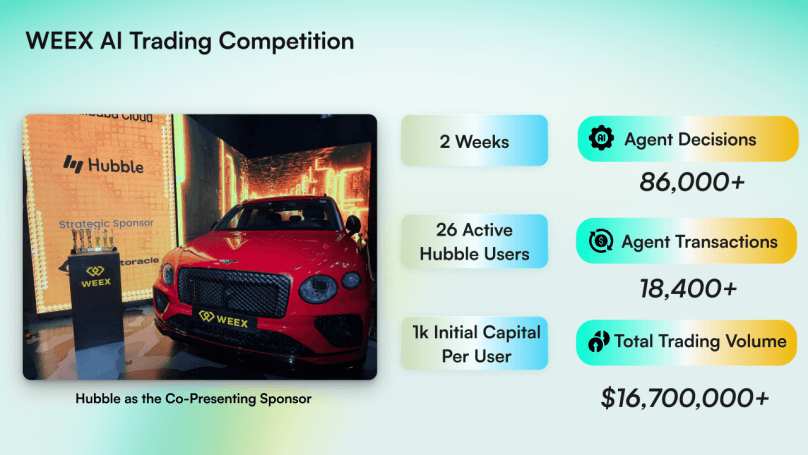
Live-market data from Hubble AI Trading’s 14-Day performance further reinforces this capability generated by 26 Active Hubble Users, with over 16.7 million in total trading volume, 86,000+ agent decisions, and 18,400+ agent transactions, all generated by Hubble AI Trading Agents during the hackathon. These results demonstrate that Hubble’s AI trading system can scale, execute at high frequency, and maintain stability across volatile markets. In AI trading, nothing speaks louder than real data from real markets.
Why Hubble AI Sponsoring WEEX AI Trading Finals Matters for the Industry
Hubble AI is not merely a trading agent provider — it is building the foundational infrastructure for Vibe Trading, and its sponsorship of the WEEX AI Trading Hackathon Finals reflects a deeper industry vision. Hubble has clearly articulated the evolution from Quant 1.2, where AI merely assists rigid rule-based strategies, to Quant 2.0, where AI becomes the core decision-making brain of trading systems. In Quant 2.0, users define risk preferences and objectives, while multiple AI Agents — acting as researchers, risk managers, and traders — collaborate to process massive nonlinear data streams and execute 24/7 autonomous trading.
As Hubble CEO Leon explains, the future of trading competition is no longer about who watches charts the longest, but who possesses sharper investment cognition and the ability to command AI effectively, ultimately democratizing quantitative trading by allowing anyone to direct AI with a single sentence.
Hubble’s sponsorship signals a shift from human execution to AI-native intelligence in trading.
-- Price
Co-Building an AI Trading Ecosystem: WEEX and Hubble's Shared Vision
The collaboration between WEEX and Hubble AI goes beyond sponsorship, rooted in a shared commitment to building user-driven AI trading ecosystems through the hackathon. Based on real feedback from participants and community voices — including public suggestions from traders on social platforms — the Hubble team is rapidly iterating its product roadmap. Upcoming features include an emergency close-position button for extreme risk scenarios, AI-generated intelligent log summaries that clearly explain why agents enter or exit trades, and built-in strategy packages within the Agent Marketplace designed for one-click adoption by less technical users. Together, WEEX and Hubble are using the hackathon as a real-world laboratory to refine AI trading tools that are practical, transparent, and accessible.
When builders and traders co-create, AI trading evolves faster — and smarter.
WEEX AI Trading Hackathon Finals Go Live: Real-Time PnL Rankings, AMAs, and AI Strategy Breakdowns
Compared to the Preliminary Round, the WEEX AI Trading Hackathon Finals will elevate both competition depth and audience experience. The core narrative of the Finals centers on the defining traits of AI trading — predictive capability, adaptive logic, and results-driven validation — asking not only who wins, but why and how. Throughout the Finals, WEEX will release daily real-time PnL leaderboards and “dark horse” rankings, enabling viewers to track momentum shifts as they happen. Each week, in-depth analytical articles will break down standout AI trading strategies, offering traders rare learning value, while weekly online AMA sessions with top contestants, sponsors, and KOLs will explore AI trading methodologies, system design, and emerging market insights.
The finals has officially kicked off on February 9th, marking the final practical stage of the competition.
Meanwhile, our global workshop journey is in full swing. The Amsterdam workshop is about to begin today — watch the livestream here: https://www.youtube.com/watch?v=HMpAlfV91vs
About WEEX
Founded in 2018, WEEX has developed into a global crypto exchange with over 6.2 million users across more than 150 countries. The platform emphasizes security, liquidity, and usability, providing over 1,200 spot trading pairs and offering up to 400x leverage in crypto futures trading. In addition to traditional spot and derivatives markets, WEEX is expanding rapidly in the AI era — delivering real-time AI news, empowering users with AI trading tools, and exploring innovative trade-to-earn models that make intelligent trading more accessible to everyone. Its 1,000 BTC Protection Fund further strengthens asset safety and transparency, while features such as copy trading and advanced trading tools allow users to follow professional traders and experience a more efficient, intelligent trading journey.
This content is provided for general informational purposes only and doesn't constitute financial, investment, legal, or tax advice. Any events, rewards, online promotions, or related information mentioned herein should not be considered a recommendation, solicitation, or invitation to purchase, sell, trade, or otherwise deal in any crypto assets. Crypto assets are highly volatile and may result in loss. The availability of WEEX services, products, and related events may vary by region. You are responsible for ensuring that your participation is in accordance with applicable local laws and regulations.
You may also like

The euro stablecoin's retail VASP transaction volume increased 12 times to $777 million over 15 months
The Federal Reserve is seeking feedback on the "streamlined master account" framework, proposing to allow cryptocurrency companies to access its payment system

Y Combinator launches the YC Crypto Deals program, with participation from the Solana Foundation and others

Futures Trading Hours Explained: How Smart Traders Cut Futures Fees and Earn More Cryptocurrency in 2026

BNKR’s Recent Surge Marks New Heights in Cryptocurrency Market
Key Takeaways BNKR Token Peak: BNKR reached an all-time high of $0.0011 on July 31, 2025. Significant Market…

Beast Industries Acquires Step – Expanding Fintech Horizons
Key Takeaways Beast Industries, led by YouTube celeb MrBeast, has acquired the teen-focused fintech banking app Step, aiming…
SlowMist’s Latest Alert: A Deep Dive into LiteLLM’s Data Breach
Key Takeaways SlowMist identifies a major breach in the LiteLLM library, with approximately 300GB of sensitive data compromised.…

Steakhouse Financial Experiences Phishing Attack: A Comprehensive Overview
Key Takeaways Steakhouse Financial’s domain experienced a phishing attack, prompting user safety advisories. Depositors’ funds and smart contracts…
FTX/Alameda Wallet Transfers Over $8 Million in ZRO Tokens to Wintermute
Key Takeaways An FTX/Alameda-associated wallet moved 4.126 million ZRO tokens to market maker Wintermute, with an approximate value…

Analysis of Recent Ethereum Short Position Activity on HyperLiquid
Key Takeaways Recently, a newly created wallet deposited $4.89 million into HyperLiquid, opening a short ETH position with…

Upbit and Bithumb Designate DRIFT as a Trading Alert Item
Key Takeaways Upbit and Bithumb have labeled DRIFT as a “trading alert” asset following guidance from the Digital…
“Brother Maji” Faces Potential Liquidation with ETH Long Position
Key Takeaways “Brother Maji” currently holds a substantial 25x leveraged long position of 6,000 ETH. The position was…
Binance’s Strategic Delisting of Trading Pairs Enhances Market Health
Key Takeaways Binance has decided to remove 23 spot trading pairs, focusing on those with low liquidity and…
Renew the Spirit, Reveal the Worth: Insights on U.S. Economic Trends
Key Takeaways U.S. Treasury Secretary Scott Bessent confirms the Federal Reserve plans to eventually lower interest rates. Current…

Hackers in Brazil Use Fake Google Play Store to Steal Cryptocurrency
Key Takeaways Hackers in Brazil are exploiting fake Google Play Store pages to spread Android malware. Infected devices…

Binance to Delist Key Spot Trading Pairs: What You Need to Know
Key Takeaways Binance is set to remove several spot trading pairs on March 27, 2026, at 11:00 AM…
Dragonfly Receives $55.8 Million Worth of LIT Tokens, Locked Until December 2026
Key Takeaways Dragonfly has acquired 55.8 million LIT tokens from Lighter, according to Arkham. The tokens are valued…
Circle and Tether Freeze Iranian Exchange Wallex Wallet with $2.49M Assets on Hold
Key Takeaways Circle and Tether have frozen a significant amount of assets from an Iranian exchange called Wallex,…
Binance to Delist 10 Spot Pairs Including ARB/EUR
Key Takeaways Binance has announced the delisting of 10 spot trading pairs. The affected pairs include ARB/EUR, BANANA/FDUSD,…

SpaceX Stock Prediction: Hitting $1,200 at 2026 IPO?
Key Takeaways Elon Musk confirms SpaceX is advancing its IPO plans, with expected filing as early as weeks…

OpenClaw 3.28 Update: Potential Security Risks with Axios
Key Takeaways Recent findings suggest OpenClaw version 3.28 may contain a compromised version of the Axios library. Dependency…
Massive Whale Movement: Unstaking $84.96 Million in HYPE Tokens
Key Takeaways A crypto whale, known as TechnoRevenant, has unstaked approximately $84.96 million in HYPE tokens. The tokens…

Security Risks of Fake Ledger Nano S+ Devices Emerging Through Chinese E-Commerce
Key Takeaways Counterfeit Ledger Nano S+ devices are being sold on Chinese e-commerce platforms, posing significant risks to…

How Crypto Futures Markets Are Fueling ‘Scam Coin’ Insider Schemes
Key Takeaways: RAVE’s market cap skyrocketed to $6.7 billion before plummeting by 95% due to insider control and…

SEC’s “Innovation Exemption” Sets New Rails for Tokenized Securities
Key Takeaways: SEC Chair Paul Atkins introduces an “innovation exemption” to regulate tokenized securities. A five-category token framework…

Ripple Sets 2028 Deadline for Quantum-Ready XRPL
Key Takeaways: Ripple commits to a 2028 deadline for XRPL’s quantum-readiness, focusing on quantum-resistant cryptographic systems. Google’s research…
Breaking: Crypto Investor Tim Cook Steps Down as Apple CEO
Key Takeaways: Tim Cook will transition from CEO to Executive Chairman on September 1, 2026. John Ternus, a…
UK Fintech Stratiphy Reopens Tax-Free Crypto ETNs Through IF ISAs
Key Takeaways: Stratiphy now offers UK investors tax-free crypto ETNs via Innovative Finance (IF) ISAs. Recent policies restrict…

Stratiphy Reopens Tax-Free Crypto ETNs for UK Investors
Key Takeaways: Stratiphy reintroduces tax-free access to crypto ETNs in the UK, reversing limitations imposed by HMRC’s ISA…
Uzbekistan Launches Tax-Free Crypto Mining Zone in Karakalpakstan
Key Takeaways: Uzbekistan has initiated the “Besqala Mining Valley” in Karakalpakstan, offering a supervised zone for crypto mining…
The euro stablecoin's retail VASP transaction volume increased 12 times to $777 million over 15 months
The Federal Reserve is seeking feedback on the "streamlined master account" framework, proposing to allow cryptocurrency companies to access its payment system
Y Combinator launches the YC Crypto Deals program, with participation from the Solana Foundation and others
Futures Trading Hours Explained: How Smart Traders Cut Futures Fees and Earn More Cryptocurrency in 2026
BNKR’s Recent Surge Marks New Heights in Cryptocurrency Market
Key Takeaways BNKR Token Peak: BNKR reached an all-time high of $0.0011 on July 31, 2025. Significant Market…
Beast Industries Acquires Step – Expanding Fintech Horizons
Key Takeaways Beast Industries, led by YouTube celeb MrBeast, has acquired the teen-focused fintech banking app Step, aiming…

Contents
Latest articles


Latest coin listings on WEEX


