
 Buy Crypto
- Markets
 Futures
- Spot
- Copy Trade
- Earn
- More
Veteran public chain going all out, finding a hundredfold opportunity standing on the shoulders of the MEME launchpad.

Everyone underestimated the resilience of established public blockchains. After the end of the new public blockchain craze, it was time for the celebration of the old-school public blockchains.
EOS surged 3x in a month; XLM skyrocketed 6x in a month; while XRP jumped 4x in a month, surpassing Solana in market capitalization to rank third in the cryptocurrency market.
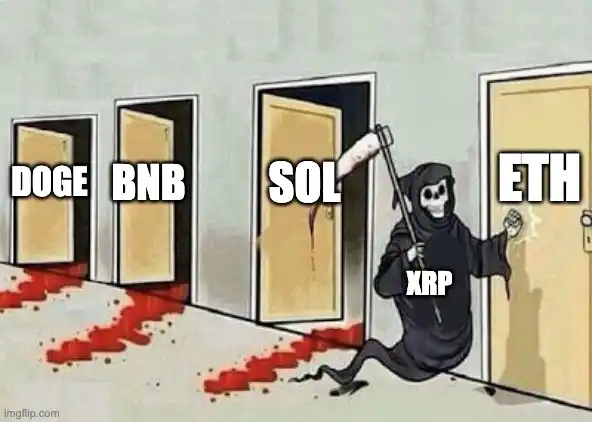
In such a market environment, besides directly investing in the mainstream coins of these established public blockchains, meme coins within their ecosystems may also hold hidden opportunities for hundredfold growth. Focusing on these meme launch platforms is a great way to find these hundredfold opportunities.
Therefore, in this Chinese article, BlockBeats introduces several meme launch platforms on established public blockchains for everyone to use.
BNB: Four.meme
There's no need to talk much about the strength and background of the BNB Chain. Since CZ's release from prison, there seems to be a "revival" of the BNB Chain ecosystem, with many recent hot memes. Moreover, the level of inside jokes and player-vs-player (pvp) intensity on this chain is relatively low, so there are many high-quality memes. Therefore, it's essential to keep an eye on the meme launch platforms on this chain.
The platform introduced to you on the BNB Chain is Four.meme. Four.meme is not only the leading meme coin issuance platform on the BNB Chain but also a driving force dedicated to promoting cryptocurrency innovation and community building.
Four.meme has currently listed over 10,440 tokens on the platform and has shown extremely rich widespread acceptance and activity on the BNB Chain. Over a hundred tokens have been launched on PancakeSwap, such as $banana, $Aicell, demonstrating good market performance and investment returns, with recent success in the trending desci concept and AI projects. Related Read: "With the Support of the BNB Chain, How Does Four.meme Build a Sustainable Meme Platform?"
In terms of basic coin issuance features, low coin issuance costs, Bonding Curve mechanism, and initial liquidity settings, Four.meme has them all. It's worth mentioning that currently, coin issuance on Four.meme is free, and the transaction fee on the platform is only 1%, with a minimum fee of 0.001 BNB. Once a meme coin reaches 100% of the Bonding Curve, Four.meme will automatically create a 20% total circulating token liquidity pool on PancakeSwap. Additionally, users can currently customize how much funding they need to raise for the launch. Once launched, the platform rewards the creator with a 1% liquidity incentive.

What's even more significant and unique is that Four.meme is not just a token issuance platform, but also an accelerator that provides comprehensive support for meme coin projects. Through its distinctive support system, Four.meme can help projects evolve from basic marketing stages to impactful community building and ecosystem collaboration phases. This sets it apart from other similar products like Pumpfun, as Four.meme offers not just a technical solution but holistic growth support.
When a meme coin is launched on Four.meme, as long as its market cap reaches 80% of the on-chain liquidity, it is eligible for a badge display and qualifies for developer airdrop events to increase the project's visibility. After a successful PancakeSwap listing, the project will be featured in the platform's weekly meme posters.
Projects that achieve a $1M market cap with a daily trading volume exceeding $100K will receive support from official KOL partners and the community matrix. They will also tap into additional traffic through partnerships with multi-chain wallet TokenPocket, derivatives DEX kiloex Finance, and other partners.

Some of Four.meme's Partnerships
When a project's market cap reaches even higher trading volumes, it will qualify for joint marketing from the BNB Chain, including official brand endorsements and resource connections. During this phase, the project will not only receive market support but also have the opportunity for CEX listing referrals and market maker recommendations, facilitating crucial steps in market penetration and community expansion.
Four.meme's accelerator program has proven its effectiveness, successfully incubating multiple meme coins with market caps exceeding $10M. For example, $BIC saw a significant surge from July, multiplying its value several times within a week, surpassing $18M in market cap by August 22nd. $Binancedog achieved a trading volume of $70M within 24 hours of listing and reached a peak market cap of 16M. Recent popular coins like $banana and $Aicell currently hold market caps of $62M and $11M, respectively, demonstrating Four.meme's effective project promotion and market capture capabilities.
Ripple: First Ledger
When it comes to Ripple, the first thing that comes to mind is its three-year-long lawsuit with the SEC regarding whether "XRP is a security." This is because, in the recent U.S. election, they made significant "political donations" to the Trump team. Additionally, ETF provider WisdomTree has submitted an S-1 registration filing for an XRP ETF with the SEC. This has labeled Ripple and $XRP as "compliant." As the price of $XRP has risen, the prices of ecosystem meme coins have naturally surged as well.
First Ledger is a project based on the XRP network similar to the Pumpfun project, aiming to provide more flexible wallet management and fast transaction options, including one-click token issuance.

It is worth noting that on the XRP network, after creating a wallet, you must deposit 10 XRP to activate the wallet. After utilizing the wallet, you can withdraw the 10 XRP upon completing transactions. However, on First Ledger, after creating a wallet, a minimum of 11 XRP is required to start transactions.
Similar to signing a contract on the Ethereum Virtual Machine (EVM) chain to interact with decentralized applications (dApps), users on XRPL need to sign a "trustline" to interact with tokens. When signing a trustline, 2 XRP is reserved for interacting with the token. Once a user completely sells their held tokens, First Ledger will automatically remove the trustline and return the 2 XRP.
First Ledger implements a 1% transaction fee. The distribution of these fees is as follows: 20% for the referral program, 25% owned by the team, 10% for infrastructure and expansion, and 45% pending allocation.

First Ledger has shown strong market performance, and some of the memes previously listed have performed well. Currently, the top-ranked meme coins on the market showcase their popularity and potential growth momentum. There is currently a meme challenge spreading on First Ledger, inviting more friends and creating more meme coins to earn points and rewards and rank on the leaderboard.
In light of the continued popularity of XRP, First Ledger may give rise to more promising meme coins. Stay tuned for further developments.
Cardano: Snek.fun
When it comes to the story of Cardano, many newcomers to the crypto world are unaware. This story dates back to a pivotal moment in Ethereum's history in 2014 when the eight co-founders had a significant disagreement over whether Ethereum's future should be a nonprofit organization or a for-profit entity, leading to their dispersal. One of the co-founders, Charles, departed from Ethereum, founded the development company IOHK (later restructured as a venture studio), and launched a PoS blockchain called Cardano.
This is the story of Cardano's inception, which has been a favorite for many years, positioning itself in the top ten cryptocurrencies by market cap. Due to its early focus on the Japanese market, it was dubbed the "Japanese Ethereum" and was also known as the first-generation "Ethereum killer." It rode the wave of the rise of established blockchains and gained prominence in the community through various meme trends.
Snek.fun is an innovative meme coin issuance platform based on the Cardano blockchain, a collaboration between the Cardano meme coin $SNEK and the Cardano ecosystem DEX Splash.
Snek.fun's operation is similar to Pump.fun. When 75% of a token's supply is bought on the market, reaching a market cap of 42,069 ADA, a liquidity pool containing 25% of the token's supply will be created on DEX Splash, and the corresponding LP (Liquidity Provider) tokens will be burned. This model aims to increase the token's market value by enhancing scarcity.

Snek.fun started its pre-launch at the end of July and officially launched in early September. Despite facing some technical challenges at the outset, such as wallet API overload, as stated on the official Twitter account, with 20,000 users flooding the website every 10 seconds, the system underwent immense pressure. Users in the tweet comments reported experiencing delays of up to 5 hours in transactions. Related Reading: "Is Cardano's meme launchpad Snek.fun a real deal?|Web3 ..."
Despite these early hurdles, in the long run, as the Cardano ecosystem heats up, liquidity for $ADA and profit-taking may flow into the ecosystem.
Another noteworthy mention is the meme coin $SNEK, launched in May 2023, which saw a 13x increase in value in the first two months until the end of the year, reaching a market cap exceeding $130 million. After a more than 70% drop from its peak, the market cap in early September was $5 million; however, as of the time of writing, $SNEK's market cap has grown to $500 million.
Tron: SunPump
Tron's TRON needs little introduction, as everyone is familiar with Sun Yuchen (Justin Sun); he recently made headlines for buying a banana at Sotheby's for $40 million, which also seems to have boosted the memes on Tron.
It is the first meme coin-focused launchpad on the TRON blockchain. When any token project's bonding curve reaches a 100% funding goal, liquidity will automatically be injected into SunSwap V2. This mechanism avoids common issues during pre-sales on traditional platforms, such as team allocations and high fees, providing users with a fully transparent token management and creation process.
When a token project's bonding curve reaches a 100% funding goal, the smart contract will automatically add approximately 100,000 TRX and the remaining 200 million tokens to the liquidity pool of SunSwap V2. Additionally, the smart contract will deduct about 3,000 TRX from the bonding curve to cover the cost of adding liquidity.

Creating a token on SunPump only requires paying around 20 TRX as a creation fee. The platform charges a highly competitive 1% transaction fee. The product itself is similar to Pump Fun, but SunPump's success mainly stems from the powerful marketing prowess of Tron's founder, Justin Sun. During the Token 2049 event in Dubai, Justin Sun openly expressed optimism about the meme market, stating, "Meme coins may seem a bit strange, but they highlight the power of community in cryptocurrency."
On the debut day of SunPump, its protocol revenue in the first 24 hours exceeded that of Pump.fun, showcasing its efficient profit-making ability. Furthermore, DWF Labs announced a partnership with SunPump, although the specific details of the collaboration have not been disclosed. SunPump has also strategically invested in other meme coin projects within the Tron ecosystem, such as SunDog.
You may also like

After TACO Ceasefire, Iran War is Just on Pause

The 17-Year Mystery Will Be Solved, Who is Satoshi Nakamoto?

5 Minutes to Make AI Your Second Brain

Uniswap is trapped in an innovation dilemma

What is the key to competition in crypto banking?

The flow of stablecoins and the spillover effects in the foreign exchange market

After two years, Hong Kong's first batch of stablecoin licenses finally issued: HSBC, Standard Chartered make the cut
The person who helped TAO rise by 90% has now single-handedly crashed the price again today

3-Minute Guide to Participating in the SpaceX IPO on Bitget

Top 5 Cryptos to Buy in 2026 Q1: A ChatGPT Deep Dive Analysis
Explore the top 5 cryptos to buy in Q1 2026 including BTC, ETH, SOL, TAO, and ONDO. See price outlooks, key narratives, and institutional catalysts shaping the next market move.
How to Earn $15,000 with Idle USDT Before Altcoin Season 2026
Wondering if altcoin season is coming in 2026? Get the latest market update, and learn how to turn your idle stablecoins waiting for entry into extra rewards up to 15,000 USDT.
Can You Win Joker Returns Without Large Trading Volume? 5 Mistakes New Players Make In WEEX Joker Returns Season 2
Can small traders win WEEX Joker Returns 2026 without huge volume? Yes—if you avoid these 5 costly mistakes. Learn how to maximize card draws, use Jokers wisely, and turn small deposits into 15,000 USDT rewards.

Altcoin Season 2026: 4 Stages to Profit (Before the Crowd FOMO In)
Altcoin Season 2026 is starting — discover the 4 key stages of capital rotation (from ETH to PEPE) and how to position before the peak. Learn which tokens will lead each phase and avoid missing the rally.

Will Alt season come in 2026? 5 Tips to Spot the Next 100x Crypto Opportunities
Will altcoin season arrive in 2026? Discover 5 rotation stages, early signals smart traders watch, and the key crypto sectors where the next 100x altcoin opportunities may emerge.

The bear market has arrived, and cryptocurrency ETF issuers are also getting involved

The richest man had a quarrel with his former boss
BTC Firm Above 70K! Saylor’s "Institutional Logic" vs. Moon’s "Retail Faith": Who is Really Harvesting the Market?
Bitcoin is holding firm above the $70,000 support level following a massive short squeeze that liquidated $427 million. As the "Four-Year Cycle" narrative shifts, the market is split: Michael Saylor’s cold, institutional "indiscriminate stacking" vs. Carl Moon’s high-energy retail "hopium." This article decodes these two polar-opposite strategies for the 2026 bull run and reveals how WEEX’s institutional-grade liquidity and AI trading tools empower every type of investor to convert market volatility into profit.



 App
App