
Robinhood Built a Chain for Tokenized Stocks: Did It Just Become a Meme Coin Casino?

 Prefer us on Google


Robinhood spent years building toward a specific vision: a blockchain serious enough to carry tokenized stocks, ETFs, and real world assets into an institution friendly corner of DeFi. Two months after that chain actually launched, some of the busiest activity happening on it isn't stock trading. It's memecoin speculation, including a token named after the company's own old branding that surged more than 2,000% in a week.
That gap between what Robinhood Chain was built to be and what it has actually become is the real story here, and it's a genuinely rich one to dig into, because the data behind it is unusually well documented across DefiLlama, on-chain explorers, and a wave of both celebratory and skeptical coverage since the July 1 launch.
A new blockchain drifting away from its stated purpose isn't unusual on its own. What makes Robinhood Chain worth a deeper look is who built it and why. Robinhood isn't a crypto native startup experimenting with token launches. It's a publicly traded, regulated brokerage with tens of millions of funded users, and a major part of its blockchain pitch was bringing the infrastructure and compliance standards associated with traditional finance into a permissionless environment.
That's exactly where the contradiction begins. The chain has grown explosively by almost every trading-volume metric available, but the composition of that growth looks very different from the tokenized-finance vision Robinhood originally emphasized.
Understanding why requires looking at what the chain was designed to do, what people actually started doing on it, and what the numbers say about the gap between the two.
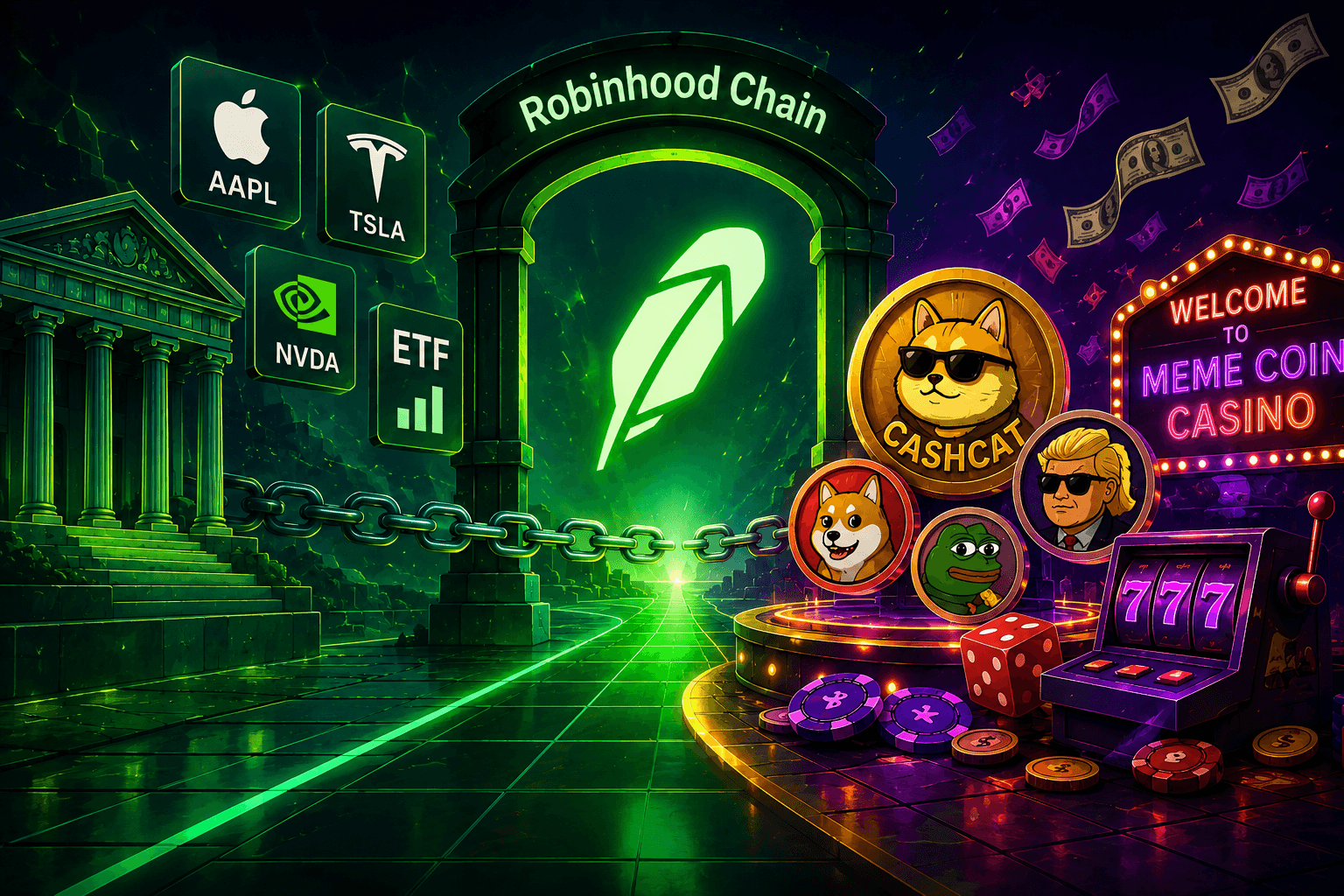
What Robinhood Chain Was Actually Built To Do
Robinhood Chain is an Ethereum compatible Layer 2 network built using Arbitrum technology. It runs its own dedicated execution environment while settling to Ethereum, with transaction fees paid in ETH. The project entered public testnet in February 2026 before the mainnet officially went live on July 1, 2026.
At a high profile product event in 2025, Robinhood announced more than 200 US stocks and ETFs for eligible European users, allowing them to gain exposure to those assets through tokens within the Robinhood app, with plans to move more of that infrastructure onto its own chain over time.
Robinhood framed the broader blockchain project as infrastructure designed to bridge traditional and on-chain finance. The ecosystem around it looked appropriately institutional. Uniswap was named as a primary public liquidity protocol, Morpho supplied underlying lending infrastructure for Robinhood's yield product, and infrastructure providers including Chainlink, Alchemy, and BitGo were among the companies working with the network.
There's an important legal detail underneath the "tokenized stocks" label that's easy to miss.Robinhood's newer Stock Tokens are structured as tokenized debt securities rather than direct ownership of the underlying equity. Holders therefore don't receive the same legal or beneficial ownership rights as shareholders of the underlying securities. The product is also unavailable to US customers and restricted to eligible international markets.
Robinhood itself is a regulated brokerage, and its official Stock Token products operate through specific legal and compliance structures. Robinhood Chain itself, however, is permissionless.
Robinhood can decide how its official financial products work. It cannot completely decide what independent developers and traders choose to build and trade on the blockchain underneath them.
Robinhood Chain Grew Extremely Fast After Launch
The growth curve since July 1 has been genuinely unusual, and it's well documented across sequential data points. By July 3, total value locked sat around $17 million, according to DefiLlama data cited by CoinDesk. Within about a week and a half, that figure had climbed to roughly $135 million, while cumulative DEX trading volume had already moved into the billions.
DefiLlama's public updates tracked a similarly steep curve. By mid-July, TVL had moved above $130 million, stablecoins had climbed above $290 million, and cumulative DEX volume had reached several billion dollars.
Daily active address counts backed up the trading data directly. On July 8 alone, the chain logged 193,187 active addresses, with 141,565 of them transacting for the first time, according to Dune Analytics data reported by industry media.
The growth didn't plateau after that initial surge. By August 11, 24 hour DEX volume had crossed $650 million, placing Robinhood Chain among the largest blockchains by that metric at the time.
By August 30, the chain processed a record 5.52 million transactions in a single day alongside roughly $875 million in DEX volume.
By the end of August, seven day DEX volume had reached roughly $6.16 billion, up about 79% from the previous week. At certain points, Robinhood Chain's 24 hour DEX volume even surpassed established networks including Ethereum mainnet, BNB Chain, and Base.
Those rankings can change quickly as daily volume moves, but the broader direction is difficult to dispute. Robinhood Chain did not struggle to attract activity. It attracted it remarkably quickly. The more important question is what kind of activity actually arrived.
The RWA Business Is Growing, Just Much More Slowly
Trading volume and TVL only tell part of the story. The number that matters more for evaluating whether Robinhood Chain is becoming what Robinhood originally envisioned is the amount of tokenized real-world assets actually living on the network.
During the chain's first few weeks, the imbalance was striking. As of mid-July, total RWA value on Robinhood Chain, spanning tokenized stocks and a small amount of tokenized US Treasuries, sat at roughly $12.8 million, according to CoinDesk's review of DefiLlama data. Around $10.68 million of that came from stocks, while roughly $410,000 came from Treasuries.
By July 17, the chain held nearly $357 million in stablecoins against an active RWA market cap below $15 million. One analysis calculated the ratio of tokenized RWA value to weekly DEX trading volume at just 0.28% during those early weeks.
But that early snapshot no longer tells the whole story. By September 1, DefiLlama data showed Robinhood Chain's active RWA market capitalization had grown to roughly $163 million. Going from around $12.8 million in mid-July to roughly $163 million is meaningful growth. It would therefore be wrong to say Robinhood's tokenized-finance strategy has gone nowhere.
The problem is that almost everything around it has grown even faster. By the end of August, seven-day DEX volume was already above $6 billion. Memecoin launchpads were creating thousands of new tokens, and speculative trading applications were generating a large share of application revenue.
Robinhood is attracting more tokenized real world assets. But the permissionless speculative side of the chain has been moving much faster.

-- Price
CASHCAT Became The Symbol Of The Contradiction
If one token captures the irony of this situation, it's CASHCAT. The memecoin takes its name from "Cash Cat," branding associated with Robinhood's early history. CASHCAT itself is an independent memecoin and is not an official Robinhood project. That distinction did little to stop it from becoming one of the most recognizable tokens in Robinhood Chain's early ecosystem.
CoinDesk reported that CASHCAT surged 2,158% over seven days in mid-July, reaching a market capitalization of roughly $156 million. At the same time, total RWA value on Robinhood Chain sat at roughly $12.8 million. That meant a single memecoin was temporarily worth roughly twelve times more than every tokenized stock and Treasury tracked on the network combined.
The comparison was specific to that moment in July. Robinhood Chain's RWA value has grown significantly since then. But as a symbol of what was happening on the network, it was difficult to beat.
Robinhood had spent years talking about tokenized finance. One of the first assets to capture widespread attention on its new blockchain was a joke token referencing its own old branding.
The story became even more unusual in early August when Robinhood made CASHCAT available for trading through its own platform. That decision is worth reading carefully. A brokerage listing decision reflects what Robinhood is willing to offer customers. It does not mean Robinhood created the token, nor does it imply that CASHCAT has an official team, product, or long-term future.
Still, it demonstrated how quickly the permissionless side of Robinhood Chain had become difficult to separate from the broader Robinhood crypto story.
The Launchpad Boom: How Pons Took Over
CASHCAT was not an isolated event. Underneath individual memecoins, another competitive dynamic was developing: token launchpads were fighting for control of Robinhood Chain's rapidly growing speculative market.
Noxa was one of the early launchpads to attract significant activity before temporarily suspending new token launches amid problems including token spam and bot activity.
Other platforms quickly moved into the gap. Pons became one of the most important. Its model looks much more like the type of product associated with Solana's memecoin economy than with traditional brokerage infrastructure. Users can create and trade new tokens with relatively little friction, drawing obvious comparisons with Pump.fun and the instant-launch token model it helped popularize.
By August 30, the absolute scale of that activity had become difficult to ignore. Users launched roughly 22,600 tokens in a single day through Pons alone. Revenue data from the same period makes the composition of Robinhood Chain's activity even clearer. Memecoin trading tools GMGN and Pons, alongside Uniswap, generated about 88% of the chain's roughly $2.66 million in 24 hour application revenue.
That does not mean Robinhood itself earned $2.66 million. It represents revenue generated by applications operating on the blockchain. Still, the composition is revealing. Some of the chain's biggest early revenue generators were not tokenized-stock products. They were tools helping people create and trade crypto tokens.
The significance goes beyond Pons itself. A Pump.fun style token factory becoming one of the largest sources of activity on a blockchain created by a regulated brokerage is a genuinely strange pairing.
When Memecoins And Tokenized Stocks Start Blending Together
Crypto native tokens are beginning to experiment with tokenized stock exposure, bringing the two sides of Robinhood Chain closer together.
One example is REAL, a meme style token project connected with tokenized NVIDIA exposure. A normal memecoin is relatively easy to understand. Its value is largely driven by speculation, community interest, liquidity, and market demand. A tokenized stock product can also be understood when it follows a clearly defined legal structure. Combining the two makes the picture less clear.
A crypto token can trade alongside tokenized stock exposure without necessarily becoming a security or derivative itself. But as projects create increasingly complicated links between permissionless tokens and traditional financial assets, determining exactly what investors are buying can become much harder.
The regulatory treatment of any individual product ultimately depends on its specific structure and jurisdiction. The broader trend is what matters here.
Robinhood Chain is already becoming a testing ground for combinations of traditional financial exposure and permissionless crypto speculation that existing categories do not always describe neatly.

The Gas Subsidy Asterisk: Why Current Growth Numbers Need Context
One detail that's easy to miss in the headline growth figures deserves explicit attention. Robinhood has been subsidizing gas fees for eligible transactions made through Robinhood Wallet during an initial 90 day period.
That does not mean every transaction on Robinhood Chain has been free. Users interacting with the blockchain outside the subsidized Robinhood Wallet experience still pay normal ETH gas fees.
It also doesn't mean the activity is fake or manufactured. Real capital has clearly moved through Robinhood Chain's decentralized exchanges and memecoin markets. But the subsidy matters when interpreting the numbers.
Lower transaction costs make it easier for users to experiment, trade more frequently, interact with new tokens, and make transactions they might not make if every action carried its normal cost. That means Robinhood Chain's first two months come with an important asterisk.
A portion of the network's early user activity developed while transaction costs were deliberately reduced for Robinhood Wallet users.
The end of that initial subsidy period should therefore provide one of the first useful tests of how durable the activity really is.
If transaction counts, active addresses, and DEX volume remain strong afterward, the argument that Robinhood Chain has developed genuinely organic demand becomes stronger.
If they fall sharply, some of the early growth may prove more incentive-sensitive than the headline numbers suggested.
What Critics And Early Investors Are Saying
The gap between Robinhood Chain's stated purpose and its actual usage hasn't gone unnoticed.
Jon Ma, who said he participated in a Robinhood pre-IPO investment while at Whale Rock in 2019, publicly criticized the memecoin-heavy direction in mid-July.
He described opening his Robinhood wallet and finding it dominated by memecoin activity, including being airdropped a token called "Pointless Coin."
His argument was specific. Tokenized real world assets, rather than memecoins, could represent a much more sustainable long-term opportunity for Robinhood. Ma also presented a scenario in which Robinhood could eventually reach 100 million users and generate around $10 billion in revenue by 2030. Those figures were part of his own investment thesis, not official Robinhood targets or company guidance.
The criticism points to a larger strategic question. Memecoins are extremely effective at generating attention and short-term activity. Tokenized financial assets potentially offer something different: a reason for people to keep using the infrastructure for years. Robinhood may eventually want both.
The challenge is preventing the first from defining the reputation of the second. Robinhood's own regulatory history adds another layer.
In 2023, the brokerage ended support for ADA, MATIC, and SOL after those assets were named as securities in SEC enforcement actions involving major crypto exchanges. Users were given time to transfer the affected assets before remaining holdings were sold.
That does not mean memecoins on Robinhood Chain will face the same outcome. Robinhood Chain itself is permissionless. A token existing on the network is not the same thing as Robinhood officially listing or supporting that token through its regulated brokerage products.
But the precedent demonstrates why those two layers of the ecosystem need to remain separate. Robinhood cannot necessarily stop a permissionless token from existing. It can decide whether Robinhood customers can trade it through Robinhood products. As the memecoin ecosystem grows, that distinction may become increasingly important.
Has Robinhood Chain Become A Memecoin Casino?
Memecoins and launchpads have clearly driven a significant share of the network's early attention, application revenue, and decentralized trading activity.
CASHCAT temporarily became worth more than twelve times the value of all RWAs on the chain at the time. Pons later enabled roughly 22,600 token launches in a single day. Memecoin related applications became some of the network's biggest revenue generators. They have been central parts of Robinhood Chain's first two months.
But declaring the original RWA experiment dead would go too far. Tokenized real world assets on Robinhood Chain have also grown substantially, from roughly $12.8 million in mid-July to around $163 million by September 1. The two sides are growing at the same time. One is simply moving much faster.
That may even be a natural consequence of making Robinhood Chain permissionless. Carefully structured financial products take time to issue, distribute, regulate, and adopt. A memecoin can be created in minutes.
The real test is therefore not whether the memecoins disappear. The real test is whether Robinhood can convert some of the liquidity, users, developers, and attention arriving through the speculative side of the network into lasting demand for the tokenized stocks, ETFs, and real world assets the chain was originally built to carry.
If it can, the memecoin boom may eventually look like an unexpected user-acquisition engine for a much larger financial ecosystem. If it can't, Robinhood Chain risks becoming permanently known as a high speed speculative venue wearing an institutional finance label. The end of the initial gas subsidy period should provide one of the first clearer signals of which direction the network is actually heading.
For traders looking to track this kind of fast moving, high volatility ecosystem directly, WEEX offers spot and futures markets covering trending tokens across multiple blockchain networks, including the memecoin and launchpad activity that has come to define Robinhood Chain's early months. Trading on WEEX is backed by a publicly disclosed 1,000 BTC protection fund, giving traders a verifiable layer of security when navigating volatile, fast moving markets like this one.
Conclusion
Robinhood Chain's first two months are a two sided story. By raw growth metrics, it's one of crypto's fastest-growing new blockchains, at times outpacing Ethereum mainnet, BNB Chain, and Base. But that growth looks nothing like the tokenized finance vision Robinhood originally pitched.
In July, a memecoin named after Robinhood's own old branding was worth twelve times more than all tokenized assets on the network combined. RWA value has since grown too, from $12.8 million to $163 million by September 1.
The question isn't whether Robinhood Chain is an RWA venue or a memecoin venue. Right now, it's both. Which side ultimately defines it is what the end of the gas subsidy should reveal.
FAQ
1. What Was Robinhood Chain Originally Built To Do?
An Ethereum Layer 2 that launched July 1, 2026, designed primarily to support tokenized stocks, ETFs, and real world assets, while remaining permissionless for independent developers.
2. Is Robinhood Chain A Regulated Blockchain?
No. Robinhood's official Stock Token products operate through regulated legal structures, but the chain itself is permissionless, so independent tokens and apps aren't automatically official Robinhood products.
3. How Much RWA Value Is Actually On Robinhood Chain?
It's grown significantly: from roughly $12.8 million in mid-July to about $163 million by September 1, though this remains far smaller than overall DEX trading activity.
4. What Is CASHCAT And Why Is It Significant?
An independent memecoin inspired by Robinhood's old "Cash Cat" branding. It surged over 2,000% in a week in July, briefly reaching a market cap more than twelve times larger than all RWAs on the chain combined.
5. Are The Growth Numbers Reliable Given The Gas Subsidy?
The activity is real, but Robinhood has subsidized gas for eligible Robinhood Wallet transactions during an initial 90 day period. Numbers after that period ends will be a clearer test of organic demand.
This content is provided for general informational purposes only and doesn't constitute financial, investment, legal, or tax advice. Any events, rewards, online promotions, or related information mentioned herein should not be considered a recommendation, solicitation, or invitation to purchase, sell, trade, or otherwise deal in any crypto assets. Crypto assets are highly volatile and may result in loss. The availability of WEEX services, products, and related events may vary by region. You are responsible for ensuring that your participation is in accordance with applicable local laws and regulations.
You may also like
What Is TermMax (TMX)? Inside the New Fixed-Rate DeFi Token Launching Today
Amid the boom in stablecoin investments, which stablecoins are worth keeping an eye on?

What Is Morpho (MORPHO) and How Does It Work?

AIINU: How a "100x Coin" on Robinhood Chain Turned NVDA Stock Into a Memecoin

"We're Back": Why Strategy's Return to Bitcoin Buying Is Moving More Than Just MSTR Stock
Does Robinhood Chain Have Its Own Token? What CASHCAT, PONS, and Stock Tokens Actually Are

Anthropic Tokenized Stock: What ANTHROPIC Actually Gives You
CSOPSAMSUNG2L Explained: 2x Samsung Leverage, Two Wrappers
SQQQ Explained: Why the 3x Inverse Nasdaq ETF Bleeds Value
KSTR ETF Explained: Inside China's STAR 50 Chip Index Bet
When Can You Trade U.S. Stock Tokens? Trading Hours Explained
Can You Trade U.S. Stocks With 5 USDT? Here's the Real Math
Should You Buy RST (Raini Studios Token)? What Low Liquidity and No Migration Plan Actually Mean

What Are Spot Stock Tokens? How Synthetic Stock Trading Works
Should I Buy PONS Coin? Sep 2026 Price Prediction & Guide
Can PONS Reach $1? PONS Coin Price Analysis After WEEX
Can PONS Reach $1? PONS Coin Price Analysis After WEEX
What Is WEEX Stock Spot Trading? A Beginner's Guide to US Stock Trading with USDT
"牛来" Niu Lai Meme Coin Just Hit a New $120M High: Why This Rally Has Lasted Weeks, Not Days
SpaceX Stock Price Holds Near $141: Why Isn't a $100 Billion Spaceport Plan Moving It?
MU Stock Price Fell After Trump Praised Micron: What Actually Happened
"我的女友景甜" Days Later: What Happened to the Viral Meme Coin
XST Coin Price Bounced 19% Off a New Low in Hours: Is This the Bottom or Just Noise?
Is NVDA Stock Overvalued After Record Q2 Earnings?
NVDA Stock Pulls Back After Earnings: Is $250 Still Next?
WEEX Promo Code and Sign-Up Bonus: What You Need to Know
WEEX Welcome Bonus Explained: How New User Rewards Work
WEEX Affiliate Program: How to Join and Track Commission

WEEX Referral Code Guide: How Tracking and Verification Work
How to Get WEEX Referral Commission: Rules and Tracking
What Is TermMax (TMX)? Inside the New Fixed-Rate DeFi Token Launching Today
Amid the boom in stablecoin investments, which stablecoins are worth keeping an eye on?
What Is Morpho (MORPHO) and How Does It Work?
AIINU: How a "100x Coin" on Robinhood Chain Turned NVDA Stock Into a Memecoin
"We're Back": Why Strategy's Return to Bitcoin Buying Is Moving More Than Just MSTR Stock
Does Robinhood Chain Have Its Own Token? What CASHCAT, PONS, and Stock Tokens Actually Are




